
Did you know that transmission replacement is one of the most expensive automotive repairs, often costing between $3,500 and $6,000? While Honda vehicles are legendary for their reliability, the transmission is frequently cited as the most sensitive component if regular maintenance is neglected. A standard Honda transmission fluid change is the single most effective way to ensure your vehicle reaches the 200,000-mile milestone and beyond. This maintenance task is not just a suggestion; it is a critical requirement for the longevity of Honda’s unique internal gear designs. In this comprehensive guide, we will provide the essential information, facts, and insights you need to understand how, when, and why to service your Honda’s gearbox.
Understanding Honda’s Specific Transmission Needs
Honda transmissions are architecturally different from many other manufacturers. While most automatic transmissions use planetary gearsets, many classic Honda automatics utilize a design more akin to a manual transmission, with individual gears on parallel shafts controlled by hydraulic clutches. This unique engineering provides an overview of why specific fluid properties are so vital. When the fluid breaks down, the friction modifiers essential for these clutches to engage smoothly begin to disappear, leading to “shudder” or slipping.
Modern Honda vehicles often utilize Continuously Variable Transmissions (CVT). These systems rely on a high-tension steel belt and pulleys. The fluid here does not just lubricate; it provides the necessary friction for the belt to grip the pulleys without slipping. Using the wrong fluid in a CVT is a recipe for immediate mechanical failure. This guide provides the facts necessary to avoid these costly mistakes.
📋
Step-by-Step Change Guide
Before starting, ensure you have three to four quarts of Genuine Honda DW-1 ATF (or HCF-2 for CVTs). You will need a 3/8-inch drive ratchet, a new 18mm aluminum crush washer, a long-neck funnel, and a drain pan. Ensure the vehicle is parked on a level surface to get an accurate fluid level reading later.
Locate the transmission drain plug, usually identified by a square 3/8-inch hole. Place your pan underneath and loosen the bolt. While the fluid drains, clean the magnetic tip of the drain plug. It is normal to see fine metallic “fuzz,” but large chunks may indicate internal damage. Insights from mechanics suggest letting it drain for at least 10 minutes to remove as much old fluid as possible.
Install the drain plug with a new crush washer. Locate the transmission dipstick (usually yellow or white) or the fill plug on top of the transmission. Add approximately 3 quarts of fluid. Start the engine, shift through all gears (P, R, N, D), then turn the engine off. Check the dipstick within 60 to 90 seconds of shutting down—this is a specific Honda requirement for an accurate reading.
✨ Key Benefits of Regular Service
Extended Lifespan
Fresh fluid contains active detergents and anti-wear agents that protect the expensive internal gearsets from premature friction-related failure.
Optimal Shifting
Correct viscosity ensures that the hydraulic solenoids actuate at the precise moment, eliminating “gear hunting” or delayed engagement.
Honda explicitly recommends against using “chemical flushes” or high-pressure flushing machines. These can dislodge debris that clogs the small internal screens and solenoids, often causing the transmission to fail shortly after the service. A simple “drain and fill” is the factory-approved method.
Detailed Insights: When to Change Your Fluid
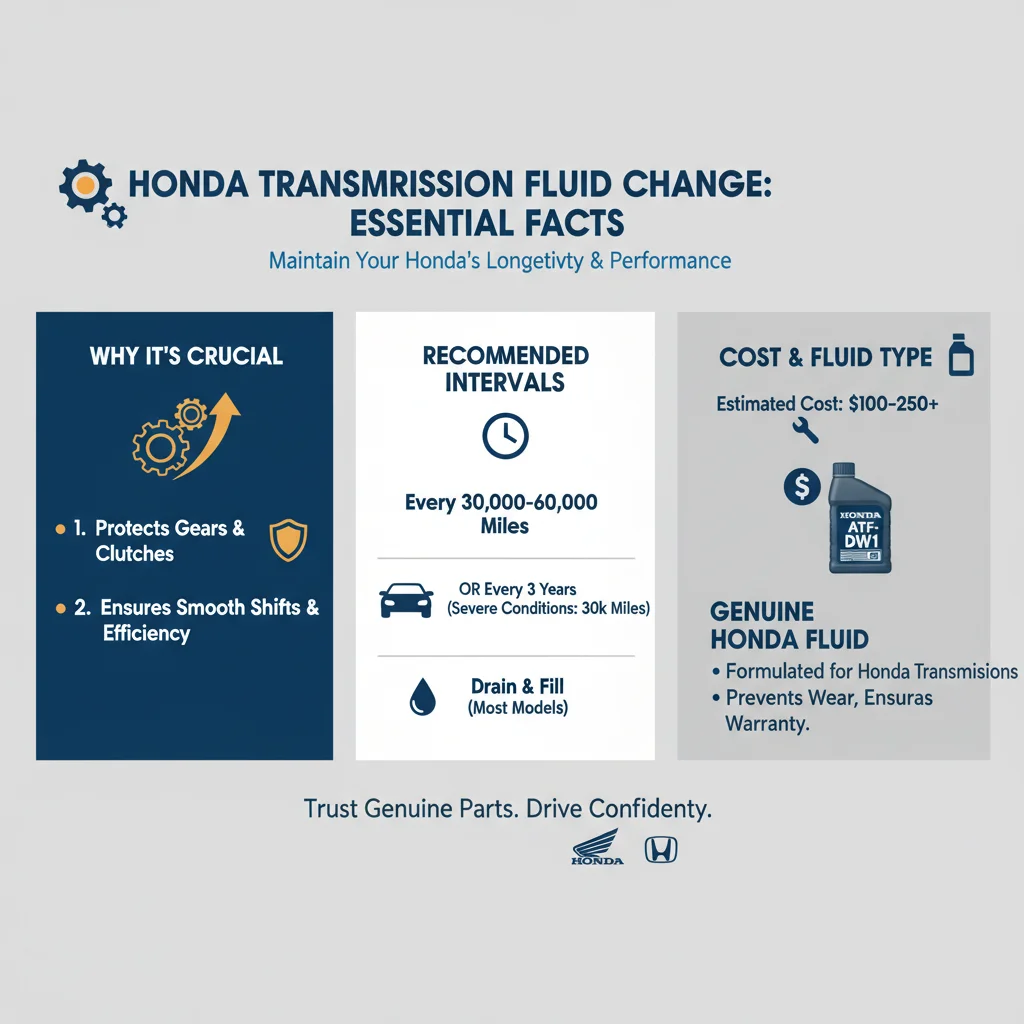
Most modern Hondas feature the “Maintenance Minder” system. When the code “3” appears on your dashboard, it is an indication that your vehicle is due for a transmission fluid service. However, if you drive in “severe” conditions—such as heavy stop-and-go traffic, mountainous terrain, or extreme heat—the facts suggest you should shorten the interval. Many experts recommend a simple drain and fill every 30,000 miles as cheap insurance against the high cost of a rebuild.
Signs that you are overdue for a change include a noticeable “judder” (a vibrating sensation) between 20 and 40 MPH, delayed gear engagement when cold, or a dark brown color on the dipstick. Fresh Honda DW-1 fluid is bright pink or red. If the fluid smells burnt or looks like chocolate milk, you may need to perform the “three-times” drain and fill method to fully refresh the system, as a single drain only removes about 1/3 of the total capacity.
Avoid using “Universal” ATF. While many bottles claim to be compatible with Honda DW-1, they often lack the specific friction modifiers required for Honda’s unique clutch materials. Using non-spec fluid can lead to harsh shifting and permanent damage to the torque converter clutch.
Summary of Maintenance Facts
Performing a Honda transmission fluid change is a straightforward process that offers high rewards in terms of vehicle durability. By following the details outlined in this guide, you can avoid the most common pitfalls of transmission maintenance. Remember that the fluid is the “lifeblood” of the gearbox; it acts as a hydraulic fluid, a coolant, and a lubricant all at once. When it degrades, the mechanical components it protects are immediately at risk.
Whether you own a Civic, Accord, CR-V, or Odyssey, the principles remain the same. Stick to genuine fluids, respect the service intervals, and listen to your car. If the shifting feels “different,” it is time to check the dipstick. This overview provides the foundation you need to keep your Honda running smoothly for decades.
In conclusion, regular transmission care is the hallmark of a savvy Honda owner. While it may seem like a minor detail in the grand scheme of vehicle ownership, the long-term savings are undeniable. By taking 30 minutes every few years to refresh your fluid, you are effectively protecting one of the most complex and expensive systems in your car. Take action today by checking your service records or inspecting your fluid color—your Honda will thank you for it with hundreds of thousands of trouble-free miles.
❓ Frequently Asked Questions
1
Why is a Honda transmission fluid change important?
Regular fluid changes provide the necessary lubrication to prevent friction and heat buildup within the gearbox. These specific details are vital because Honda transmissions rely on precise fluid properties for smooth shifting. Neglecting this maintenance leads to gear slippage, accelerated wear, and potentially catastrophic mechanical failure over time.
2
How often should I change Honda transmission fluid?
Most Honda maintenance schedules suggest providing new fluid every 30,000 to 60,000 miles, depending on your driving conditions. Heavy city driving or towing requires more frequent attention. Consult your owner’s manual for specific info regarding your model’s maintenance minder system to ensure you follow the expert recommendations.
3
Should I flush or change my Honda transmission fluid?
Honda generally recommends a drain and fill procedure rather than a high-pressure machine flush. Expert insights suggest that flushes can dislodge debris and damage delicate internal seals or solenoids. A standard change provides enough fresh fluid to maintain performance without the risks associated with pressurized cleaning systems.
4
What fluid should I use for a Honda?
You should always use Genuine Honda ATF DW-1 for traditional automatics or HCF-2 for CVTs. These facts are essential because Honda transmissions are engineered around these specific chemical compositions. Using generic fluids often results in poor shift quality, unusual noises, and long-term damage to the internal components.
5
What are the signs of bad transmission fluid?
Key indicators include hesitant shifting, unusual grinding noises, or a slipping sensation while accelerating. If you check the dipstick and find the fluid is dark brown, black, or has a burnt odor, it is time for a change. These insights help you catch problems before they become expensive.