
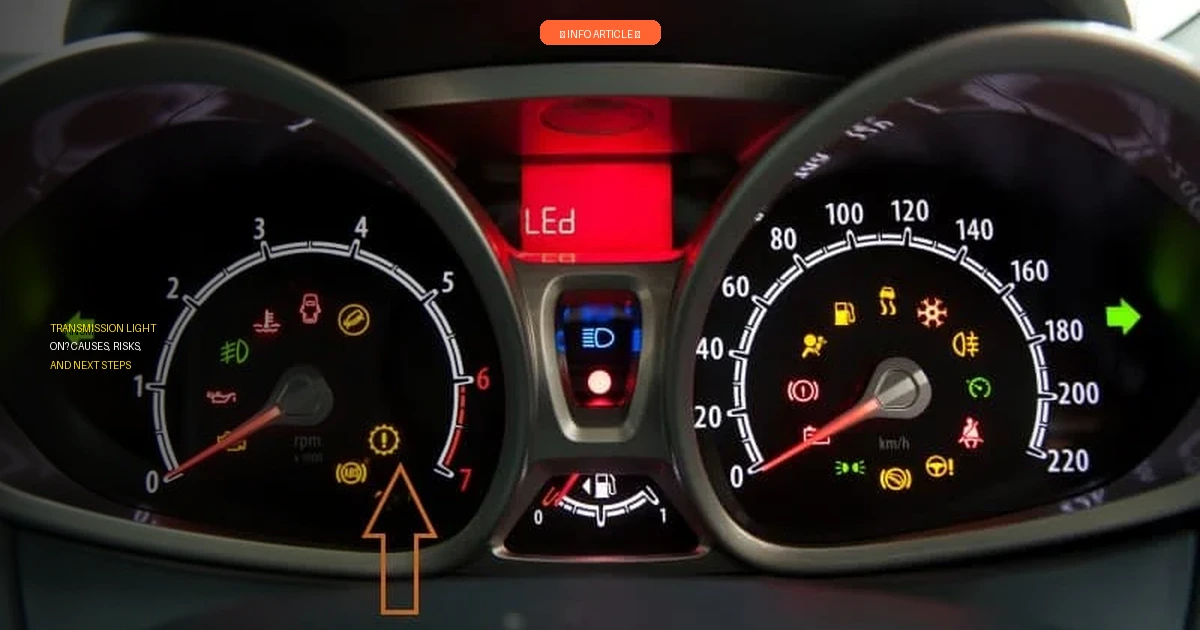
A transmission warning light indicates a serious internal or electronic issue that requires immediate attention to prevent total gearbox failure. If the light flashes or the car enters ‘Limp Mode,’ pull over safely and seek professional diagnosis to avoid high repair costs.
🎯 Key Takeaways
- Check transmission fluid levels first, as low fluid is a primary trigger.
- A flashing light often signals overheating; stop driving immediately to avoid damage.
- Use an OBD-II scanner to identify specific error codes for accurate diagnosis.
- Limp mode protects the engine by restricting gears when severe faults occur.
- Ignoring the light can turn a minor sensor fix into a costly replacement.
When your transmission warning light illuminates, your car’s internal computer has detected a malfunction in the powertrain system. This is not a suggestion for future maintenance; it is an active alert that your vehicle is operating outside of its safe mechanical parameters. Ignoring this light can lead to a total transmission failure, which often results in repair costs ranging from $2,500 to over $5,000. Essentially, the light is your last line of defense against a complete mechanical breakdown.
The immediate question you likely have is whether your car is safe to drive. While you can often travel a short distance to a service station, you should avoid high speeds, steep hills, or towing anything. Your transmission is responsible for transferring power from the engine to the wheels. If it fails while you are driving, you could lose power suddenly in traffic, creating a dangerous situation. This guide will help you identify the specific cause of the light and determine your next logical steps.
Understanding the Transmission Warning Light and Limp Mode
Most modern vehicles do more than just turn on a light when they detect a problem; they actively change how the car drives to prevent further damage. This protective state is known as Limp Mode or “Limp Home Mode.” When the Transmission Control Module (TCM) detects a logic error or a mechanical failure, it may restrict the transmission to a single gear (usually second or third) to limit heat and pressure.

What Happens in Limp Mode?
If your car enters Limp Mode, you will notice a significant drop in performance. The vehicle will feel sluggish, and it will likely refuse to shift into higher gears. You might notice:
- Reduced RPMs: The computer limits engine power to prevent overheating.
- Fixed Gear Operation: The car stays in one gear to avoid the friction of shifting.
- Hard Shifting: If the car does shift, it may feel like a physical “thud” or jolt.
Is it Safe to Keep Driving?
Technically, the car is designed to be driven to a mechanic while in Limp Mode. However, you are not safe to continue your daily commute or go on a road trip. Driving with the transmission light on means the fluid pressure is likely inconsistent. This causes internal components like clutches and bands to wear down rapidly. If the light is flashing rather than solid, pull over immediately. A flashing light usually indicates a severe overheat or a mechanical timing issue that could seize the transmission within minutes.
Common Causes: From Fluid Issues to Electronic Sensor Failures
The transmission is a complex mix of hydraulics and electronics. When the light triggers, it is usually due to a failure in one of these two areas. Identifying the symptom can help you narrow down the potential repair cost before you even reach the shop.
Transmission Fluid Problems
Low or degraded fluid is the leading cause of transmission warnings. Unlike engine oil, transmission fluid does not burn off; it is part of a closed system. If your fluid is low, you have a leak that needs to be addressed. Common fluid-related issues include:
- Low Fluid Levels: This causes a drop in hydraulic pressure, leading to gear slipping and delayed engagement.
- Fluid Oxidation (Burnt Fluid): If the fluid smells like burnt toast or looks dark brown/black, it can no longer lubricate the gears effectively.
- Contamination: Water or metal shavings in the fluid can cause the sensors to trigger a warning light as the viscosity changes.
Electronic Sensor and Solenoid Failures
Your transmission relies on a network of sensors to tell it when to shift. If one sensor provides “garbage data,” the computer triggers the light because it doesn’t know how to manage the gear ratios safely. Key components include:
- Speed Sensors: These monitor how fast the input and output shafts are spinning. If they don’t match, the computer assumes the transmission is slipping.
- Shift Solenoids: These are small electro-magnetic valves that open and close to direct fluid into the correct gear circuits. A stuck solenoid will prevent the car from shifting into specific gears.
- Transmission Control Module (TCM): This is the “brain” of the system. If the TCM has a software glitch or a hardware failure, it may trigger the light even if the mechanical parts are healthy.
Overheating Issues
Heavy towing, stop-and-go traffic in extreme heat, or a clogged transmission cooler can cause the fluid temperature to skyrocket. Heat is the number one killer of transmissions. When the fluid gets too hot, it thins out and loses its ability to protect metal surfaces. Most vehicles have a specific temperature sensor that triggers the transmission light the moment the fluid exceeds roughly 220 to 240 degrees Fahrenheit.
Safety First: Risks of Driving with a Transmission Warning
When that amber or red light flickers onto your dashboard, your first instinct might be to hope it is just a glitch. However, ignoring a transmission warning is a high-stakes gamble. Unlike a low washer fluid notification, a transmission alert indicates a problem with the system that transfers power from your engine to your wheels. If that system fails while you are in motion, the results can be both dangerous and expensive.
The Danger of “Limp Mode”
Many modern vehicles are programmed with a software defense mechanism known as “Limp Mode” or “Limp Home Mode.” When the computer detects a severe internal problem, it intentionally limits engine power and restricts the transmission to a single gear (usually second or third). This is designed to protect the hardware from further destruction, but it creates immediate safety risks in the real world.
- Reduced Acceleration: Trying to merge onto a high-speed highway or cross a busy intersection becomes incredibly dangerous when your car refuses to speed up.
- Unpredictable Shifting: The car may suddenly downshift or “hunt” for gears, causing the vehicle to jerk violently in heavy traffic.
- Loss of Power: In extreme cases, the car may lose forward momentum entirely, leaving you stranded in a vulnerable position on the road.
Potential for Catastrophic Mechanical Failure
Driving with a transmission light often turns a minor adjustment into a total overhaul. For example, a light triggered by a small fluid leak might only cost a hundred dollars to seal. If you continue to drive, the resulting friction and heat can “burn” the internal clutches and gears. What started as a simple fix quickly escalates into a $3,000 to $5,000 replacement bill. If you feel the car slipping or smell something sweet and burnt, pull over immediately to prevent permanent metal-on-metal damage.
Diagnostic Indicators: Decoding Symbols and OBD-II Trouble Codes
Your car is constantly talking to you through its onboard computer. The transmission light is essentially the vehicle’s way of saying, “I’ve found an error, and I need help.” However, because one light can represent dozens of different issues, understanding the specific language of your car’s diagnostics is the key to an efficient repair.
Common Dashboard Symbols to Watch
Not every car uses the same icon for transmission trouble. Depending on your make and model, you might see a variety of visual cues. Some vehicles use a dedicated gear-shaped icon with an exclamation point in the center. Others may simply display a text “TRANS OVER TEMP” or “CHECK ADAPTIVE DRIVE” message. Interestingly, on many older or budget-friendly models, a flashing Check Engine Light or a blinking “D” (Drive) indicator on the gear selector is the primary way the car communicates a transmission fault.
The Role of OBD-II Diagnostic Codes
To get to the heart of the issue, mechanics use an OBD-II scanner to pull “P-codes” (Powertrain codes). These codes act as a map, pointing technicians toward the specific circuit or component that is malfunctioning. Knowing these codes can help you have a more informed conversation with your repair shop.
- P0700: This is a general “placeholder” code. It simply tells the main computer that the transmission control module (TCM) has a problem.
- P0730: This indicates an “Incorrect Gear Ratio,” often meaning the transmission is slipping or a sensor is misreading speeds.
- P0715: This points to an Input/Turbine Speed Sensor circuit malfunction, which can cause erratic shifting.
- P0218: This is a specific warning for Transmission Over-Temperature, usually caused by heavy towing or low fluid levels.
Conclusion
A transmission light is never something to take lightly. Whether it is a minor electronic hiccup or a sign of an impending mechanical breakdown, early intervention is your best defense against astronomical repair bills and dangerous roadside breakdowns. By understanding the risks of “Limp Mode” and knowing how your car communicates through diagnostic codes, you can take control of the situation before it worsens.
Your Next Steps: If your light is on, start by checking your transmission fluid levels and color. If the fluid looks dark or the light stays on, schedule a diagnostic scan at a trusted local shop immediately. Most auto parts stores will even scan your codes for free to give you a head start. Don’t wait for the car to stop moving—act now to keep your vehicle safe and reliable for the road ahead!
❓ Frequently Asked Questions
Is it safe to drive to a mechanic if the transmission light is on?
If the car shifts normally, you may drive a short distance to a shop, but if it’s slipping or jerking, you should call a tow truck. Continued driving under stress risks total transmission failure, which is significantly more expensive than a minor repair.
What is ‘Limp Mode’ and what should I do?
Limp mode is a security state where the car’s computer limits speed and gear shifts to protect the transmission from catastrophic damage. If this activates, pull over safely and consult a professional immediately to avoid ruining internal components.
How much does it cost to fix a transmission light issue?
Costs vary depending on the cause, ranging from $100 for a fluid change to $3,000+ for a full rebuild. Diagnosing the specific error code via an OBD-II scanner is the only way to determine the actual repair cost.
Can a bad battery trigger the transmission light?
Yes, modern transmissions rely heavily on electronic sensors and solenoids that require stable voltage. A failing battery or alternator can send incorrect signals, causing the computer to trigger a false transmission warning.
What are the symptoms of a failing transmission sensor?
Common signs include erratic shifting, the inability to change gears, or a speedometer that stops working. These sensors communicate with the ECU, and when they fail, the transmission light is almost always triggered.
Does the warning light come on for manual transmissions too?
While less common, some modern manual vehicles have sensors for internal temperature or gear position that can trigger a light. Most manual issues are felt physically, but electronic warnings are appearing more frequently in newer models.