
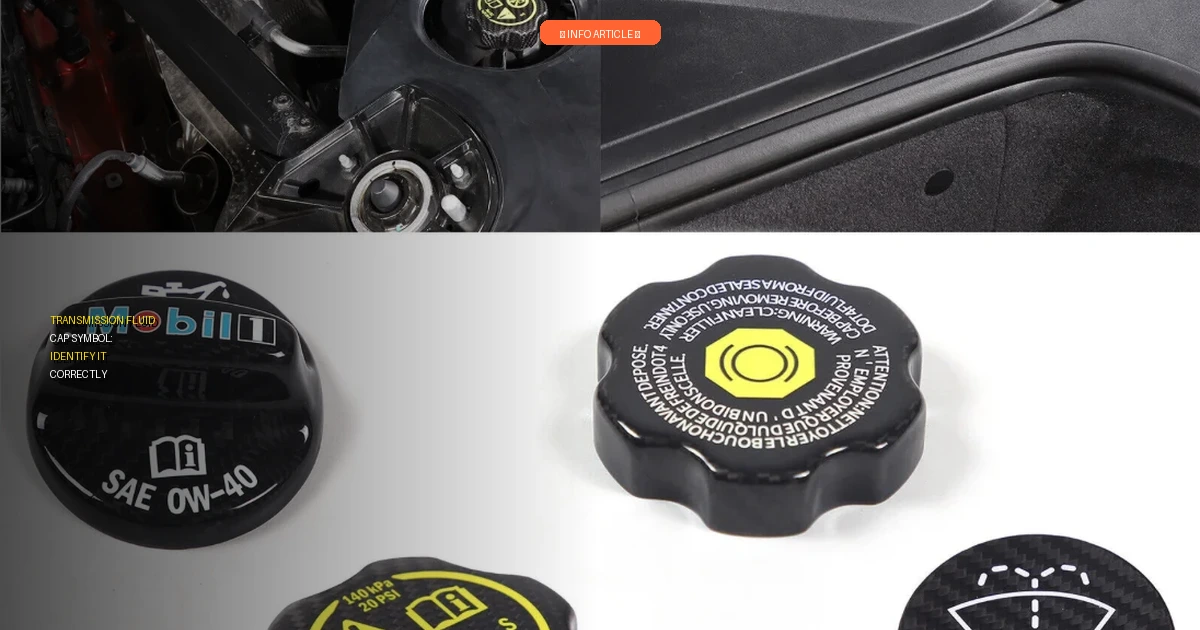
The transmission fluid cap symbol typically features a gear or cogwheel icon or text labels such as ‘ATF’ or ‘Trans’. It is most often identified by a bright red or yellow handle and is located deeper in the engine bay compared to the engine oil cap.
🎯 Key Takeaways
- Look for a gear icon or labels like ‘ATF’ or ‘Transmission’ on the cap.
- Transmission dipsticks are usually red or yellow to stand out from other fluids.
- Many modern vehicles use sealed transmissions and will not have a visible cap.
- The transmission cap is usually located near the back of the engine bay.
- Never confuse the gear symbol with the oil can symbol to avoid damage.
Most modern vehicles identify the transmission fluid fill point with a specific gear or cogwheel icon. If your car doesn’t use a graphic, you will almost certainly see bold text identifiers like ATF, Trans, or Transmission embossed directly onto the surface of the cap. Correctly identifying this symbol is the first step in basic vehicle maintenance and the best way to avoid a catastrophic repair bill caused by cross-contamination.
Mistaking the transmission fill port for the engine oil or coolant reservoir is a common error that can lead to immediate mechanical failure. Transmission systems are incredibly sensitive to fluid chemistry. Adding the wrong liquid can cause gear slippage, seal damage, and total system breakdown within miles. This guide focuses on the specific visual cues you need to recognize before you ever twist the cap off or pull the dipstick.
Common Visual Icons and Markings on Transmission Caps
The most universal symbol for transmission fluid is a cogwheel or gear icon. This is typically represented as a circle with small teeth or notches around the outer edge. Manufacturers use this to signify the mechanical nature of the transmission. In many cases, this gear icon will have a small oil drop or a dipstick graphic placed right in the center of the cog to clarify that it is a fluid-related component.
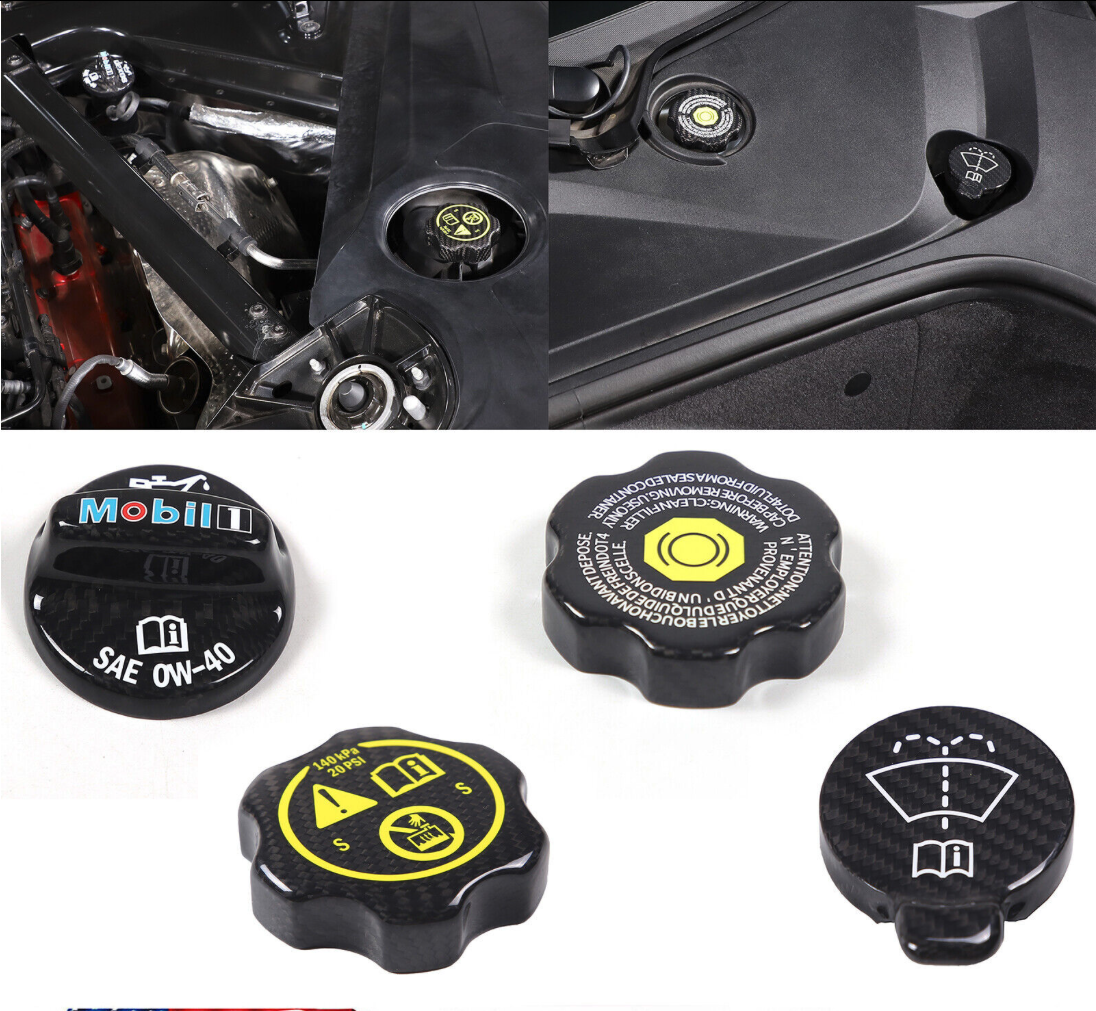
The Gear or Cogwheel Symbol
When you look under the hood, search for a cap that features a jagged, circular border. This “gear” indicates that the fluid below services the drivetrain rather than the engine block. Depending on the make of your vehicle, the icon may appear in several variations:
- Standard Gear: A simple, bold outline of a gear with 8 to 12 teeth.
- Gear with Dipstick: A gear icon with a vertical line through the middle, ending in a small loop.
- Gear with Fluid Drop: A gear surrounding a single droplet, indicating a pressurized or lubricating fluid.
- Yellow or Red Coloration: Many manufacturers color-code the transmission cap or the dipstick handle in bright yellow or red to distinguish it from the black or blue engine caps.
Text Identifiers (ATF, CVT, and Trans)
If your vehicle does not use a graphic icon, it will rely on standardized abbreviations. These are usually molded into the plastic of the cap in high-relief lettering. You should look for the following specific terms:
- ATF: Stands for Automatic Transmission Fluid. This is the most common label found on non-manual vehicles.
- CVT: Found on modern vehicles with Continuously Variable Transmissions. It is critical not to mix standard ATF with CVT fluid.
- Trans / Transmission: Some domestic manufacturers skip the abbreviations and spell the word out entirely.
- Dexron/Mercon: On older vehicles, you might see the specific fluid brand name required by the manufacturer rather than the word “Transmission.”
Identifying Transmission Caps vs. Engine Oil and Brake Fluid
To avoid a “fluid mix-up” disaster, you must be able to tell the difference between the transmission cap and other nearby reservoirs. While they are all located in the engine bay, their symbols and physical locations follow specific patterns. The transmission fill point is usually located further back toward the firewall (the wall between the engine and the cabin), whereas the engine oil cap is located directly on top of the engine block.
Transmission vs. Engine Oil Symbols
The engine oil cap is the one most people confuse with the transmission cap. However, the symbols are very distinct once you know what to look for. The engine oil symbol is almost always an old-fashioned oil can, often resembling an “Aladdin’s lamp” with a single drop coming out of the spout. In contrast, the transmission cap focuses on the gear or cog.
- Engine Oil: Look for the oil can icon or the text “5W-20”, “5W-30”, or “Oil.”
- Transmission: Look for the gear icon or “ATF.”
- Physical Shape: Engine oil caps are usually large, round, and screw-on. Transmission caps are often smaller or attached to the top of a long, thin dipstick tube.
Spotting the Difference with Brake and Coolant Caps
Brake fluid and coolant reservoirs are the other two “danger zones” for accidental mixing. Brake fluid caps are typically smaller and located near the driver’s side firewall. The symbol for brake fluid is a circle inside a set of parentheses, which represents brake shoes and a drum. It may also have a warning triangle or the text “DOT 3” or “DOT 4.”
Coolant (antifreeze) caps are usually large and pressurized. They feature a thermometer icon sitting in wavy lines, which represent the liquid. You will also see “Warning: Never Open When Hot” printed on or around the cap. Transmission symbols never use waves or thermometers; they stick strictly to gears or drivetrain-related text. By focusing on the gear-toothed border, you can immediately rule out the brake and cooling systems as you scan the engine bay.
Color Coding Standards for Transmission Dipsticks and Handles
If you are squinting at the components under your hood trying to find the transmission fluid cap symbol, color coding is often your best friend. Manufacturers know that engines are crowded, so they use high-visibility colors to help you distinguish between the transmission, the engine oil, and the coolant. While not a universal law, most brands follow a specific palette to make DIY checks easier.
Red and Yellow: The Traditional Identifiers
In the vast majority of vehicles, the transmission dipstick handle—which often serves as the “cap” for the fill tube—is colored bright red or pinkish-orange. This is a logical choice because fresh transmission fluid (ATF) is itself dyed red. Seeing a red handle is a strong visual cue that you are looking at the right system. However, some manufacturers, particularly in older American trucks, might use a bright yellow handle. If you see two yellow handles, the one located further back toward the firewall (the wall between the engine and the cabin) is almost always the transmission.
- Red/Pink: The most common standard for automatic transmissions.
- Yellow: Frequently used, but always check for the gear or “ATF” text to ensure it isn’t the oil dipstick.
- Black: Often used in European brands; these usually rely more heavily on the embossed symbol than the color.
Brand-Specific Variations
While the red-is-transmission rule is common, it isn’t absolute. For example, many Honda models use a distinct bright yellow loop for the transmission, while Ford often sticks to a rugged black or dark yellow handle with “Transmission” clearly printed on it. If your vehicle is more than a decade old, these colors might fade due to engine heat. In these cases, don’t rely on color alone—look for the gear-shaped icon or the “Trans” abbreviation stamped directly into the plastic.
Sealed Transmissions: Why Your Vehicle Might Lack a Symbol
You might be searching for a transmission fluid cap symbol only to realize it simply isn’t there. If you’ve scoured the engine bay and found nothing, don’t worry—your car isn’t missing a part. You likely have a sealed transmission. This design has become the industry standard for many modern sedans, SUVs, and luxury vehicles, moving away from the traditional user-accessible fill tube.
The “Fill-for-Life” Philosophy
Manufacturers like BMW, Mercedes-Benz, and even Toyota now frequently produce “sealed” units. The idea behind this is to prevent contaminants like dust and moisture from entering the sensitive transmission system. These vehicles lack a traditional dipstick or an easy-access cap under the hood. Instead, the fluid is checked via a plug located on the side or bottom of the transmission casing, usually accessible only from underneath the car while it is on a lift.
How to Confirm You Have a Sealed System
If you cannot find a cap with a gear or thermometer symbol, check for these signs that your system is sealed:
- The Owner’s Manual: Look for sections labeled “Maintenance Free” or “Lifetime Fluid.”
- Under-Hood Labels: Some cars have a small sticker near the radiator that lists the fluid types but notes that the transmission does not require checking.
- Dashboard Alerts: Modern sealed systems rely on electronic sensors to monitor fluid life and level, alerting you via the “Check Engine” or “Transmission Service” light instead of a manual dipstick.
Practical Tip: Even if your car is “sealed,” the fluid isn’t actually permanent. Most mechanics recommend a professional fluid exchange every 60,000 to 100,000 miles, even if there is no symbol under the hood to remind you.
Conclusion
Identifying the transmission fluid cap symbol is a small but vital part of vehicle ownership. Whether you are looking for the classic gear icon, a thermometer inside a circle, or a bright red handle, knowing these visual cues prevents costly mistakes. Remember that while most cars offer an easy way to check levels, many modern “sealed” vehicles have moved this task to the professional shop.
As a next step, pop your hood this weekend and locate your transmission identifier so you aren’t searching for it during an emergency. If you find a sealed system, take a moment to check your service manual for the recommended maintenance interval. Staying proactive today ensures your gears keep shifting smoothly for years to come!
❓ Frequently Asked Questions
How do I tell the difference between the oil cap and the transmission cap?
The oil cap features an oil can symbol and is located directly on top of the engine. In contrast, the transmission cap or dipstick often has a gear icon or ‘ATF’ and is positioned further back toward the firewall.
What does the gear symbol with a thermometer inside mean?
This symbol specifically indicates transmission fluid temperature or a system warning. While more common on dashboards, it may appear on fluid reservoirs in heavy-duty or performance vehicles.
Why do some transmission caps have no symbol at all?
Older vehicles or specific manufacturers may use a plain colored handle without an icon. In these cases, the location and the text ‘Trans’ or ‘ATF’ are the primary identifiers.
Is the transmission fluid symbol the same for manual and automatic cars?
Most manual transmissions do not have a cap under the hood; they are filled from underneath the car. Gear symbols under the hood are almost exclusively for automatic transmissions.
What should I do if the symbol is faded or unreadable?
Check the color of the handle; red or yellow is the industry standard for transmission fluid. If you remain unsure, consult your owner’s manual to verify the exact location of the fluid port.
Are there different symbols for CVT transmissions?
Some manufacturers use specific ‘CVT’ text instead of a gear icon or ‘ATF’. Because CVT fluid is highly specialized, these caps are often clearly labeled to prevent the use of incorrect fluid types.