
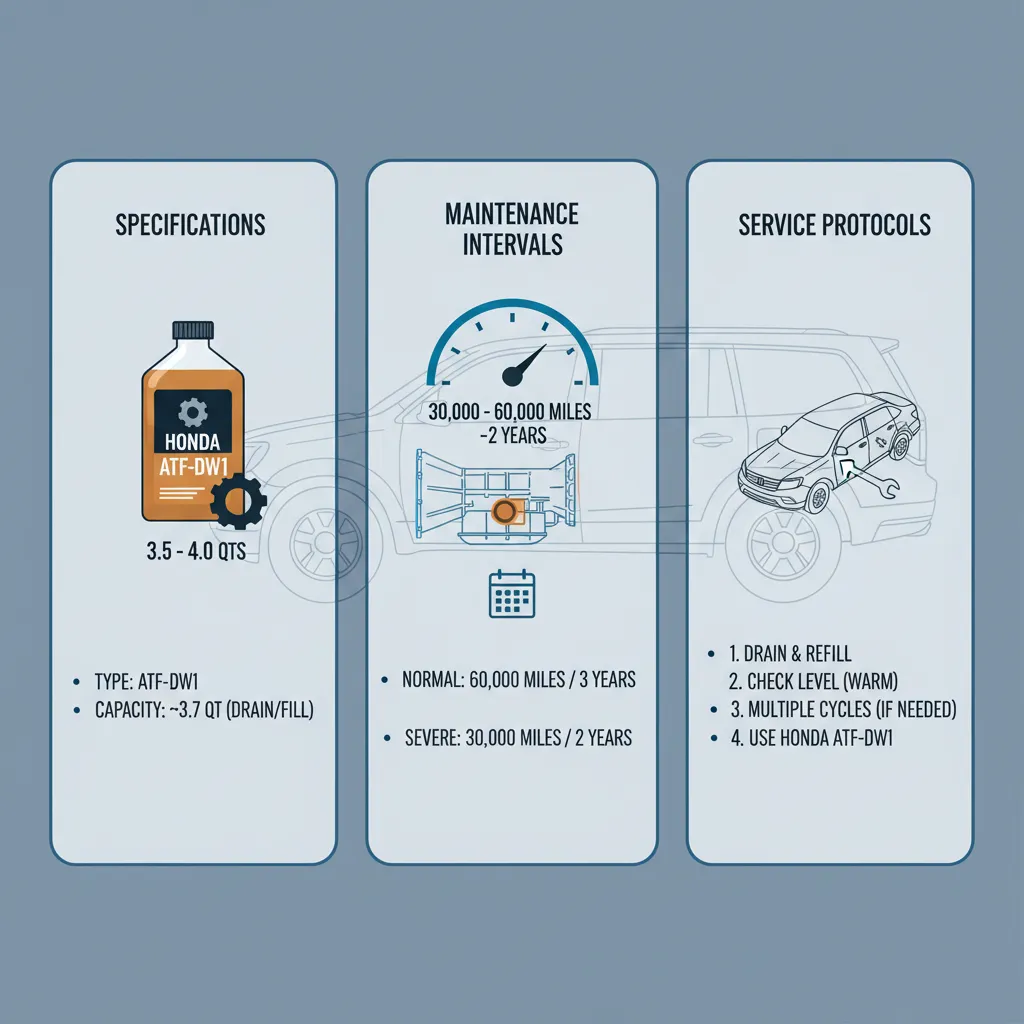
Maintaining the hydraulic integrity of your Honda Pilot transmission fluid is the single most important factor in ensuring your vehicle reaches the 200,000-mile milestone. While the Pilot is renowned for its reliability, its sophisticated drivetrain requires precise lubrication to manage heat and friction. Many owners struggle with confusing maintenance codes, conflicting advice on service intervals, and the distinct requirements of 6-speed versus 9-speed transmissions. This comprehensive guide provides a professional technical breakdown of fluid specifications, step-by-step maintenance protocols, and expert advice on identifying signs of fluid degradation to keep your vehicle performing at its peak.
Identifying the Correct Honda Pilot Transmission Fluid for 6-Speed and 9-Speed Systems
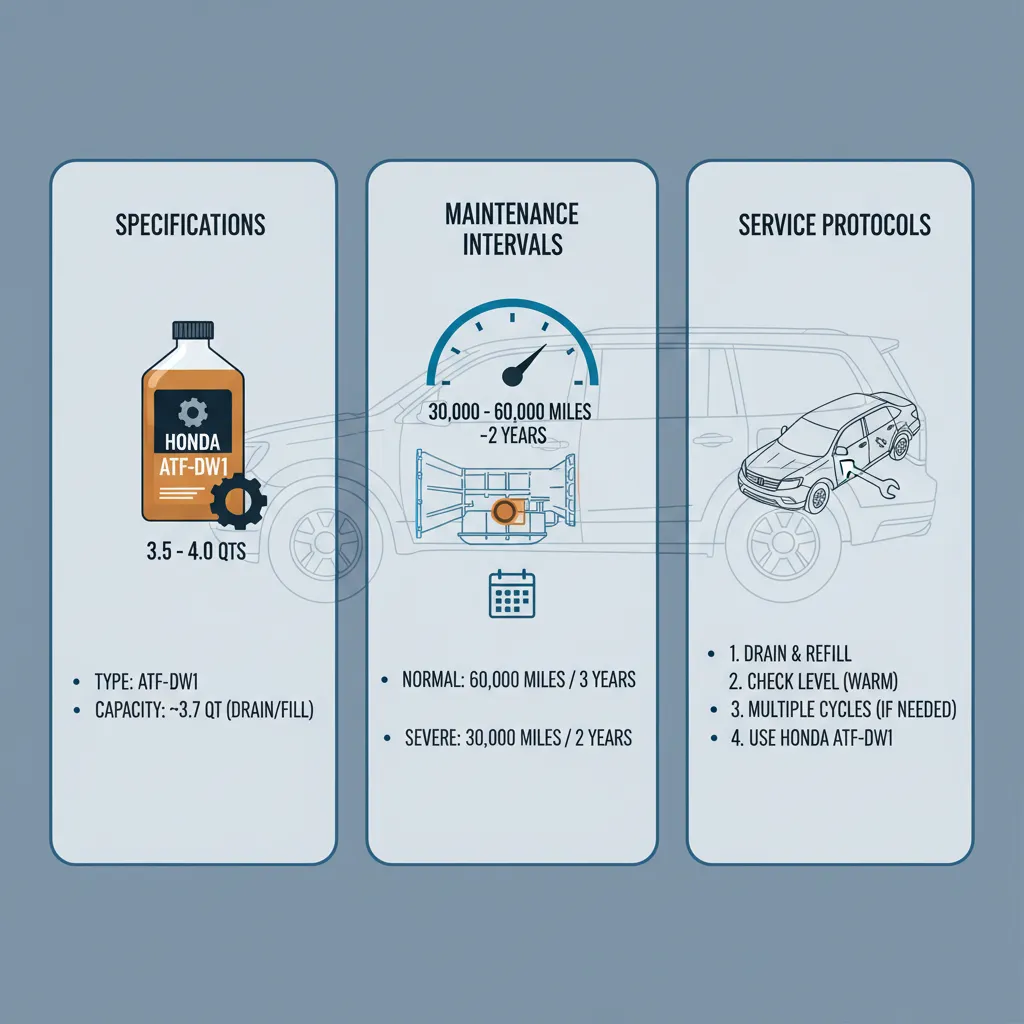
The most critical step in transmission maintenance is identifying which unit is installed in your Pilot. Honda utilizes different transmissions across generations, and misidentifying them can lead to catastrophic internal damage. For the third-generation Pilot (2016-2022), models were equipped with either a 6-speed automatic or a ZF-sourced 9-speed automatic. You can quickly distinguish these by looking at the gear selector: if you have a traditional shift lever, you have the 6-speed; if you have a push-button selector, you have the 9-speed.
Honda ATF-DW1 vs. ATF-Type 3.1
The trusted professional standard for all Honda 5-speed and 6-speed units is Honda ATF-DW1. This fluid was introduced to phase out the older Z1 formulation, offering significantly better low-temperature performance. In fact, ATF-DW1 maintains a consistent viscosity at low temperatures, improving cold-start shift quality by approximately 20% over the older Z1 fluid. Its chemical properties are specifically engineered to protect internal clutches and prevent the premature hardening of seals that often leads to internal pressure leaks.
However, the 9-speed transmission (standard on the 2019-2022 Touring, Elite, and Black Edition models) requires Honda ATF-Type 3.1. This fluid is vastly different from DW1 and is tailored for the specific hydraulic requirements of the ZF 9HP unit. Using DW1 in a 9-speed transmission—or vice versa—will alter the friction coefficient, leading to slipping and eventual solenoid failure.
Always use Genuine Honda fluid to maintain the specific OEM-equivalent viscosity. This ensures the hydraulic pressure required for the intricate solenoid cycle rates remains within factory tolerances, preserving that “like-new” shift feel.
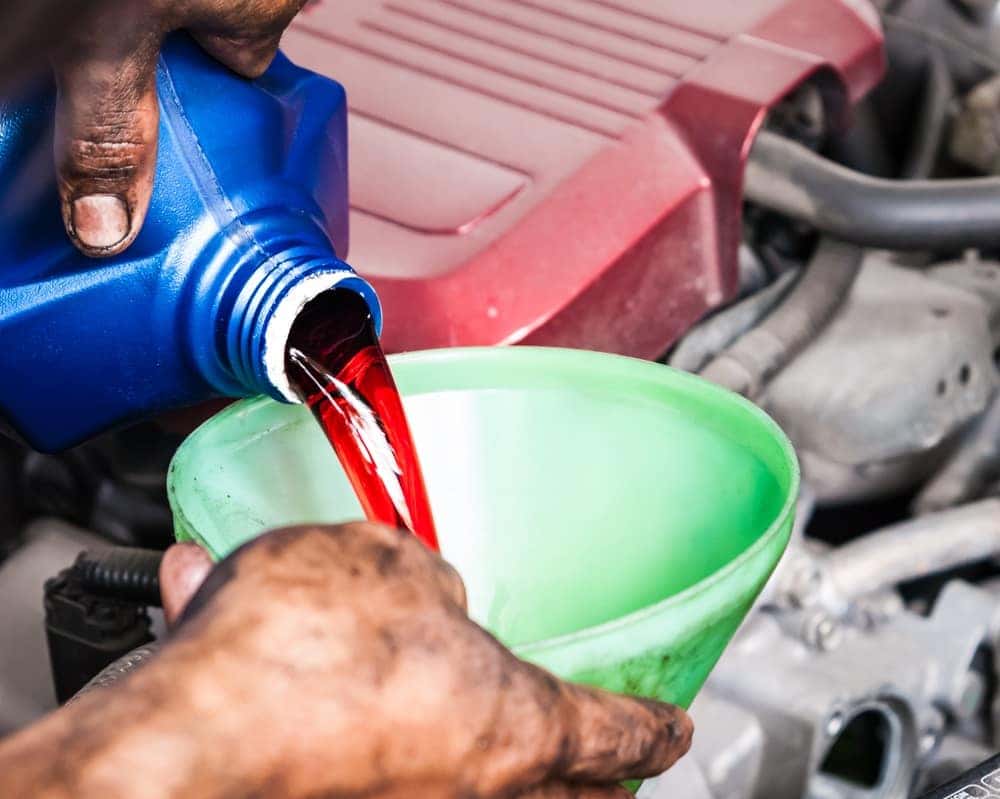
Honda Pilot Transmission Fluid Change Intervals and Maintenance Minder Code 3
Modern Honda vehicles use the Maintenance Minder system to track service needs based on driving conditions. When you see Sub-Item 3 appear on your dashboard, it indicates that a transmission fluid service is due. However, waiting for the computer can sometimes be risky for owners in specific environments.
Severe Service vs. Normal Service
While the standard recommendation for “Normal Service” might stretch to 60,000 miles, seasoned technicians advocate for a “Severe Service” interval of every 30,000 miles. This is particularly crucial for Pilots used for family towing or those driven in mountainous terrain, where fluid degradation occurs 40% faster than during steady highway cruising. Heat is the primary enemy; as additives oxidize, the fluid loses its ability to protect the torque converter clutch.
Service Data by Transmission Type
Standard Drain & Fill (9-Speed)
Severe Service Interval (Miles)
Recommended Refresh Cycles
A common pitfall is assuming a single drain and fill replaces all the fluid. In reality, the torque converter and internal galleries hold a significant volume that does not drain by gravity. For a complete fluid refresh, many experts recommend the “3x Drain and Fill” method. This involves draining the fluid, refilling it, driving the vehicle to circulate the new fluid through all gears, and repeating the process three times. This ensures that over 90% of the old, oxidized fluid is replaced with fresh, high-quality ATF.
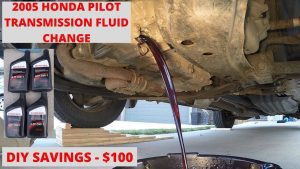
Recognizing Symptoms of Degraded Honda Pilot Transmission Fluid
Early detection of fluid breakdown can save you thousands in repair costs. One of the most documented issues in the 2016-2018 Honda Pilot is “Transmission Judder.” This is a distinct vibration or shuddering sensation felt between 20-60 mph, often caused by the torque converter clutch failing to engage smoothly due to friction modifier depletion in the fluid.
Fluid Clarity
Fresh fluid is bright red. Dark brown or black fluid indicates severe oxidation and heat stress.
Engagement Speed
Healthy fluid allows for near-instant engagement when shifting from Park to Drive or Reverse.
Other red flags include “gear hunting,” where the transmission struggles to decide on the appropriate gear during light acceleration, or delayed engagement. Furthermore, if you live in a humid climate or have driven through deep water, moisture contamination can occur. This turns the fluid into a milky “strawberry milkshake” consistency, which destroys clutch packs almost instantly. Transmission fluid that reaches 300 degrees Fahrenheit can reduce the expected life of the transmission by half for every 20-degree increase above normal operating temps. Always perform an olfactory check; a burnt smell is a reliable indicator that the fluid’s protective properties have failed.
Technical Execution: The Drain and Fill Procedure for Professional Results
Performing a comprehensive fluid service requires the right tools and attention to detail. For the 6-speed Pilot, you will need a 3/8-inch drive ratchet to remove the drain plug and a 17mm socket for the fill plug located on top of the transmission casing. A standard drain and fill on a 3rd Gen Pilot typically recovers only 3.3 to 3.5 quarts of the total 8+ quart capacity, which is why precision in measurement is vital.
📋
Professional Service Protocol
Ensure the vehicle is level. Remove the 17mm fill plug FIRST to ensure you can refill the unit before draining. Clean the area to prevent debris from falling into the transmission.
Drain the fluid into a graduated container to measure the exact amount removed. Always replace the 24mm aluminum crush washer on the drain bolt and the smaller washer on the fill plug.
Use a torque wrench to tighten the drain plug to 36 lb-ft and the fill plug to 33 lb-ft. This prevents stripping the soft aluminum casing while ensuring a leak-free seal.
Unlike many other manufacturers, Honda specifies that transmission fluid levels should be checked with the engine OFF, but while the fluid is at operating temperature. Checking while the engine is running will result in an inaccurate low reading.
Comparing OEM Fluid vs. Aftermarket Alternatives for Long-Term Reliability
One of the most debated topics among Pilot owners is whether to use Genuine Honda ATF or a high-quality synthetic alternative like Valvoline MaxLife or Amsoil. From a professional standpoint, Honda transmissions are uniquely sensitive to friction modifiers. The solenoid cycle rates and clutch plate materials are specifically tuned for the viscosity and anti-foaming agents found in Honda ATF-DW1.
✅ Why Choose OEM
- Guaranteed compatibility with internal seals
- Maintains factory shift feel and timing
- No risk to powertrain warranty coverage
- Proprietary anti-foaming agents
❌ Aftermarket Risks
- “Universal” fluids may have incorrect friction levels
- Potential for increased torque converter judder
- Savings are marginal ($10-$20 per service)
- Could complicate warranty claims if a failure occurs
A cost-benefit analysis makes the decision clear: the marginal savings of using aftermarket fluid is negligible compared to the high cost of a replacement Honda transmission, which averages $4,000–$6,000. There are numerous case studies where a persistent transmission shudder was resolved simply by switching from a generic “all-vehicle” fluid back to OEM ATF-DW1. For vehicles still within their 60,000-mile powertrain warranty, using anything other than the specified fluid is an unnecessary risk.
In summary, while high-quality synthetic fluids can perform well in many vehicles, the Pilot’s specific shifting logic—particularly in the 6-speed and the ZF 9-speed—is optimized for the trusted, proprietary chemistry of Genuine Honda products. Following these expert protocols ensures that your Pilot remains reliable for years to come.
Always verify your Pilot’s generation and transmission type before purchasing fluid to ensure compatibility. Adhere to a strict 30,000-mile drain and fill interval if you engage in towing or heavy city driving, and prioritize Genuine Honda ATF-DW1 or Type 3.1 to maintain shift quality. Check your dashboard for Maintenance Minder Code 3 today; if you are past the 60,000-mile mark without a service, consult a professional to perform a triple drain and fill for a complete system refresh.
Frequently Asked Questions
Can I use Valvoline MaxLife instead of Honda ATF-DW1 in my Pilot?
While many professional mechanics successfully use Valvoline MaxLife Multi-Vehicle Synthetic ATF because it meets the DW-1 specification, Honda officially recommends only Genuine Honda fluids. MaxLife is often praised for its synthetic durability, but for vehicles under powertrain warranty, staying with OEM fluid is the most reliable way to avoid potential claim denials.
What is the ‘3x Drain and Fill’ method for the Honda Pilot?
Because a single drain only removes about 40% of the total fluid, the 3x method involves draining and refilling the fluid, driving the car to cycle through all gears, and repeating this process three times. This expert technique replaces approximately 85-90% of the old fluid, including what is trapped in the torque converter and cooler lines.
How do I know if my Honda Pilot has a 9-speed transmission?
The easiest way to identify the transmission is by looking at the center console gear selector. If your Pilot has a traditional shift lever, it is a 6-speed (using ATF-DW1). If it has a series of buttons for Park, Reverse, Neutral, and Drive, it is a ZF 9-speed transmission, which requires a specific Honda 3.1 or 3.2 fluid.
Why does my Honda Pilot shudder when accelerating at low speeds?
This is often referred to as ‘torque converter judder.’ It typically occurs when the transmission fluid has broken down and can no longer provide the necessary friction for the torque converter’s lock-up clutch. In many cases, a professional fluid change using high-quality Honda ATF-DW1 and a software update can resolve the issue without requiring mechanical repairs.
How much does a Honda Pilot transmission fluid change cost?
A standard drain and fill at a trusted dealership usually costs between $150 and $250, including parts and labor. If you require the ‘3x Drain and Fill’ procedure, the cost can rise to $400-$600 due to the increased volume of fluid and labor time required to cycle the transmission through gears multiple times.