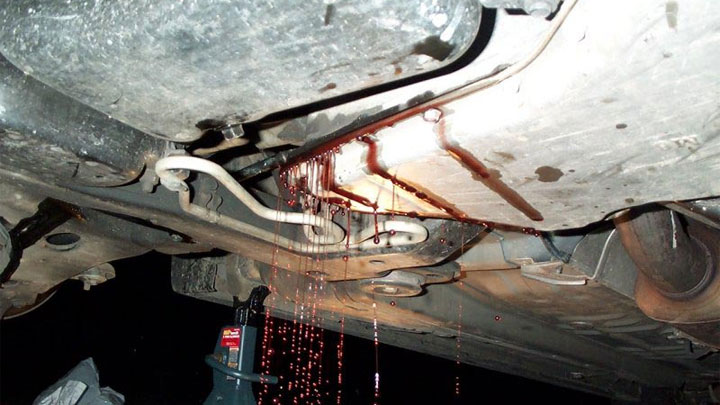
Nissan Versa Transmission Fluid Maintenance, Specifications, And Service Intervals
The Nissan Versa has established itself as a cornerstone of the subcompact segment, renowned for its exceptional fuel efficiency and urban agility….
The Nissan Versa has established itself as a cornerstone of the subcompact segment, renowned for its exceptional fuel efficiency and urban agility. However, the longevity and reliability of its sophisticated Xtronic Continuously Variable Transmission (CVT) or its rugged manual gearbox depend almost entirely on one critical factor: the health and specification of its transmission fluid. While Nissan’s engineering offers a seamless driving experience, the fluid serves as the lifeblood that manages heat, provides hydraulic pressure, and lubricates moving components under immense stress.
Many owners are unfortunately misled by “lifetime fluid” marketing claims, leading to premature transmission wear, shuddering, and catastrophic failures that could have been easily prevented. This comprehensive guide provides an expert breakdown of Nissan Versa transmission fluid specifications, recommended service intervals, and the critical warning signs that your vehicle requires immediate professional attention to ensure years of reliable performance.
Identifying the Correct Nissan Versa Transmission Fluid Specifications
📤 Share Image
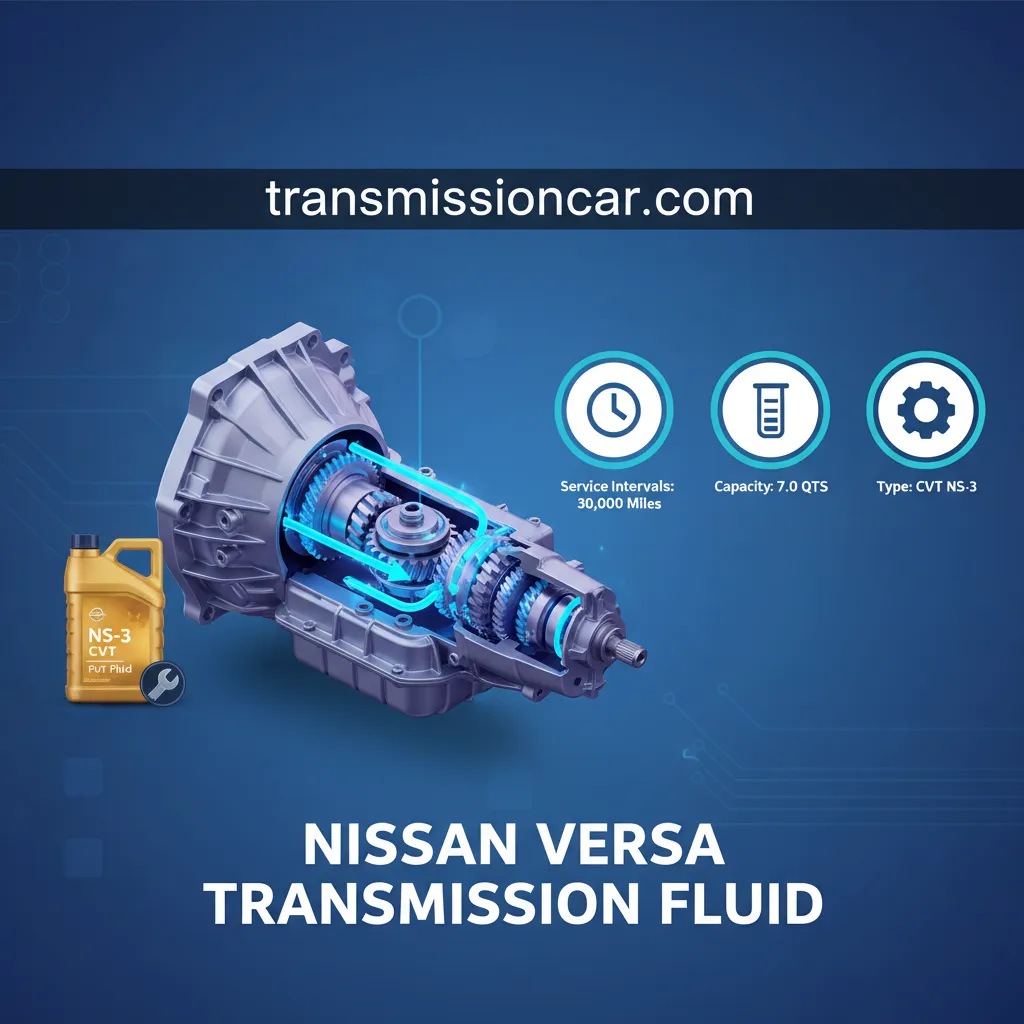
Selecting the correct fluid for a Nissan Versa is not merely a suggestion; it is a mechanical necessity. The Xtronic CVT, manufactured by Jatco, operates on a belt-and-pulley system that requires a very specific friction coefficient. Using a generic “multi-vehicle” Automatic Transmission Fluid (ATF) can lead to belt slippage, as these universal fluids lack the chemistry to maintain the required grip between the steel belt and the pulleys.
NS-2 vs. NS-3: The Critical Distinction
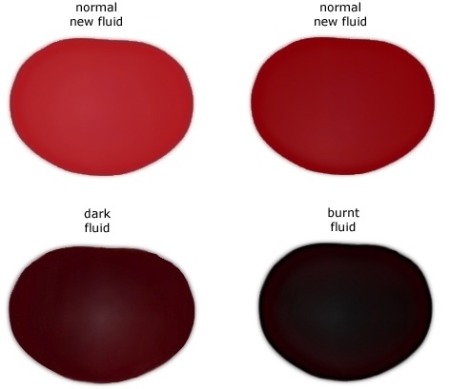
The primary distinction lies between Genuine Nissan NS-2 and NS-3 CVT fluids. Generally, Nissan Versa models produced prior to 2013 utilize NS-2, while 2013 and newer models require the lower-viscosity NS-3. NS-3 was specifically engineered to improve fuel economy and provide better lubrication in the tighter tolerances of modern Xtronic units. Fresh NS-3 fluid typically displays a distinctive blue/green tint, which darkens to a brownish hue as it ages and heat-cycles.
Manual Transmission Requirements
For those driving the 5-speed manual variants, the requirements shift to a professional-grade gear oil. These transmissions typically require a 75W-85 weight gear oil. Using the correct weight ensures that the synchronizers can engage smoothly without excessive wear. Unlike CVTs, manual gearboxes are less sensitive to chemical nuances but are highly sensitive to viscosity; using a heavy 90-weight oil can make shifting difficult in cold climates.
Data indicates that a 2015 Nissan Versa CVT requires approximately 7.5 to 8.0 quarts for a “dry fill” (such as after a complete overhaul), but a standard professional drain and fill only replaces about 4 quarts. This is why consistent service is vital—you are essentially refreshing the additive package rather than replacing the entire volume.

Recommended Service Intervals for Reliable Transmission Performance
One of the most dangerous myths in modern automotive maintenance is the concept of “lifetime fluid.” In the context of a Nissan CVT, “lifetime” often implies the lifetime of the manufacturer’s warranty, not the 200,000-mile lifespan many owners expect. Over time, the high heat and sheer forces within the CVT break down the fluid’s molecular structure, leading to a loss of viscosity and the depletion of protective anti-wear additives.
The Expert Maintenance Schedule
While Nissan’s official manuals often suggest a simple inspection every 10,000 miles, seasoned technicians recommend a complete fluid exchange at 30,000-mile intervals for vehicles driven in severe conditions. Severe conditions include heavy stop-and-go traffic, mountainous terrain, or high-ambient temperatures. For a driver who operates primarily on highways in temperate climates, 60,000 miles is the absolute maximum recommended threshold.
Modern Nissan CVTs track “CVT Fluid Deterioration Data” via the On-Board Diagnostic (OBD) system. This counter increases based on high-temperature operating conditions. A professional shop can read this value with a scan tool to determine exactly how “cooked” your fluid is, regardless of the mileage on the odometer.
Climate and Usage Factors
Consider a daily commuter in Arizona or Florida. The high ambient heat, combined with idling in traffic, prevents the transmission oil cooler from shedding heat effectively. In these scenarios, the fluid can easily exceed 200°F, which can reduce the fluid’s effective lifespan by 50% or more. Conversely, a highway driver in the Midwest may see lower operating temperatures and can safely push toward the 60,000-mile mark. Regardless of driving style, regular exchanges prevent “chain slip,” where the metal belt momentarily loses grip, causing irreversible scoring on the pulleys.

Symptoms of Degraded or Low Nissan Versa Transmission Fluid
Early detection of transmission issues is the difference between a minor service bill and a total mechanical failure. Because the CVT relies on hydraulic pressure to move the pulleys and maintain belt tension, even a slight degradation in fluid quality can manifest as noticeable driving issues.
The “CVT Whine”
A high-pitched whining noise that increases with engine RPM often indicates fluid aeration or an overheating transmission. This is frequently caused by fluid that has lost its anti-foaming properties.
Shuddering & Lag
Also known as the “rubber band effect,” this occurs when there is a delay between pressing the gas and the car accelerating. It signals that the fluid cannot maintain proper hydraulic pressure.
Visual and Olfactory Indicators
If you suspect a problem, check the fluid on the dipstick (if equipped) or via a drain sample. Healthy NS-3 is translucent with a blue-green tint. Fluid that is dark brown or black—and carries a distinct “burnt toast” odor—indicates that the internal clutch packs are wearing or that the fluid has been severely overheated. Furthermore, if the fluid level is low, the transmission may enter “limp mode,” a fail-safe state where the computer limits engine RPM to protect internal components from further damage.
Professional Procedures for Fluid Exchange and Filter Replacement
A truly professional service goes beyond just pulling a drain plug. To ensure a comprehensive refresh, technicians must address the filters and the accumulated debris within the transmission pan. The Nissan Versa CVT actually contains two filters: a primary internal screen and a secondary external cartridge filter.
📋
The Professional Service Protocol
The technician drains the fluid and removes the transmission pan. This allows for an inspection of the pan magnets, which catch metallic “sludge.” Fine grey paste is normal break-in wear; large metal chunks indicate imminent failure.
The internal screen is cleaned or replaced, and more importantly, the external cartridge filter (located behind the oil cooler housing near the front driver-side wheel well) is replaced. This cartridge filter is the most common point of restriction.
After filling with fresh NS-3 fluid, a professional-grade scan tool is used to reset the ‘CVT Fluid Deterioration’ counter. This tells the car’s computer that the fluid is new, allowing it to adjust solenoid pressures accordingly.
If your Nissan Versa has gone over 100,000 miles without a single fluid change, do not perform a pressurized “flush.” A high-pressure flush can dislodge debris that may clog the small passages in the valve body. Stick to a gentle “drain and fill” or multiple drain and fills to refresh the fluid gradually.
The Long-Term Value of Expert Transmission Maintenance
The financial logic for proactive transmission maintenance is undeniable. A typical professional fluid exchange, including both filters and Genuine Nissan fluid, ranges between $250 and $400 depending on your region. In contrast, a complete replacement of a Jatco CVT in a Nissan Versa can easily cost between $3,500 and $5,000 for parts and labor.
By The Numbers
Cost of Maintenance vs. Replacement
Potential Mileage with Proper Care
Estimated Resale Value Increase
Documented Reliability and Resale
Beyond immediate mechanical safety, regular maintenance builds a “service pedigree.” When selling a used Nissan Versa, documented proof of transmission fluid changes every 30,000 miles is the most effective way to build buyer trust. Because Nissan CVTs have a reputation (fairly or not) for sensitivity, showing a prospective buyer that you have used trusted, professional-grade fluids completely mitigates their concerns. Furthermore, keeping the fluid fresh prevents the dreaded P0744 (Torque Converter Clutch Circuit Intermittent) or P1778 (Step Motor Function) diagnostic trouble codes, which are often triggered by debris-laden fluid interfering with electronic sensors.
✅ Pros of Regular Service
- Prevents belt slippage and pulley scoring.
- Maintains factory-spec fuel efficiency.
- Eliminates annoying CVT whine and shuddering.
- Extends the life of expensive internal solenoids.
❌ Cons of Neglecting Fluid
- High risk of catastrophic transmission failure.
- Sudden “limp mode” activation during driving.
- Voiding of potential extended warranty claims.
- Severe reduction in vehicle resale value.
Ultimately, your Nissan Versa is a reliable tool, but it is one that requires specific attention to its transmission health. By refusing to accept the “lifetime fluid” trap and insisting on high-quality, spec-correct NS-3 or NS-2 fluid, you are ensuring that your vehicle remains on the road for its full engineered lifespan. Treat the transmission well, and it will provide the fuel-efficient, smooth performance you bought the car for in the first place.
Conclusion: Always use Nissan-approved NS-2 or NS-3 fluid to match your specific model year requirements and strictly adhere to a 30,000 to 60,000-mile service interval to avoid the ‘lifetime fluid’ trap. Monitor your vehicle for whining noises or acceleration lag as early indicators of fluid degradation. Protect your investment by scheduling a professional transmission fluid inspection and exchange with a trusted technician today.
Frequently Asked Questions
Can I use Valvoline or Castrol CVT fluid in my Nissan Versa?
While some aftermarket brands claim compatibility with Nissan NS-2 or NS-3 standards, Nissan transmissions are highly sensitive to friction coefficients. For professional-grade reliability and to maintain your warranty, experts strongly recommend using Genuine Nissan fluid. Using an unapproved lubricant can lead to belt slippage and catastrophic internal damage.
How do I check the transmission fluid level in a Nissan Versa?
Most modern Nissan Versa models feature a ‘sealed’ transmission without a traditional dipstick. Checking the level requires a specialized charging pipe tool and a scan tool to monitor fluid temperature, as the level must be checked at exactly 104°F to 113°F. It is best to have this performed by a professional to ensure accuracy.
Why is my Nissan Versa making a whining noise when I accelerate?
A high-pitched whining noise is often a sign that the transmission fluid has overheated or broken down, causing the pump to cavitate or the belt to slip slightly. This is a critical warning sign. Replacing the fluid and the external cooler filter often resolves the noise if addressed before mechanical failure occurs.
What is the difference between NS-2 and NS-3 fluid?
NS-3 is a lower-viscosity fluid designed for newer Nissan CVTs (generally 2013+) to improve fuel economy and cold-weather performance. NS-2 was the standard for older models. They are not interchangeable; using NS-3 in an older NS-2 system, or vice versa, can cause incorrect hydraulic pressure and accelerate wear on the transmission components.
Does my manual transmission Nissan Versa need fluid changes?
Yes, although manual transmissions are less complex than CVTs, the gear oil still shears down and accumulates metal particulates. A professional service every 30,000 to 60,000 miles using high-quality 75W-85 gear oil will ensure smooth shifting and protect the synchronizers and bearings from premature wear.