Too Much Transmission Fluid: Symptoms, Mechanical Risks, And Removal Procedures
While many vehicle owners focus on the dangers of low fluid levels, having too much transmission fluid can be equally catastrophic for…
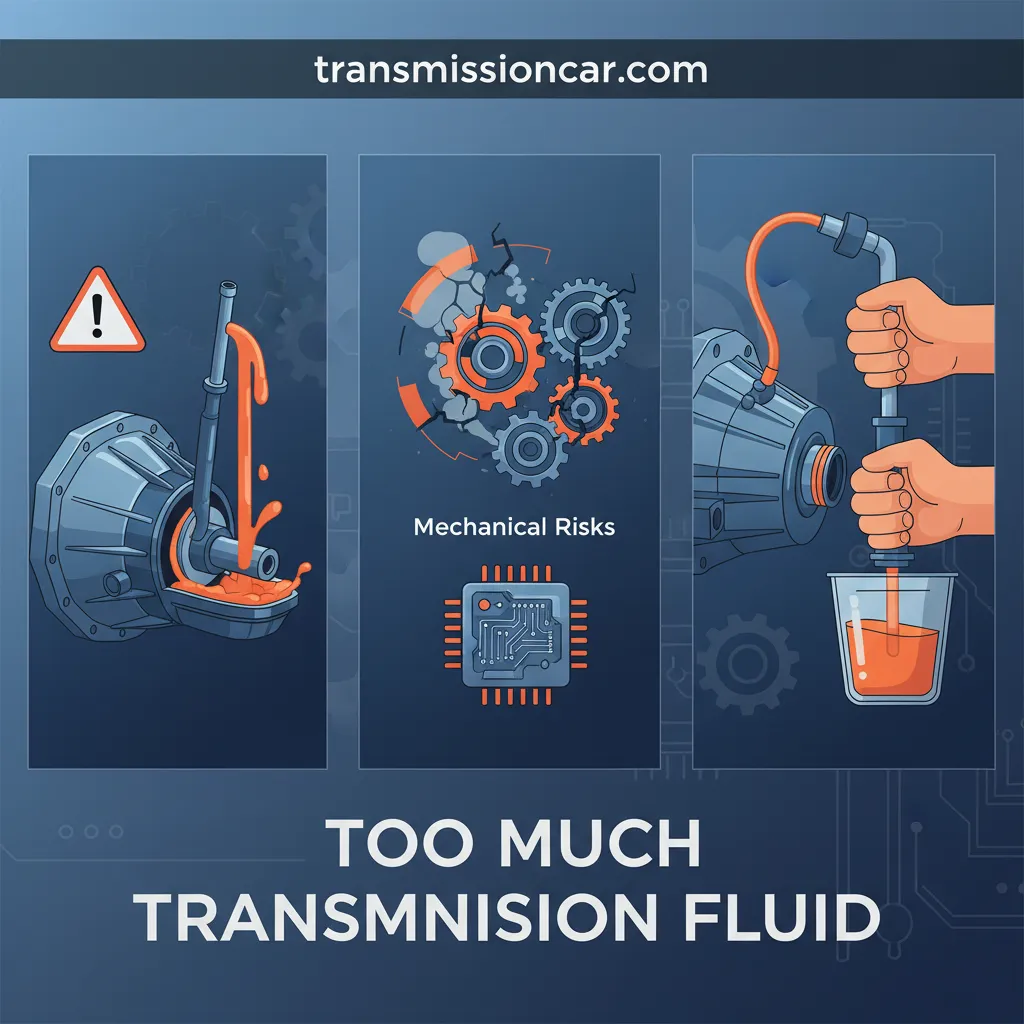
While many vehicle owners focus on the dangers of low fluid levels, having too much transmission fluid can be equally catastrophic for your vehicle’s drivetrain. Overfilling a transmission is a common mistake during routine maintenance that leads to fluid aeration, increased pressure, and internal component damage. This comprehensive guide provides an expert analysis of the symptoms of excess fluid, the mechanical risks involved, and the professional steps required to rectify the level and protect your transmission’s longevity. By understanding the nuances of hydraulic balance, you can avoid the “trusted” DIY pitfalls that lead to multi-thousand-dollar repair bills.
Recognizing the Warning Signs of an Overfilled Transmission
📤 Share Image
Identifying an overfilled condition requires a keen eye for operational shifts and physical anomalies. An automatic transmission relies on precise hydraulic pressures to function; when fluid volume exceeds design parameters, the entire system begins to behave erratically. One of the most prominent signs is erratic shifting patterns. You may experience delayed engagement when moving from Park to Drive, or harsh, “clunking” gear changes. In some scenarios, the vehicle may “hunt” for gears, especially when maintaining speed on a slight incline, as the TCM (Transmission Control Module) struggles to interpret inconsistent hydraulic signals.
The primary culprit behind these symptoms is fluid aeration. As the fluid level rises, it reaches the spinning internal components of the transmission. These parts act like a high-speed whisk, churning the fluid into a froth. If you pull the dipstick and notice pinkish foam or tiny bubbles, you have confirmed an overfill condition. This aerated fluid is no longer a reliable hydraulic medium. Consider a common DIY scenario: a driver adds an extra quart “just to be safe” and soon notices a distinct burnt smell alongside slipping acceleration. This occurs because the foam cannot provide the necessary friction for the clutch packs to grab, causing them to slide and overheat.
Fluid aeration can reduce the cooling capacity of the system by up to 30%. This leads to rapid temperature spikes, often exceeding 220 degrees Fahrenheit, which is the “danger zone” where transmission fluid begins to oxidize and lose its lubricating properties permanently.
External symptoms are equally telling. Excess pressure often forces fluid out of the breather tube or vents, creating a mess on the transmission casing or even the exhaust manifold, resulting in smoke. Furthermore, you may hear unusual noises, such as a high-pitched whining or localized humming. This sound is typically the transmission pump struggling to move the thick, foam-heavy fluid through the narrow passages of the valve body.

The Mechanical Impact of Excess Hydraulic Pressure
To understand why overfilling is dangerous, one must understand the physics of hydraulic systems. Liquids are virtually incompressible, which allows them to transmit force instantly through the valve body to engage gears. Air, however, is highly compressible. When fluid becomes aerated due to overfilling, the hydraulic circuit is compromised. Instead of the fluid moving a shift solenoid with 100% efficiency, the air bubbles compress, causing a soft or delayed shift. This lack of pressure means the clutch plates are not fully clamped, leading to high-friction “slipping” that generates extreme heat.
Furthermore, transmission fluid expands significantly as it reaches operating temperature. Engineering specifications include an “expansion room” or air pocket at the top of the transmission case to accommodate this. When you overfill the unit, you eliminate this safety margin. As the fluid heats and expands, it creates excessive static and dynamic pressure spikes. These spikes are often powerful enough to compromise internal seals and gaskets that were never designed to hold such high PSI levels. Once a seal “weeps” or blows, the transmission loses its ability to hold pressure even after the fluid level is corrected.
By The Numbers
The margin that causes rotating assembly contact in many 8-speeds.
Loss in thermal dissipation efficiency due to foaming.
The torque converter is also at risk. If the fluid volume is too high, it can lead to a condition resembling hydro-locking within the converter’s housing. The increased resistance makes it harder for the engine to spin the turbine, placing unnecessary load on the crankshaft and reducing engine efficiency. In modern 6-speed and 8-speed transmissions, the clearances are so tight that overfilling by as little as one quart can cause the rotating assembly to physically strike the fluid surface, creating a “parasitic drag” that feels like driving with the parking brake partially engaged.

Long-Term Risks to Transmission Longevity
Neglecting an overfilled transmission is a fast track to total mechanical failure. The most insidious long-term risk is the degradation of fluid chemistry. When fluid foams and overheats, it undergoes rapid oxidation. This process changes the chemical structure of the oil, turning it dark, thick, and acidic. This acidic fluid then begins to eat away at the delicate copper and brass components within the transmission, as well as the rubber seals that prevent internal pressure leaks.
Consider the reliability gap between a well-maintained vehicle and one that suffered an overfill. A quality 100,000-mile transmission with regular, professional fluid adjustments should shift like new. Conversely, we frequently see units that suffer catastrophic seal failure at just 40,000 miles because the owner consistently operated the vehicle with an overfilled reservoir. This neglect doesn’t just damage hardware; it affects the electronics. High-pressure fluid can be forced through the internal wiring harness and into external electrical connectors or the Transmission Control Module (TCM), causing phantom sensor codes and electrical shorts that are notoriously difficult to diagnose.
Fuel Efficiency
Properly filled units reduce parasitic drag, saving you up to 2-3% in fuel costs compared to an overfilled, high-resistance system.
Component Protection
Correct levels prevent the $3,500 to $6,000 replacement costs common in modern SUVs and trucks by keeping seals intact.
The financial implications are severe. While a simple extraction might cost less than a tank of gas, a complete rebuild involves pulling the transmission, replacing the friction plates, and swapping out the torque converter. In today’s market, these repairs are rarely under $4,000. Maintaining the professional standard of fluid levels is the single most cost-effective way to ensure your vehicle reaches its maximum life expectancy.
How to Accurately Verify Transmission Fluid Levels
Before you can fix an overfill, you must confirm it using a complete, professional verification process. Guesswork is the enemy of transmission longevity. Fluid can expand in volume by nearly 10% between a cold start-up and full operating temperature, meaning a level that looks “perfect” when cold may be dangerously high once the vehicle has been on the highway for twenty minutes.
📋
Professional Verification Checklist
Park the vehicle on a perfectly level surface. Drive the vehicle until it reaches operating temperature (160-175°F). Never trust a reading on an incline.
While stationary with your foot on the brake, cycle the shifter through P, R, N, and D, holding each for 5 seconds. This ensures the valve body and torque converter are fully primed.
With the engine running, pull the dipstick, wipe it, reinsert it fully, and pull it again. The fluid should be within the ‘HOT’ crosshatch area. Any level above the ‘HOT’ line indicates an overfill.
For vehicles with “sealed” transmissions (no dipstick), the procedure involves a bottom-fill plug. You must remove the check-plug while the engine is running and the fluid is at the specific temperature mentioned above. If fluid streams out of the hole, it was overfilled. If nothing comes out, it is underfilled. This requires a reliable OBD-II scanner to monitor the internal fluid temperature in real-time, as traditional thermometers cannot provide the necessary accuracy.
Professional Procedures for Removing Excess Fluid
Once an overfill is confirmed, the excess must be removed immediately. There are several methods for this, ranging from surgical extraction to more invasive drainage. The most refined and trusted method for minor overfills is using a vacuum-operated extraction pump. By inserting a thin extraction tube down the dipstick hole, you can withdraw fluid in small, measured increments without ever going under the car. This is the cleanest and most controlled approach, allowing you to remove exactly the amount needed.
Professional extraction pumps can remove fluid at a rate of 1.5 liters per minute. However, we recommend extracting only 200-300ml at a time, then re-checking the dipstick. It is far easier to remove a little more than it is to fix an accidental underfill.
If your vehicle lacks a dipstick or is significantly overfilled, you may need to use the cooler return line. By disconnecting the return line at the radiator and briefly running the engine, you can pump fluid out into a graduated container. Alternatively, for transmissions with a traditional pan, you can loosen the pan bolts to let fluid weep out—though this is messy and risks gasket failure. If you choose to use the drain plug, always ensure you have a replacement crush washer on hand and adhere strictly to the manufacturer’s torque specifications. Over-tightening a drain plug into an aluminum transmission case can lead to stripped threads and permanent damage.
✅ Top Methods
- Vacuum extraction via dipstick (Cleanest)
- Drain plug removal (Fastest)
- Cooler line discharge (Complete)
- Check-plug overflow (For sealed units)
❌ Pitfalls
- Draining too much (Underfilling)
- Stripping aluminum threads
- Checking while cold
- Using dirty extraction tools
For sealed units, we strongly recommend a technician’s intervention. These systems require specialized fill adapters and precise temperature monitoring via OBD-II to ensure the level is correct. Regardless of the method, the goal remains the same: restore the hydraulic balance to protect the friction plates and maintain shift quality. Once the level is corrected, perform another “Hot Check” after a brief test drive to confirm the symptoms of aeration have vanished and the system is operating within spec.
In summary, excess transmission fluid leads to aeration, which compromises the hydraulic integrity of the shifting system. Ignoring symptoms like foaming, leaks, or slipping can lead to permanent seal damage and expensive rebuilds. Correcting the fluid level using professional extraction methods is a critical and time-sensitive maintenance task. If you suspect your transmission is overfilled, perform a hot-check on level ground immediately or consult a trusted professional to extract the excess and ensure your vehicle’s reliability. Your transmission’s health depends on precision, not surplus.
Frequently Asked Questions
Can half a quart of extra transmission fluid cause damage?
In most modern vehicles, being overfilled by half a quart is unlikely to cause immediate catastrophic failure, but it reduces the ‘expansion room’ in the case. This can lead to increased internal pressure and minor leaks. However, in smaller, high-precision transmissions, even this small amount can cause the fluid to hit the spinning gears, leading to aeration and foam.
Is it better to check transmission fluid when the engine is hot or cold?
For an accurate reading, you must check the fluid when it is at operating temperature. Transmission fluid expands significantly as it heats up. Checking it cold will result in a false low reading, which often leads owners to overfill the system. Always follow the manufacturer’s specific guidelines, which usually involve idling the engine for 10-15 minutes before checking.
Will excess transmission fluid eventually burn off?
No, transmission fluid does not ‘burn off’ like engine oil. It operates in a closed system. If the level is too high, the only way it leaves is by being forced out of the breather vent or past the seals under high pressure. This usually results in a mess on your driveway or, worse, a fire hazard if it hits the hot exhaust manifold.
What does foamy transmission fluid on the dipstick mean?
Foam indicates that the fluid level is so high that the rotating internal parts are whipping air into the liquid. This is a critical warning sign. Air bubbles are compressible, whereas hydraulic fluid is not. When the fluid foams, the transmission loses the pressure needed to engage clutches and lubricate bearings, leading to rapid wear and gear slipping.
How much does a professional charge to remove excess fluid?
If the vehicle has a dipstick, a professional shop may charge a small fee (typically 0.5 to 1 hour of labor) to extract the fluid using a pump. For sealed transmissions that require lifting the car and using scan tools to monitor temperature, the cost may be higher, ranging from $100 to $200 depending on the vehicle’s complexity.