Where Is the Transmission? How to Locate It in Any Car
📌 Quick Summary The transmission is bolted directly to the engine, typically positioned either behind it or to the side depending on…
The transmission is bolted directly to the engine, typically positioned either behind it or to the side depending on your vehicle’s drivetrain. In front-wheel drive (FWD) cars, it is usually found on the driver’s side of the engine bay, while in rear-wheel drive (RWD) vehicles, it sits centrally behind the engine block.
🎯 Key Takeaways
- Identify the transmission as the large metal component bolted to the engine block.
- Look for the transmission on the driver’s side in most FWD vehicles.
- Locate RWD transmissions underneath the car, extending toward the center console.
- Check near the firewall for the transmission dipstick, often colored red or yellow.
- Spot the ‘bell housing’ as the wide part connecting the transmission to the engine.
In almost every passenger vehicle, you will find the transmission bolted directly to the back or side of the engine block. It acts as the intermediary between your engine’s power and your wheels. To find it, you simply need to follow the engine until you see a large, typically silver or gray metal housing that looks distinct from the engine block itself. If you are looking under the hood, it is usually located lower down than the top of the engine, often tucked toward the firewall or the wheel wells.
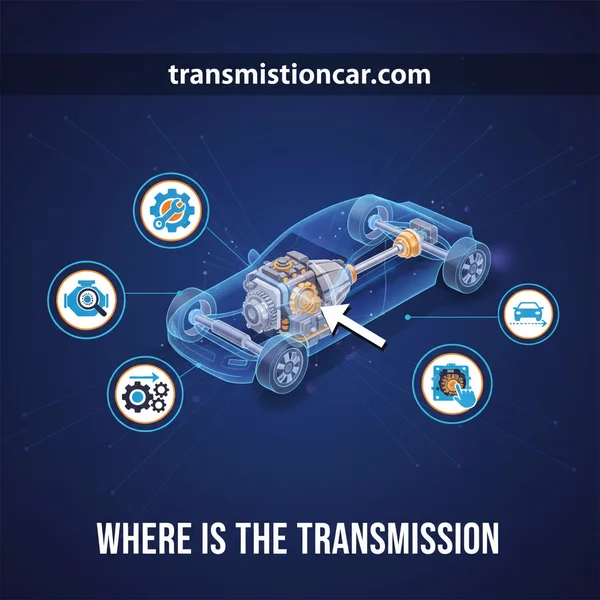
Locating your transmission is a fundamental skill for any vehicle owner. It allows you to perform basic maintenance like checking fluid levels, which can save you thousands of dollars in repair costs. Furthermore, if you ever spot a puddle of red or brown fluid under your car, knowing where the transmission sits helps you determine if that leak is coming from the gearbox or a different system like the cooling or braking system. This knowledge turns a confusing mechanical mystery into a manageable task.
Drivetrain Layouts: FWD vs. RWD Transmission Placement
The easiest way to find your transmission is to determine your car’s drivetrain layout. Most cars on the road today use either Front-Wheel Drive (FWD) or Rear-Wheel Drive (RWD). The orientation of the engine under your hood tells you exactly where the transmission is hiding. If your engine is mounted “sideways” (transverse), your transmission sits to the side. If the engine points from the front of the car toward the back (longitudinal), the transmission is located behind it, stretching toward the cabin.

Front-Wheel Drive (FWD) and Transaxles
In a Front-Wheel Drive vehicle, the transmission and the differential are combined into one unit called a transaxle. Because the engine sits sideways in the engine bay, space is tight. You will typically find the transaxle bolted to the end of the engine, usually on the driver’s side of the vehicle. If you look down past the battery or the air intake box, you will see a large metal casing. To confirm you’ve found it, look for the thick rubber boots of the CV axles; these axles plug directly into the sides of the transaxle to power the front wheels.
- Visual Cue: Look for the engine’s “end.” If the belts are on the passenger side, the transmission is on the driver’s side.
- Access Point: Often easier to see by removing a front wheel or looking through the wheel well.
- Key Components: The transaxle will have two large shafts (axles) protruding from its lower section.
Rear-Wheel Drive (RWD) and 4WD Placement
Rear-Wheel Drive and Four-Wheel Drive vehicles use a longitudinal setup. The engine sits “front-to-back,” and the transmission is bolted to the very rear of the engine block. It sits directly underneath the center of the dashboard and extends back into a “tunnel” in the floor of the car. Because of this, you usually cannot see the bulk of an RWD transmission from the engine bay. Instead, you will see the back of the engine disappear toward the firewall, where the transmission begins.
- Visual Cue: Follow the engine toward the cabin; the transmission is the part located under the center console area.
- Under-Car View: If you slide under the vehicle, the transmission is the large metal component behind the engine that connects to a long, spinning driveshaft.
- 4WD/AWD Note: On 4WD vehicles, a “transfer case” is bolted to the back of the transmission to send power to both ends of the car.
The Ultimate Transmission Location Walkthrough
Locating the transmission in your vehicle is a fundamental skill for any car owner, whether you are planning to check your fluid levels, perform a DIY filter change, or simply understand how your drivetrain operates. The transmission is essentially the gearbox that transfers power from the engine to the wheels, and its physical location varies significantly depending on whether your vehicle is front-wheel drive, rear-wheel drive, or all-wheel drive. This guide will walk you through the process of identifying your vehicle’s layout and pinpointing the exact location of the transmission from both above and below the chassis, ensuring you can perform maintenance safely and accurately.
Step 1: Determine Your Vehicle’s Drivetrain Layout
What you need: Your vehicle’s owner’s manual or a quick Google search of your specific make and model.
Instructions: Before you even pop the hood, you need to know how your engine is oriented. If you have a Front-Wheel Drive (FWD) car, the engine is likely mounted “transversely,” meaning it sits sideways across the engine bay. In this setup, the transmission is technically a “transaxle” and is located on one side of the engine. If you have a Rear-Wheel Drive (RWD) vehicle or a truck, the engine is usually “longitudinal,” sitting front-to-back. Here, the transmission sits directly behind the engine, extending toward the middle of the vehicle. All-Wheel Drive (AWD) vehicles typically follow the RWD layout but include extra components like a transfer case. Understanding this layout immediately tells you which direction to look when searching for the gearbox.
Pro Tip: Look at your accessory belts; if the belts are facing the side of the car (usually the passenger side), you have a transverse engine, and the transmission will be on the opposite side (the driver’s side).
Step 2: Open the Hood and Locate the Transmission Dipstick
What you need: A flashlight and a clean rag.
Instructions: For vehicles equipped with an automatic transmission and a dipstick (though many modern “sealed” units lack one), this is the easiest way to find the unit from above. Pop the hood and look for a handle that is usually colored bright red, yellow, or sometimes has a gear symbol on it. On RWD vehicles, the dipstick is almost always located at the very back of the engine bay, near the firewall (the metal wall separating the engine from the cabin). In FWD vehicles, look to the side of the engine block—usually the driver’s side. The tube for this dipstick leads directly down into the transmission casing, providing a physical “map” to the unit’s location.
Pro Tip: Do not confuse the transmission dipstick with the engine oil dipstick, which is usually located closer to the front or center of the engine and is often colored yellow or orange.
Step 3: Identify the Bell Housing Connection
What you need: A high-lumen flashlight.
Instructions: The transmission is always bolted to the engine. To find it, first locate the engine block (the largest metal component under the hood). Follow the engine toward the rear of the car (for RWD) or toward the driver’s side (for FWD) until you see a large, bell-shaped metal casting. This is called the “bell housing.” It bridges the gap between the engine and the gears of the transmission. The bell housing contains the torque converter (for automatics) or the clutch and flywheel (for manuals). Once you have spotted this large circular flare where the two massive metal components meet, you have successfully located the front of the transmission.
Pro Tip: Look for a ring of large bolts (usually 14mm to 19mm) that encircle this housing; these are the “bell housing bolts” that keep the drivetrain together.
Step 4: Locate the Transmission from Underneath (RWD/4WD)
What you need: Jack stands, a floor jack, or vehicle ramps, and safety glasses.
Instructions: Safely lift the front of the vehicle and secure it on stands. Slide underneath the vehicle starting from the front bumper. Move past the engine’s oil pan (the lowest part of the engine). Directly behind the engine oil pan, you will see the transmission. In a RWD vehicle, it is a long, cylindrical metal component that runs down the “tunnel” in the center of the car’s underbody. It ends where it connects to the driveshaft—a long, rotating metal tube that heads toward the rear wheels. The transmission will be supported by a metal “crossmember,” which is a heavy-duty beam bolted to the frame of the car to hold the gearbox’s weight.
Pro Tip: If you see a secondary smaller gearbox attached to the back of the transmission with two driveshafts coming out of it, you have found the transfer case, which is specific to 4WD/AWD vehicles.
Step 5: Identify the Transaxle in FWD Vehicles
What you need: Flashlight and safety glasses.
Instructions: In FWD cars, looking from underneath is slightly different. Instead of a long tube running toward the back of the car, the transmission (transaxle) is a bulky, somewhat square-shaped metal housing located to the left or right of the engine. You can confirm its location by looking for the CV axles—thick, black rubber-booted shafts that go from the center of the wheels directly into the sides of the transmission. If you follow the axles inward from the wheels, they will lead you straight to the transmission output seals. This unit sits roughly between the front wheels and is much more compact than a RWD transmission.
Pro Tip: FWD transmissions are almost always on the driver’s side of the engine bay to balance the weight of the engine, which is often slightly offset to the passenger side.
Step 6: Locate the Transmission Fluid Pan and Drain Plug
What you need: A creeper (optional) and a shop light.
Instructions: Once you are under the car and have identified the main transmission body, look at the very bottom of the unit. You will see a flat metal pan, usually held on by 10 to 20 small bolts. This is the transmission fluid pan. This is where the fluid is stored and where the filter resides. Many pans feature a drain plug (similar to an oil drain plug) which is the primary access point for fluid changes. Note that on some modern European cars (like BMW or ZF-equipped vehicles), this pan might be made of heavy-duty black plastic rather than steel. Identifying this pan is crucial because it is the most common area for leaks and the primary spot for routine maintenance.
Pro Tip: Be careful not to confuse the transmission pan with the engine oil pan; the transmission pan is usually further back and often has a more rectangular or irregular shape compared to the engine’s pan.
Step 7: Confirm Using the VIN or Service Manual
What you need: Your Vehicle Identification Number (VIN) and a smartphone or computer.
Instructions: If your engine bay is particularly cramped or has plastic “beauty covers” obscuring your view, use your VIN to look up a parts diagram online. The VIN is located on a plate on the driver’s side dashboard (visible through the windshield) or on the door jamb sticker. By entering this into an OEM parts website, you can see an “exploded view” diagram of your drivetrain. This will show you exactly what the transmission looks like and where the fill and drain plugs are located. This step is vital for “sealed” transmissions where there is no dipstick, as it will show you the “level check” plug located on the side of the transmission case rather than the top.
Pro Tip: Many manufacturers provide “Component Location” maps in the back of the owner’s manual in the technical specifications section.
✅ Final Checklist
- Verified engine orientation (transverse for FWD, longitudinal for RWD).
- Identified the bell housing where the engine meets the transmission.
- Located the transmission dipstick tube or the side-fill plug for fluid checks.
- Confirmed the location of the transmission pan and checked for any active leaks.
- Identified the output point (driveshaft for RWD or CV axles for FWD).
Important Notes:
- Safety Warning: Never work under a vehicle supported only by a hydraulic jack; always use rated jack stands. Ensure the engine is cool before touching transmission components, as they can reach temperatures over 200°F.
- Professional Help: If you cannot find a dipstick, your car likely has a “sealed” transmission. Checking fluid levels on these often requires a scan tool to monitor fluid temperature, and you should seek professional help if you aren’t comfortable with this level of complexity.
- Estimated Time: 15–30 minutes to locate and identify all components.
- Cost: $0 (DIY identification).
Identifying the Transmission Housing and Bell Housing
Once you know the general area to look, you need to identify the physical characteristics of the transmission. Most transmissions are encased in heavy-duty cast aluminum. This metal often has a slightly rough, “pebbled” texture and may have structural ribs cast into the surface to provide extra strength and heat dissipation. Unlike the engine, which is often covered in plastic shields, sensors, and wires, the transmission housing looks like a solid, industrial piece of machinery.
Spotting the Bell Housing
The “Bell Housing” is the most recognizable part of the transmission. It is the flared, cone-shaped section at the very front of the transmission that “claps” onto the back of the engine. It is named for its resemblance to a church bell. This section houses the torque converter (in automatics) or the clutch and flywheel (in manuals). If you follow the engine block toward the rear or side, look for the point where the metal flares out wide to meet the engine; that is your definitive starting point for the transmission.
- The Connection: You will see a circle of large bolts securing the bell housing to the engine’s “mating surface.”
- Inspection Port: Many bell housings have a small plastic or rubber plug at the bottom that can be removed to inspect the internal components.
Finding the Dipstick and Fill Points
While the bulk of the transmission is low in the chassis, many manufacturers provide access points from the top. In older vehicles and many modern trucks, you will find a transmission dipstick. This is often located near the firewall (the back of the engine bay). It is typically colored red, pink, or yellow to distinguish it from the engine oil dipstick, which is usually yellow or orange and located closer to the front of the engine.
- No Dipstick? Many modern “sealed” transmissions do not have a dipstick. In these cases, the “fill point” is a bolt (plug) located on the side of the transmission housing itself.
- The Dipstick Tube: If your car has one, the tube leads directly down into the transmission pan. Following this tube is the fastest way to trace the location of the unit from the top down.
- Manual Transmissions: These almost never have dipsticks. You will find a fill plug on the side of the housing that requires a wrench to open.
Visual Indicators: Locating the Dipstick and Fill Ports
If you are struggling to spot the heavy metal casing of the transmission directly, you can often find it by tracing the “access points” used for fluid maintenance. Most older vehicles and many modern trucks feature a dedicated transmission dipstick, which serves as a direct guide to the unit tucked below the engine components.
Identifying the Transmission Dipstick
In a Rear-Wheel Drive (RWD) vehicle, the dipstick is almost always located near the back of the engine bay, positioned very close to the firewall. In Front-Wheel Drive (FWD) cars, it is usually tucked to one side of the engine block, often closer to the driver’s side. Unlike the engine oil dipstick, which commonly features a yellow or black ring, the transmission dipstick has its own unique markers:
- Color Coding: Many manufacturers use bright red, pink, or orange handles to distinguish the transmission fluid from engine oil or coolant.
- Extended Length: Transmission dipsticks are typically much longer than oil dipsticks because they must reach deep into the transmission pan at the very bottom of the drivetrain.
- Specific Labels: Look closely at the handle or the top of the tube; you will often see text etched into the plastic such as “Trans,” “ATF,” or “Fluid Level.”
What If There Is No Dipstick?
Many modern vehicles now utilize “sealed” transmissions to prevent contamination. In these cases, you will not find a dipstick under the hood at all. Instead, the visual indicator is a fill plug or a check plug located on the side of the transmission housing itself. These appear as large, standalone bolts that often look different from the bolts holding the casing together. If you see a thick rubber hose or a plastic cap labeled “Transmission” but no pull-handle, your car likely uses one of these sealed systems common in brands like BMW, Ford, and Toyota.
External Differences Between Automatic and Manual Transmissions
While both types of transmissions reside in the same general area—bolted to the back of the engine—they have distinct physical characteristics. Knowing these differences can help you identify exactly what you are looking at when you peer under the chassis.
Spotting an Automatic Transmission
Automatic transmissions are generally bulkier and more complex in their external design than manual versions. Because they rely heavily on hydraulic pressure and temperature regulation, they have several tell-tale features:
- The Transmission Pan: Almost all automatic units have a large, flat metal pan on the bottom held on by a dozen or more bolts. This is where the fluid collects.
- Cooling Lines: You will notice two narrow metal or rubber lines exiting the transmission and running toward the front of the car, connecting to the radiator or a dedicated oil cooler.
- Electrical Harnesses: Modern automatics are “fly-by-wire,” meaning they are covered in sensors and thick bundles of wires that plug into the casing to manage gear shifts electronically.
Identifying a Manual Transmission
Manual transmissions are significantly more compact and “cleaner” in appearance. They do not require the massive cooling systems or large fluid reservoirs that automatics do. Key identifiers for a manual unit include:
- The Clutch Slave Cylinder: Look for a small hydraulic cylinder attached to the side of the bell housing (the wide part near the engine) with a thin fluid line running to it.
- External Shift Linkage: You will likely see metal rods or thick, heavy-duty cables connecting the gear shifter inside the cabin to the top or side of the transmission housing.
- Solid Housing: Manuals usually feature a solid, one-piece cast aluminum housing. Unlike an automatic, there is typically no removable bottom pan; instead, there are simple drain and fill plugs.
Conclusion
Locating your transmission is the first step toward better vehicle maintenance and faster troubleshooting. Whether you drive a compact Front-Wheel Drive car with a transaxle or a heavy-duty truck with a massive longitudinal gearbox, the secret is simply knowing where the engine ends and the drivetrain begins. By identifying visual cues like colored dipsticks, cooling lines, and the specific shape of the metal housing, you can confidently navigate your engine bay like a pro.
Your next step should be to consult your owner’s manual to confirm the specific fluid requirements for your vehicle. It is also a great idea to occasionally peek under your car for any signs of red or brown fluid leaks. Taking a few minutes to get familiar with your transmission now can save you a lot of stress—and money—down the road. Happy hunting, and keep your gears turning smoothly!
💬 Quick Questions & Answers
Is the transmission in the front or back of the car?
In most modern vehicles, the transmission is located in the front, bolted directly to the engine block.
Where is the transmission in a FWD car?
It is usually tucked to the side of the engine, often on the driver’s side, and is called a transaxle.
Can I see the transmission from under the hood?
Yes, you can usually see the top of the housing or the dipstick located toward the back of the engine bay.
Where is the transmission on a RWD truck?
It is located directly behind the engine and sits under the hump in the floor of the cabin.
Is the transmission the same thing as the transaxle?
A transaxle is a specific type of transmission that incorporates the differential, common in front-wheel-drive cars.
❓ Frequently Asked Questions
How do I distinguish the transmission from the engine block?
The engine is the primary block where the spark plugs and oil cap are located; the transmission is the large, secondary metal housing bolted to it. You can identify the junction point by the wide, flared ‘bell housing’ that joins the two components together.
Why is the transmission location different in AWD vehicles?
All-wheel-drive vehicles often have a transmission connected to a transfer case. This setup is generally located centrally behind the engine but includes additional output shafts that send power to both the front and rear wheels.
How can I find the transmission fluid dipstick?
Search for a handle, typically colored red or yellow, located deeper in the engine bay than the engine oil dipstick. Note that many modern ‘sealed’ transmissions do not have a dipstick and must be checked via a plug underneath.
Where is the transmission located in a mid-engine or rear-engine car?
In these specialized layouts, the transmission is located behind the engine at the rear of the vehicle. It is typically positioned between or just behind the rear wheels to facilitate direct power delivery.
What does the transmission housing look like from underneath the car?
From below, it appears as a large, often ribbed aluminum or iron case. In RWD cars, it connects to a long driveshaft, while in FWD cars, two shorter axles (half-shafts) will emerge from its sides to power the wheels.
How do I tell if I’m looking at a manual or automatic transmission?
Automatic transmissions are usually larger and feature a flat fluid pan on the bottom with many bolts. Manual transmissions are more compact, lack a bottom pan, and will have a visible clutch linkage or slave cylinder attached to the exterior.