Where Is The Transmission In A Car: Locating The Gearbox Across Different Vehicle Layouts
While every driver interacts with their gear shifter daily, few can pinpoint the exact physical location of the complex machinery that actually…
While every driver interacts with their gear shifter daily, few can pinpoint the exact physical location of the complex machinery that actually moves the vehicle. Locating the transmission can be difficult for the average owner because its position varies significantly based on whether a car is front-wheel, rear-wheel, or all-wheel drive. Understanding where this component sits is not merely an academic exercise; it is essential for checking fluid levels, identifying leaks, and performing basic maintenance. This comprehensive guide provides an expert breakdown of transmission placement, offering professional tips to help you locate this critical component for maintenance and troubleshooting regardless of your vehicle’s layout.
Understanding the Fundamental Location of the Transmission Relative to the Engine
📤 Share Image
In the world of automotive engineering, the transmission and the engine form a unified power plant known as the drivetrain. For any internal combustion vehicle to function, the transmission must be physically bolted to the rear of the engine block via a bell housing. This flared, bell-shaped portion of the transmission case contains the critical interface between the two units: the torque converter in automatic vehicles or the clutch assembly in manual versions. This connection is not just structural; it is the primary point of power transfer where the engine’s crankshaft output drives the transmission’s input shaft.
When you open the hood of a modern passenger vehicle, you may not immediately see the transmission. It is typically positioned lower in the chassis than the engine’s intake manifold and is frequently obscured by peripheral components such as the air filter box, battery tray, or coolant reservoir. To identify it, look for a large, cast-aluminum housing. This housing usually features a lighter, silvery-grey color that contrasts with the darker cast iron or plastic covers found on the engine block. In a standard inline-four engine configuration, the engine occupies the front-most part of the bay, while the transmission extends toward the passenger compartment (the “firewall”).
Professional technicians look for the “split line” where the engine block meets the transmission. The bell housing bolts—typically ranging from 14mm to 19mm in size—are the most reliable visual indicator of where the engine ends and the gearbox begins. These bolts must withstand several hundred pound-feet of torque to maintain precise alignment between the crankshaft and input shaft.
Locating Transmissions in Front-Wheel Drive vs Rear-Wheel Drive Configurations
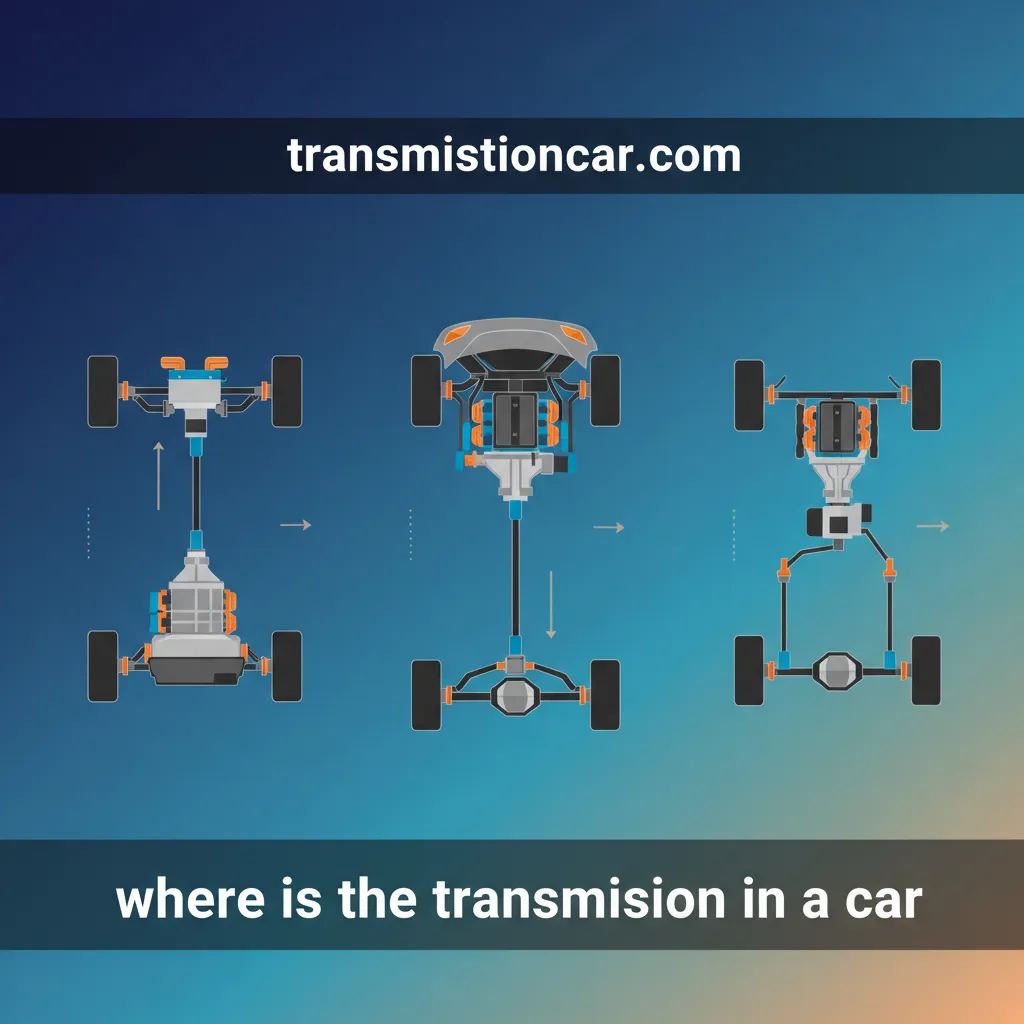
The drive layout of your vehicle dictates the orientation of the engine and, consequently, the location of the gearbox. Approximately 70% of modern passenger cars utilize a Front-Wheel Drive (FWD) layout. In these vehicles, the engine is mounted “transversely,” meaning it sits sideways across the engine bay. The transmission in a FWD car is actually a transaxle, a single unit that combines the transmission gears and the differential. To find the transaxle, look to the side of the engine—usually the driver’s side in North American vehicles—and follow the thick rubber boots of the CV axles that lead directly to the front wheels.
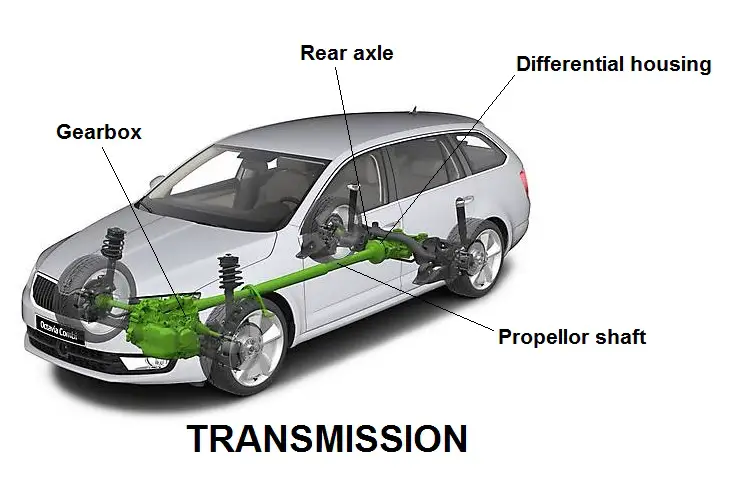
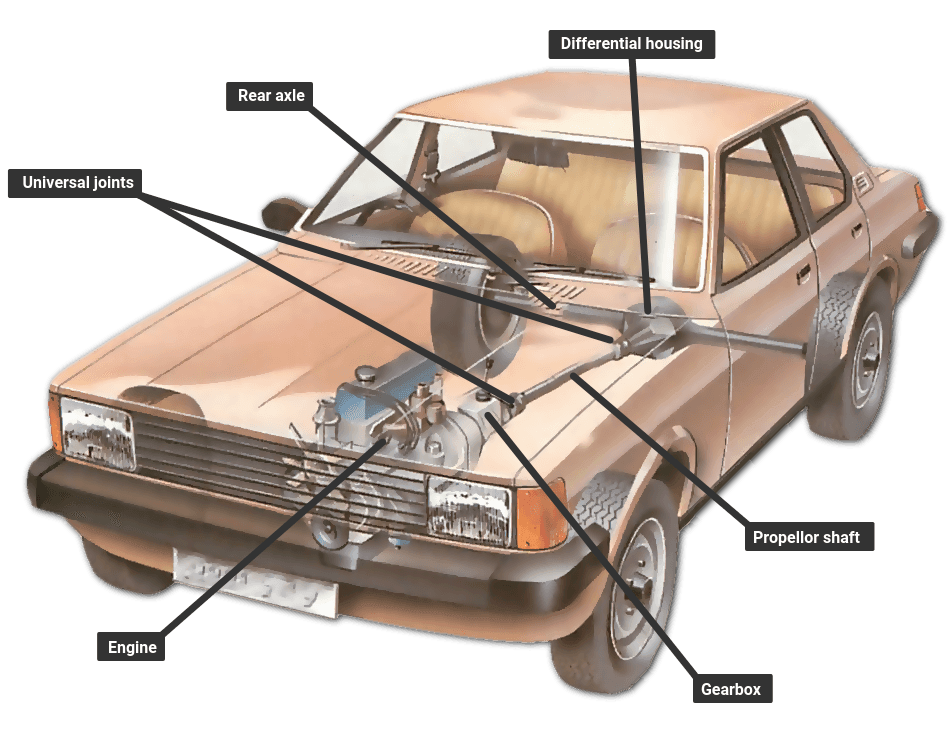
Conversely, Rear-Wheel Drive (RWD) vehicles, such as the Ford Mustang or most full-size pickup trucks, utilize a “longitudinal” mount. Here, the engine sits front-to-back, with the belts facing the radiator and the transmission extending directly underneath the vehicle’s center console. The transmission occupies the transmission tunnel, which is the structural hump running down the middle of the vehicle’s interior floor pan. This layout allows for a larger, more robust gearbox and easier access for certain repairs, though it consumes more interior cabin space.
An expert way to quickly identify the layout is to look at the engine’s accessory belts. If the belts and pulleys face the passenger side fender (sideways), it is a FWD transaxle setup. If the belts face the front radiator (parallel with the frame rails), it is almost certainly a RWD longitudinal setup. This distinction is vital for any quality diagnostic work.
Identifying Transmission Components in Four-Wheel Drive and All-Wheel Drive Systems
In Four-Wheel Drive (4WD) and All-Wheel Drive (AWD) systems, the drivetrain complexity increases significantly. The transmission remains in its standard position (bolted to the engine), but it is immediately followed by a transfer case. This secondary gearbox is bolted to the rear output shaft of the main transmission. Its role is to split the torque and send it to both the front and rear axles. In a Jeep Wrangler or a large truck, you can see the transfer case protruding from the back of the transmission, with two separate driveshafts exiting from it.
AWD vehicles, particularly those from brands like Subaru, feature a unique symmetrical layout. In a Subaru Outback, the engine and transmission are perfectly centered along the vehicle’s longitudinal axis. This creates a balanced distribution of weight and power but can make the transmission harder to access from the sides. For most AWD SUVs, locating the gearbox requires looking past the front axle. You will often find the transmission partially protected by metal or plastic skid plates, which are designed to shield the gearbox and transfer case from off-road debris. Removing these shields is often a necessary first step for a complete inspection.
By The Numbers: AWD Drivetrains
Added weight of transfer case
Driveshafts exiting the unit
Standard power split ratio
Visual Cues and Access Points for Reliable Identification
If you are attempting to locate the transmission for a reliable fluid check or to identify the source of a leak, there are several professional visual cues you can follow. The most straightforward method is to look for the transmission fluid dipstick. In older or heavy-duty vehicles, this dipstick is often color-coded—usually red, yellow, or pink—and is situated further back toward the firewall than the engine oil dipstick. However, be aware that over 80% of vehicles manufactured after 2015 utilize “sealed” transmissions that lack a traditional top-side dipstick. For these, you must locate the fill or check plug on the side of the transmission casing from underneath the vehicle.
📋
Step-by-Step Guide to Locating Your Gearbox
Trace the two metal or reinforced rubber hoses leading from the bottom or side of the radiator. These are the transmission cooling lines that carry hot fluid to the heat exchanger and back to the gearbox.
Locate the thick cable or metal rod assembly that moves when an assistant shifts gears inside the cabin. This linkage attaches directly to the transmission’s gear selector valve on the side of the housing.
From underneath, look for the flat fluid pan. Unlike the engine oil pan, which is often small and rounded, the transmission pan is usually square or rectangular and held by 12 to 20 small bolts (usually 10mm).
In a practical scenario, imagine a DIYer trying to locate the transmission in a Honda Accord. By identifying the red-handled dipstick near the radiator fan, they can trace the tube down to the large aluminum transaxle housing. This visual confirmation allows them to distinguish the transmission from the engine block, ensuring they don’t accidentally drain the wrong fluid during a trusted service interval.
Never assume a “sealed” transmission is maintenance-free. While they lack a dipstick, they still have fill and drain plugs. Attempting to service these without the proper expert knowledge or a fluid pump can lead to catastrophic transmission failure if the fluid level is not set precisely at the correct temperature.
The Evolution of Gearbox Placement in Hybrid and Electric Vehicles
As the automotive industry shifts toward electrification, the traditional concept of a “transmission” is being redefined. In many Battery Electric Vehicles (BEVs), such as the Tesla Model 3, there is no multi-speed transmission at all. Instead, a single-speed reduction gear is integrated directly into the electric motor housing. In rear-motor Tesla models, this unit is located within the rear subframe, completely absent from the traditional under-hood area. These reduction gears typically utilize a fixed 9:1 ratio to translate the high RPM of the electric motor into usable wheel torque.
Hybrid vehicles, such as the Toyota Prius, utilize a more complex arrangement known as an eCVT (electronic Continuously Variable Transmission). This unit is a power-split device located between the gasoline engine and the electric traction motors. It essentially replaces the traditional gearbox with a planetary gear set that blends power from multiple sources. For professional diagnostics, these units are often integrated into the vehicle’s high-voltage cooling system. Identifying them requires extreme caution, as they are surrounded by orange high-voltage cables that present a significant safety risk to untrained individuals.
✅ Pros of Modern Placement
- Lower center of gravity for EVs
- Space-saving “pancake” designs
- Reduced mechanical complexity
- Integration with motor cooling
❌ Cons of Modern Placement
- Extremely difficult DIY access
- High-voltage safety hazards
- Often requires “unit replacement”
- Specialized diagnostic software needed
Regardless of whether you are looking at a classic RWD muscle car or a cutting-edge EV, the transmission remains the “brain” of the drivetrain. Knowing its location—whether in the transmission tunnel, as a sideways transaxle, or integrated into an electric drive unit—is the first step in becoming a more informed and professional vehicle owner.
Final Summary and Recommendations
Locating the transmission in a car is a foundational skill for automotive maintenance. To recap the expert findings: transmissions are always directly coupled to the engine, but their orientation (transverse vs. longitudinal) depends entirely on the drive system. FWD vehicles house the transmission as a side-mounted transaxle, while RWD and 4WD vehicles place it centrally under the chassis. Identification can be performed reliably using fluid dipsticks, cooling lines, or by locating the bell housing beneath the vehicle. If you are attempting to locate your transmission for fluid service, always consult your owner’s manual for specific dipstick locations or seek a trusted professional for sealed-unit inspections to avoid costly errors.
Frequently Asked Questions
Can I see my transmission by just opening the hood?
In most front-wheel-drive cars, you can see the top of the transmission (transaxle) by looking down past the engine, usually on the driver’s side. In rear-wheel-drive cars, the transmission is tucked further back under the dashboard area and floor pan, making it difficult to see without looking from underneath the vehicle or removing plastic engine covers.
What does a transmission look like from under the car?
From beneath the vehicle, the transmission appears as a large, heavy, ribbed aluminum housing. It is bolted to the back of the engine. In RWD cars, it is long and cylindrical, extending toward the back. In FWD cars, it is a more compact, boxy unit (the transaxle) located to one side of the engine block.
Where is the transmission fluid dipstick located?
If your vehicle has one, the transmission dipstick is usually located further back in the engine bay than the oil dipstick and often features a brightly colored handle (typically red or yellow). Note that many modern cars feature ‘sealed’ transmissions, meaning they do not have a dipstick and must be checked via a plug on the transmission casing itself.
Is the transmission located in the same place in an automatic vs. a manual?
Yes, the general mounting location remains the same for both automatic and manual gearboxes. Both must be bolted to the engine’s output to receive power. The primary difference is internal; however, an automatic transmission is generally larger and heavier, often featuring a prominent cooling pan at the bottom, whereas a manual transmission has a more streamlined, solid casing.
How do I find the transmission in a mid-engine or rear-engine car?
In mid-engine cars (like a Porsche Cayman) or rear-engine cars (like a Porsche 911), the transmission is located behind the passenger compartment. It is typically positioned behind or integrated with the rear axle. In these configurations, the ‘front’ of the transmission faces the front of the car, contrary to standard front-engine layouts.