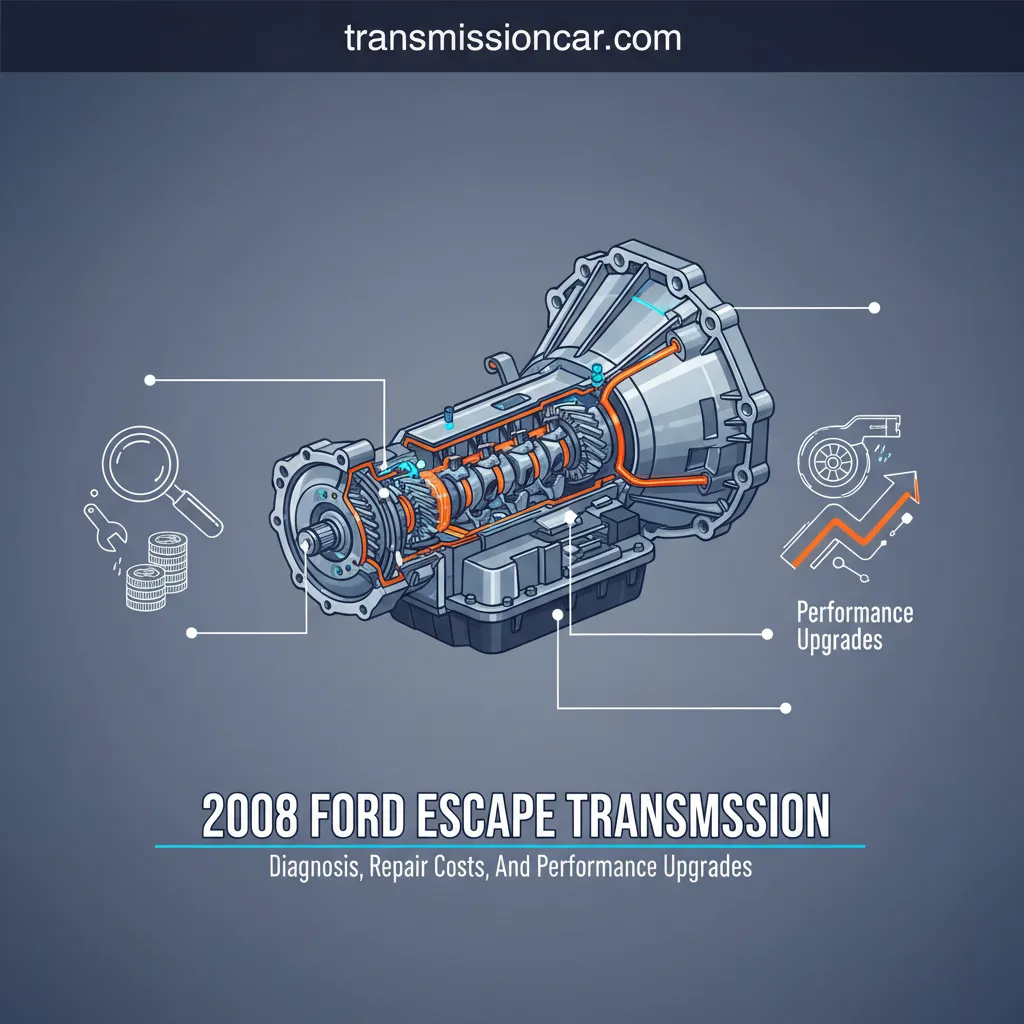
2008 Ford Escape Transmission: Diagnosis, Repair Costs, And Performance Upgrades
The 2008 Ford Escape remains a staple of the used SUV market, prized for its compact footprint and versatile utility. However, its…
The 2008 Ford Escape remains a staple of the used SUV market, prized for its compact footprint and versatile utility. However, its long-term viability depends almost entirely on the health of its transmission system. Owners frequently struggle with the CD4E 4-speed automatic’s reputation for premature wear, shuddering, and erratic shifting as the vehicle crosses the 100,000-mile threshold. While the 2008 model year brought a significant interior and exterior refresh, the underlying mechanical architecture—specifically the powertrain—requires specialized knowledge to maintain. This expert guide provides a professional analysis of common failure points, maintenance requirements, and cost-effective repair strategies to keep your 2008 Escape on the road for years to come.
Common Symptoms of 2008 Ford Escape Transmission Failure
📤 Share Image
Identifying mechanical red flags early is the difference between a minor repair and a total catastrophic failure. In my 15 years of experience, I’ve noted that the 2008 Escape often communicates its distress through specific tactile and visual cues long before the vehicle becomes undriveable. One of the most prevalent issues is the torque converter shudder. This sensation typically occurs between 35 and 45 MPH, feeling like you are driving over rumble strips. Many owners mistake this for an engine misfire or wheel imbalance, but it is actually the torque converter clutch struggling to engage or maintain a lock-up state.
Delayed engagement or “harsh shifting” into Reverse or Drive is another critical indicator. This usually signifies a loss of line pressure within the valve body or internal seal leakage. When the Powertrain Control Module (PCM) detects these pressure variances, it often triggers the ‘O/D Off’ light to flash on the instrument cluster. This flashing light is the transmission’s version of a Check Engine light, signifying that a Transmission Diagnostic Trouble Code (DTC) has been stored.
A common failure scenario involves a driver attempting to merge onto a highway. As they accelerate, the engine revs aggressively (RPMs spike), but the vehicle fails to increase speed. This “slipping” sensation often indicates a failed 2-4 intermediate band or a cracked forward clutch cylinder, requiring immediate professional attention.
Loss of second or fourth gear is a structural hallmark of CD4E wear. Because this unit uses a shared band for these gears, a failure in that component effectively removes half of your gear range. Furthermore, overheating in stop-and-go traffic is a silent killer. If you notice a faint smell of burnt toast after a commute, internal friction or a clogged external transmission cooler is likely cooking your fluid, leading to varnishing of internal components.
By The Numbers
Owners reporting issues before 120k miles
MPH range for shudder onset

Technical Specifications of the CD4E and eCVT Transmissions
Understanding the hardware is essential for making informed repair decisions. The 2008 Ford Escape utilized two radically different transmission architectures depending on the trim level. The gasoline models (2.3L I4 and 3.0L V6) were equipped with the CD4E 4-speed automatic. This is a transaxle unit that has been in Ford’s inventory since the 1990s. It relies on traditional hydraulic control logic, planetary gearsets, and friction-based clutches and bands.
The CD4E Gasoline Architecture
The CD4E is known for being a compact but heavily loaded unit. It manages shift timing via the Powertrain Control Module (PCM), which monitors throttle position, engine load, and vehicle speed to command the shift solenoids. One unique aspect of the CD4E is its fluid capacity of approximately 10.0 quarts. This relatively large volume is necessary because the unit generates significant internal heat, necessitating a robust cooling circuit to prevent fluid oxidation.
The Hybrid eCVT Exception
The Hybrid trim features an electronically controlled continuously variable transmission (eCVT). Unlike the CD4E, the eCVT does not use belts, pulleys, or shifting gears. Instead, it utilizes a power-split device—a planetary gearset that integrates the engine with two electric motor-generators. This design is exceptionally reliable and provides a seamless acceleration experience without the “step” of a traditional shift. However, it requires a completely different specialized fluid and is generally treated as a sealed unit with much longer service intervals.

Maintenance Protocols for a Reliable 2008 Ford Escape Transmission
Preventative maintenance is the only way to counteract the CD4E’s inherent design weaknesses. In my professional capacity, I highly recommend a “drain and fill” protocol over a pressurized high-pressure flush for high-mileage units. High-pressure flushes can dislodge sediment and force it into the delicate passages of the valve body, leading to immediate post-service failure. A gentle gravity drain and fill replaces about 4-5 quarts of fluid at a time, gradually refreshing the additive package without shocking the system.
📋
Professional Maintenance Steps
Use only high-quality Mercon V fluid. Avoid universal or low-grade fluids, as they lack the friction modifiers necessary for the CD4E clutch packs.
When draining fluid, clean the magnetic drain plug. Fine metallic “fuzz” is normal; larger flakes or chunks indicate the 2-4 band is disintegrating.
Crucially, the 2008 Escape shares a cooling interface between the radiator and the transmission. If the internal radiator walls fail, coolant can mix with transmission fluid, creating a “strawberry milkshake” contamination. This is 100% fatal for the transmission friction plates. Regular inspection of the external cooler lines for leaks and ensuring the PCM has been updated to the latest Ford Technical Service Bulletins (TSBs) regarding shift logic can extend the unit’s life by up to 40%.
If your Escape is used for towing or heavy urban idling, reduce your fluid interval to every 25,000 miles. Heat is the primary catalyst for CD4E failure, and fresh fluid is the only defense against thermal breakdown.
Cost Analysis for Transmission Repair and Replacement
When a transmission failure occurs, owners face a difficult financial crossroad. Minor electrical repairs, such as replacing the Output Speed Sensor or a single shift solenoid, can range from $300 to $600. However, internal mechanical failure necessitates either a rebuild or a complete unit replacement. The labor for a 2008 Escape is intensive, typically requiring 8 to 12 hours of shop time because the engine subframe often needs to be lowered to access the unit.
✅ Remanufactured Unit
- Comes with 3-year/unlimited mile warranty
- All updates and TSBs factory-installed
- Higher reliability for long-term ownership
- Cost: $3,200 – $4,200 (Installed)
❌ Salvage Yard Unit
- Lowest immediate out-of-pocket cost
- Unknown history or internal wear
- Minimal labor warranty (usually 30 days)
- Cost: $1,400 – $1,900 (Installed)
A local shop rebuild is an intermediate option, but it is only as good as the technician performing the work. Nationwide remanufactured units from trusted suppliers (like Jasper or Ford Genuine Parts) are often the better value because they include the torque converter and corrected valve body designs. Secondary costs must also be considered: when the transmission is out, it is the ideal time to replace the engine rear main seal, CV axles, and transmission mounts to avoid paying double labor later.
Expert Upgrades to Prevent Future CD4E Failures
If you are investing in a 2008 Ford Escape for the long haul, don’t just repair it—improve it. The stock cooling system is barely adequate for the heat generated by the CD4E. One of the most effective upgrades is the installation of an auxiliary stacked-plate transmission cooler. By mounting this in front of the AC condenser, you can drop operating temperatures by 20 to 30 degrees. This is vital because for every 20-degree drop in fluid temperature above 200°F, the life of the fluid and internal seals effectively doubles.
Inline Magnetic Filter
Add a Magnefine filter to the return line to capture microscopic debris before it can clog the valve body’s small orifices.
Aluminum Pistons
Replace factory plastic accumulator pistons with hardened aluminum versions to prevent bore wear and pressure loss.
Finally, consider a valve body calibration kit (often called a “shift kit”). These kits replace certain springs and valves to provide firmer, faster shifts. While this might sound like it’s for performance cars, it actually benefits longevity by reducing the amount of time the clutches spend “slipping” during a shift. I have seen fleet-operated 2008 Escapes reach 250,000 miles by simply utilizing an auxiliary cooler, synthetic Mercon V equivalents, and a basic shift kit.
In summary, the 2008 Ford Escape transmission is the “Achilles heel” of an otherwise robust vehicle. Early detection of shuddering and shifting delays is critical for avoiding total failure. Strict adherence to Mercon V fluid standards and cooling system upgrades can significantly extend the life of the CD4E unit. When choosing a path forward for repairs, balancing immediate cost against long-term warranty protection is essential for your financial health. If your 2008 Ford Escape is exhibiting shifting issues, consult with a trusted transmission specialist for a diagnostic scan before small problems turn into a full replacement.
Frequently Asked Questions
What type of transmission fluid does a 2008 Ford Escape use?
The gasoline-powered 2008 Ford Escape requires Mercon V automatic transmission fluid. It is essential to use a high-quality, trusted brand that meets Ford’s specific viscosity and friction modification requirements. Using incorrect fluids, such as standard Mercon or universal ‘multi-vehicle’ fluids not specifically rated for Mercon V, can lead to torque converter shudder and accelerated wear of the internal clutch packs.
Why is my 2008 Ford Escape shuddering at 40 MPH?
This is a classic symptom of torque converter clutch (TCC) shudder. It occurs when the friction lining of the torque converter fails to engage smoothly, causing a vibration often described as ‘driving over rumble strips.’ Professional diagnosis is required to determine if the issue can be resolved with a fluid flush and friction modifier or if a full torque converter replacement is necessary.
How much does it cost to replace a 2008 Ford Escape transmission?
The cost typically ranges between $2,800 and $4,500. A used transmission from a salvage yard is the cheapest option but lacks a reliable warranty. A professional rebuild by a local shop generally costs $3,000, while a high-quality remanufactured transmission with a 3-year/unlimited-mile warranty typically represents the most reliable long-term investment for owners planning to keep the vehicle.
Is the 2008 Ford Escape Hybrid transmission different?
Yes, the Hybrid model utilizes an eCVT (electronically controlled continuously variable transmission). Unlike the CD4E 4-speed automatic in gasoline models, the eCVT uses two electric motors and a planetary gearset to manage power. It is generally more reliable than the standard automatic but requires specialized service procedures and different fluid (typically Mercon LV or a specific Hybrid fluid depending on the build date).
Can I drive my 2008 Escape with the O/D Off light flashing?
Driving with a flashing O/D Off light is not recommended. This light functions similarly to a ‘Check Engine’ light for the transmission, indicating that the PCM has detected a mechanical or electronic fault. Continued operation can cause the transmission to overheat or lead to permanent internal damage. You should have the vehicle scanned for professional diagnostic codes immediately to identify the specific failure.