
How to Choose a Tire Inflator for SUV Owners

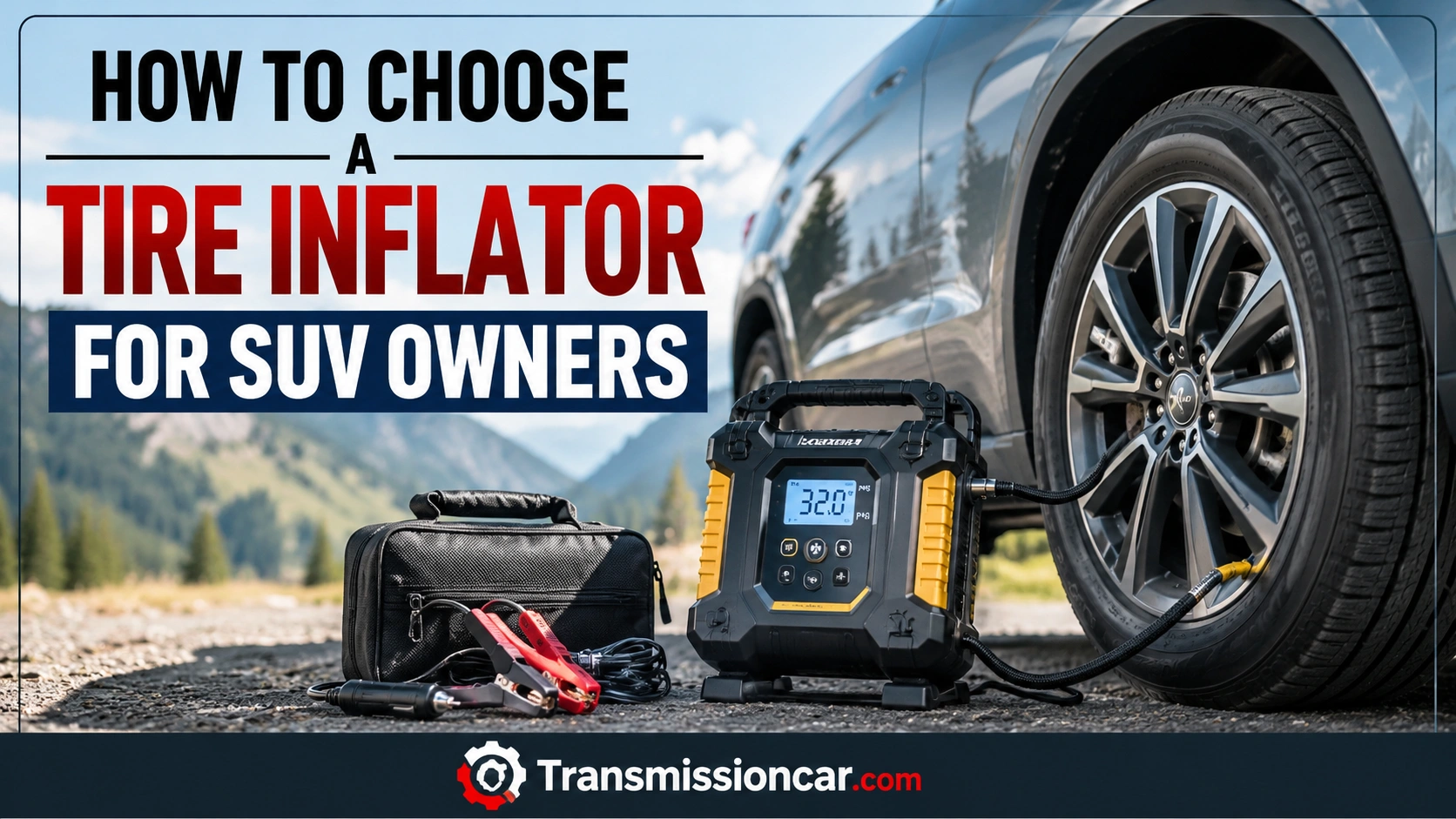
SUV tires hold more air than typical passenger-car tires. That means a small inflator that works well for a compact sedan may take too long, overheat, or shut down before finishing an SUV tire.
Learning how to choose a tire inflator for SUV use can help you avoid buying an underpowered unit. The right inflator should match your tire size, power source, driving habits, and expected emergency use. This guide explains the specifications that matter, the features worth paying for, common buying mistakes, and when tire or transmission symptoms require professional attention.
Quick Answer
To choose a tire inflator for an SUV, prioritize strong airflow, a suitable duty cycle, accurate pressure readings, a long hose and power cord, and reliable thermal protection. Match the inflator to your SUV’s tire size and intended use. Do not choose one based only on its advertised maximum PSI.
Why SUVs Need a More Capable Tire Inflator
An SUV tire generally has a larger internal air volume than a small passenger-car tire. Filling that larger space requires more airflow and may keep the compressor running longer.
The challenge becomes greater when your SUV has:
- Large factory wheels and tires
- All-terrain or off-road tires
- Three rows of seating and heavier loads
- A trailer or cargo carrier
- Oversized aftermarket tires
- A full-size spare tire
- Tires that are regularly aired down for off-road driving
A lightweight emergency inflator may be acceptable for topping up a slightly low tire. However, it may struggle to reinflate a large tire from a very low pressure.
The best SUV tire inflator is not always the model with the highest pressure rating. It is the model that can move enough air without overheating.
Understand Your SUV’s Tire Requirements First
Before comparing inflators, inspect your SUV and identify what the compressor will need to handle.
Find the Correct Tire Pressure
Look for the Tire and Loading Information label on the driver’s doorjamb. It lists the vehicle manufacturer’s recommended cold tire pressure for the original tire size.
The NHTSA TireWise guidance recommends checking tire pressure when the tires are cold, generally before driving or after the vehicle has been parked for several hours. It also explains that the recommended pressure is found on the door label or in the owner’s manual—not simply on the tire sidewall. (NHTSA)
Do not inflate an SUV tire to the maximum number molded into the sidewall. That number identifies a tire limit under specified conditions. It is not automatically the correct operating pressure for your vehicle.
Check the Tire Size
Read the size printed on the tire sidewall. It may look similar to:
- 225/65R17
- 235/60R18
- 265/70R17
- 275/55R20
The first number represents tire width in millimeters. The other numbers describe the sidewall profile and wheel diameter.
You do not need to calculate the exact tire volume. Use the size to compare your SUV with the inflator manufacturer’s stated vehicle and tire compatibility.
A product described only as suitable for “cars, bicycles, and sports equipment” may not be ideal for a full-size SUV. Look for clear references to SUVs, light trucks, or larger tires.
Decide How You Will Use the Inflator
Your intended use determines how much performance you need.
A compact model may be enough if you only want to:
- Add two or three PSI during monthly checks
- Carry an emergency backup
- Maintain a compact crossover with standard tires
Choose a stronger inflator if you expect to:
- Fill a significantly low tire
- Inflate several tires during one session
- Maintain a large three-row or full-size SUV
- Air tires down and reinflate them off-road
- Tow regularly
- Use the inflator in very hot weather
- Inflate a full-size spare
Tire Inflator Features That Matter Most
1. Airflow and Real Inflation Time
Airflow tells you how quickly the compressor can move air. It may be listed in liters per minute, cubic feet per minute, or simply demonstrated through an inflation-time test.
For an SUV, airflow is usually more useful than maximum PSI.
A compressor may advertise a very high pressure limit but still fill a large SUV tire slowly. Pressure capacity tells you what the unit may eventually reach. It does not tell you how quickly it will get there.
When comparing products, look for:
- Tested inflation time on an SUV-sized tire
- Inflation from a low starting pressure, not just a small top-up
- Reviews mentioning repeated use on large tires
- Performance tests completed without overheating
- Clear tire-size limitations from the manufacturer
Be cautious when a product gives only a maximum PSI number without explaining inflation time or supported tire size.
2. Duty Cycle
Duty cycle describes how long an inflator can operate before it needs to cool.
A short-duty-cycle unit may run for several minutes and then require a long cooling period. That can be frustrating when more than one SUV tire needs air.
For occasional pressure adjustments, a shorter duty cycle may be acceptable. For off-road recovery, towing, or multi-tire use, prioritize a longer operating period.
Check the manual for:
- Maximum continuous running time
- Required cooling time
- Ambient temperature limitations
- Automatic thermal shutdown
- Instructions for inflating multiple tires
Never cover an inflator while it is operating. Compressors create heat and need ventilation.
3. Power Source
SUV tire inflators generally use a 12-volt outlet, direct battery connection, rechargeable battery, household outlet, or a combination of these.
| Power source | Best use | Advantages | Limitations |
|---|---|---|---|
| 12-volt accessory outlet | Emergency top-ups | Simple and widely compatible | Vehicle outlet may limit available power |
| Direct battery clamps | Larger SUV tires | Supports stronger compressors | Requires opening the hood and correct polarity |
| Rechargeable battery | Routine maintenance | Cordless and convenient | Battery can discharge during storage |
| Household AC power | Garage use | Reliable for home maintenance | Cannot be used roadside without another power source |
| Dual-power design | Mixed home and travel use | Flexible and practical | Usually larger and more expensive |
Before buying a 12-volt model, check your SUV owner’s manual for the outlet’s fuse rating and operating instructions. Some power outlets switch off when the ignition is off.
For a higher-output inflator, direct battery clamps are often more appropriate than a dashboard accessory plug. Follow the inflator manufacturer’s connection sequence carefully.
4. Gauge Accuracy
An inflator’s built-in gauge should provide a stable, easy-to-read measurement. Digital displays are convenient, especially at night, but display precision does not guarantee real-world accuracy.
Useful features include:
- Pressure shown in PSI, kPa, and bar
- A bright display
- Readings that remain visible after the motor stops
- Small adjustment increments
- Automatic shutoff at a selected pressure
Keep a separate quality tire-pressure gauge in your SUV. Compare it with the inflator periodically.
A slight difference between gauges is common. A large or inconsistent difference suggests the inflator should not be trusted as the only measuring tool.
5. Automatic Shutoff
Automatic shutoff allows you to enter a target pressure. The inflator stops when it reaches that setting.
This feature is especially helpful for vehicle owners who are uncomfortable estimating pressure manually. It also reduces the chance of accidentally adding too much air.
However, do not walk away while the inflator is running. Stay nearby and verify the final pressure with a separate gauge.
6. Hose and Power-Cord Length
SUVs are taller and longer than many passenger cars. A short hose or power cord may not reach the rear tire comfortably from the available power source.
Check whether the inflator can reach:
- Both front tires
- Both rear tires
- A rear-mounted spare
- An underbody spare
- A trailer tire, when applicable
A longer air hose improves reach, but it should also be thick enough to avoid excessive heat and pressure loss.
7. Valve Connector Design
The connector attaches the air hose to the tire valve stem.
Common designs include:
- Screw-on connectors
- Clamp-on chucks
- Locking lever chucks
- Push-on connectors
A screw-on fitting usually creates a secure seal, although removing it can release a small amount of air. A locking chuck is faster but must fit tightly.
Choose a design that is easy to operate with cold, wet, or gloved hands.
8. Heat Protection and Build Quality
Portable compressors can become extremely hot during operation. Better units usually provide clearer cooling instructions and protection against overheating.
Look for:
- Thermal overload protection
- A ventilated housing
- Heat-resistant hose sections
- A protected fuse
- Secure cord storage
- Rubber feet that reduce movement
- A stable carrying handle
- Replaceable accessories when available
A heavier inflator is not automatically better. However, an extremely light housing combined with vague specifications may indicate limited internal components.
Choosing an Inflator for Different SUV Uses

Compact Crossovers
A compact 12-volt or cordless inflator can work well for a small crossover with standard road tires.
Prioritize:
- Convenient storage
- Automatic shutoff
- A reliable digital gauge
- Enough cord length for all four wheels
- A backup 12-volt power option
A battery-only model is convenient, but remember to recharge it periodically.
Midsize and Three-Row SUVs
Midsize SUVs need a better balance of portability and sustained performance.
Look for:
- Verified SUV compatibility
- Stronger airflow
- A reasonable continuous run time
- Thermal protection
- A stable base
- A long hose
- Dual-power operation when possible
This category is often the best match for families taking road trips or carrying passengers and luggage.
Full-Size SUVs and Large Tires
A full-size SUV can overwhelm small handheld compressors, particularly when a tire is significantly low.
A direct-to-battery inflator may be a better choice. It can support a larger motor without depending on the vehicle’s accessory outlet.
Choose a model that provides:
- Clear large-tire compatibility
- Strong airflow
- A longer duty cycle
- Heavy-duty clamps
- A replaceable inline fuse
- A thick power cable
- A durable hose and chuck
Off-Road SUVs
Off-road drivers often reduce tire pressure for traction and then reinflate before returning to pavement. This is much more demanding than adding a small amount of air.
An off-road inflator should handle all four tires during one session. Speed, cooling ability, hose reach, and continuous operation become more important than compact size.
Do not drive at highway speed with tires still set to an off-road pressure. Restore them to the vehicle or tire manufacturer’s appropriate road-use recommendation first.
SUVs Used for Towing
Towing may require pressure adjustments based on the vehicle manufacturer’s instructions, tire specifications, axle load, and trailer requirements.
Do not guess. Review the SUV owner’s manual, trailer tire information, and load labels.
The inflator should also be capable of reaching the trailer tires. In some cases, a separate hose extension or higher-pressure capability may be needed.
Cost, Quality, and Durability Considerations
The least expensive inflator can be adequate for occasional top-ups. However, a low purchase price offers little value if the compressor cannot complete one large tire without overheating.
Consider total value rather than price alone:
- Does the manufacturer state supported tire sizes?
- Are replacement fuses included?
- Is the hose permanently attached?
- Is the warranty clear?
- Are operating and cooling limits explained?
- Can the battery be replaced?
- Does the storage case protect the gauge and fittings?
- Are customer-support details available?
Cordless units provide convenience, but their batteries age. A corded inflator is less convenient to carry around the vehicle but may remain dependable during long-term storage.
The Consumer Reports evaluation of cordless tire inflators also highlights practical differences such as connector design, automatic pressure settings, and ease of use. (Consumer Reports)
Expert Tip:
Test your new inflator at home before depending on it during a roadside emergency. Confirm that its cord reaches every tire, its connector seals properly, and its gauge agrees with a separate pressure gauge.
How to Test an SUV Tire Inflator After Buying It
Do not leave a new inflator unopened in the cargo area. A roadside emergency is the wrong time to discover a missing adapter, blown fuse, short cable, or discharged battery.
1. Read the Instructions
Find the maximum run time, cooling period, approved power source, and inflation procedure.
2. Check the SUV’s Cold Tire Pressure
Use the driver’s door label or owner’s manual. Do not use the sidewall maximum as your target.
3. Compare Gauges
Measure one cold tire with a separate gauge. Connect the inflator without adding air and compare the readings.
4. Perform a Small Top-Up
Add a few PSI while timing the process. Listen for unusual rattling, struggling, or sudden speed changes.
5. Check Heat Buildup
The hose fitting and compressor may become warm. Stop immediately if you smell burning insulation, see smoke, or notice melting plastic.
6. Test Every Tire Position
Confirm that the cable and hose reach all four tires and the spare. Make sure cords do not need to be stretched tightly.
7. Store It Securely
Keep the unit in a dry, protected area where it will not become a loose projectile during sudden braking.
Store it with:
- A separate pressure gauge
- Work gloves
- A flashlight
- Spare fuses
- The instruction manual
- Charging cable or battery
- Valve adapters
- A reflective warning triangle
Warning Signs an Inflator Is Not Suitable

Stop using the unit if you notice:
- Frequent thermal shutdowns during minor top-ups
- A burning smell
- Smoke or melted wiring
- A power plug that becomes unusually hot
- A fuse that repeatedly blows
- Large pressure differences between the inflator and a separate gauge
- A hose that leaks near the fitting
- A connector that will not stay attached
- Sudden motor-speed changes
- Cracked battery clamps or exposed wire
- A rechargeable battery that swells or overheats
Do not install a larger fuse to prevent repeated blowing. A fuse protects the circuit. A higher-rated replacement may allow the wiring to overheat.
Safe Tire Inflation Practices
Check all tires when they are cold, including the spare. NHTSA advises monthly pressure checks because a tire-pressure monitoring system may not alert the driver until a tire is already significantly underinflated. (NHTSA)
Follow these safety rules:
- Park on a stable surface away from traffic.
- Apply the parking brake.
- Keep the engine and moving parts clear of cables.
- Do not operate the inflator in standing water.
- Do not touch hot metal fittings immediately after use.
- Never exceed the compressor’s run-time limit.
- Recheck pressure after removing the hose.
- Replace the valve cap.
- Investigate repeated pressure loss.
Proper pressure also affects operating cost. The U.S. Department of Energy’s fuel-saving guidance notes that underinflation can reduce fuel economy as pressure falls below the recommended level. (The Department of Energy’s Energy.gov)
Common Mistakes Vehicle Owners Should Avoid
- Buying by maximum PSI alone: High pressure capability does not guarantee fast SUV-tire inflation.
- Ignoring tire size: A unit suited to small car tires may struggle with a full-size SUV.
- Using the sidewall number as the target: Follow the doorjamb label or owner’s manual.
- Depending entirely on TPMS: The warning system is not a replacement for regular pressure checks.
- Ignoring duty cycle: Continuous operation beyond the stated limit can damage the compressor.
- Leaving a cordless unit discharged: Recharge it according to the manufacturer’s storage schedule.
- Stretching cables tightly: Tension can damage the connector or pull the inflator over.
- Running the compressor unattended: Stay close enough to stop it if it overheats or malfunctions.
- Assuming added air repairs a puncture: Inflation may restore pressure temporarily, but it does not remove the cause of the leak.
- Using tire sealant without checking compatibility: Some sealants may complicate tire repair or affect pressure-monitoring components.
- Failing to test the spare: SUV spare tires may use a different pressure from the road tires.
- Storing loose equipment: Secure the inflator so it cannot move around the cargo area.
When to Call a Tire or Transmission Professional
A tire inflator is a maintenance and emergency tool. It cannot repair structural tire damage, wheel damage, or a serious air leak.
Call a tire professional when:
- One tire repeatedly loses pressure
- You can see a nail, screw, cut, or bulge
- The sidewall is damaged
- The wheel is bent or cracked
- The tire will not hold air
- The valve stem leaks
- The tire has been driven while nearly flat
- The TPMS warning remains on after correct inflation
Stop driving if a tire is visibly damaged or cannot maintain safe pressure. Roadside assistance is safer than trying to repeatedly refill a failing tire.
A tire-pressure problem can also make an SUV feel sluggish, pull to one side, or respond differently. However, adding air will not repair a drivetrain fault.
Contact a transmission professional when correct tire pressure does not resolve symptoms such as:
- Delayed engagement into Drive or Reverse
- Slipping during acceleration
- Harsh or repeated gear changes
- Transmission-fluid leakage
- Grinding, whining, or clunking from the drivetrain
- A transmission-temperature warning
- A check-engine light combined with shifting problems
- Loss of movement despite increasing engine speed
A qualified shop can scan the vehicle, inspect fluid condition, test pressures, and determine whether the problem comes from the transmission, transfer case, differential, wheel-speed sensors, or another system.
FAQs
What size tire inflator do I need for an SUV?
Choose a unit that specifically lists compatibility with your SUV’s tire size. For a compact crossover, a quality 12-volt or cordless model may be sufficient. Full-size, off-road, and large-tire SUVs usually need stronger airflow and a longer duty cycle.
Is a 12-volt tire inflator powerful enough for an SUV?
It can be, especially for routine top-ups. Confirm that the inflator is approved for SUV tires and that its current requirements do not exceed the rating of your vehicle’s power outlet.
Is maximum PSI important when choosing an inflator?
It matters, but it should not be the main deciding factor. Most SUV owners benefit more from adequate airflow, dependable cooling, an accurate gauge, and proven inflation time.
Should I choose a cordless or corded inflator?
Cordless models are convenient for regular maintenance. Corded models are often more dependable for long-term emergency storage because they do not rely on a charged internal battery. A dual-power model provides the most flexibility.
Can a portable inflator fill a completely flat SUV tire?
Some can, but the tire must first be inspected. A completely flat tire may have sidewall damage, a failed valve, a large puncture, or a broken bead seal. Adding air does not make a damaged tire safe.
How often should I check SUV tire pressure?
Check it at least once a month and before long trips, towing, or carrying heavy loads. Measure when the tires are cold and include the spare tire.
Can I leave a tire inflator in my SUV year-round?
Yes, provided the manufacturer permits storage in the temperatures your vehicle may experience. Protect it from moisture, secure it in the cargo area, and periodically inspect cords, hoses, fuses, and battery condition.
Conclusion
Understanding how to choose a tire inflator for SUV use begins with your tire size and intended use. Look beyond maximum PSI and compare airflow, inflation time, duty cycle, power connection, hose reach, gauge accuracy, and heat protection.
A compact inflator may be suitable for occasional top-ups on a crossover. Larger SUVs, towing vehicles, and off-road tires usually require a more capable compressor.
Before relying on any inflator, test it at home, compare its gauge with a separate pressure gauge, and confirm it can reach every tire. Choose a model that can safely complete the work—not simply the smallest or least expensive unit available.
