
How to Choose Tire Inflator for Truck: A Practical Buyer’s Guide

A truck tire can lose pressure before work, during towing, or far from a service station. The wrong inflator may overheat, blow a fuse, or take too long to fill a large tire.
This guide explains how to choose tire inflator for truck use by matching airflow, pressure capacity, duty cycle, power source, hose reach, gauge quality, and durability to your truck.
Quick Answer
To choose a tire inflator for a truck, match it to your tire size and required cold pressure. Prioritize strong airflow, a useful duty cycle, direct-battery power for larger tires, an accurate gauge, and enough hose to reach every wheel. Do not choose by maximum PSI alone.
Why Truck Tires Need a More Capable Inflator
Truck tires generally hold more air than passenger-car tires. Light-truck tires, towing setups, and oversized off-road tires may also need higher pressure or longer inflation times.
A suitable truck inflator should:
- Reach the pressure required for your truck and load.
- Move enough air to fill a large tire in a reasonable time.
- Run long enough without overheating.
Maximum PSI is only one specification. Airflow and duty cycle often matter more.
1. Check Your Tire Size and Required Pressure
Start with the Tire and Loading Information label on the driver-side door jamb or the owner’s manual. The NHTSA TireWise guidance says to use the vehicle manufacturer’s listed pressure, not the maximum pressure molded into the tire sidewall. (NHTSA)
Record:
- Front and rear cold pressure
- Tire size
- Whether the truck uses P-metric or LT tires
- Spare-tire pressure
- Any approved pressure change for towing or heavy loads
“Cold” pressure means the tires have not heated up from extended driving. Pressure normally rises as tires warm.
Maximum PSI Does Not Equal Fast Inflation
An inflator’s maximum PSI shows the highest pressure it can theoretically produce. It does not show how quickly it can move air into a large truck tire.
Two inflators may both claim 150 PSI, yet one may fill an LT tire much faster. Compare airflow and runtime instead of relying on the largest number printed on the box.
2. Prioritize Airflow
Airflow is usually measured in CFM, or cubic feet per minute. More airflow generally means faster filling, especially for large tires.
Look for airflow measured at a stated pressure. A “free-flow” rating measured at zero PSI may not represent performance at 50, 65, or 80 PSI because airflow usually falls as pressure increases.
| Truck use | Features to prioritize | Suitable inflator style |
|---|---|---|
| Compact or midsize pickup | Moderate airflow, compact storage, accurate gauge | Quality 12-volt or cordless inflator |
| Full-size pickup with LT tires | Strong airflow, battery clamps, longer duty cycle | Heavy-duty portable compressor |
| Heavy-duty pickup used for towing | High-pressure performance, long hose, heat protection | Direct-battery compressor |
| Off-road truck with large tires | High airflow and extended runtime | Dual-cylinder or onboard-air system |
| Commercial truck | Commercial-rated equipment and load-based procedures | Fleet or service compressor |
This is a selection guide. Always follow the compressor manufacturer’s tire-size and operating limits.
3. Choose the Right Power Source
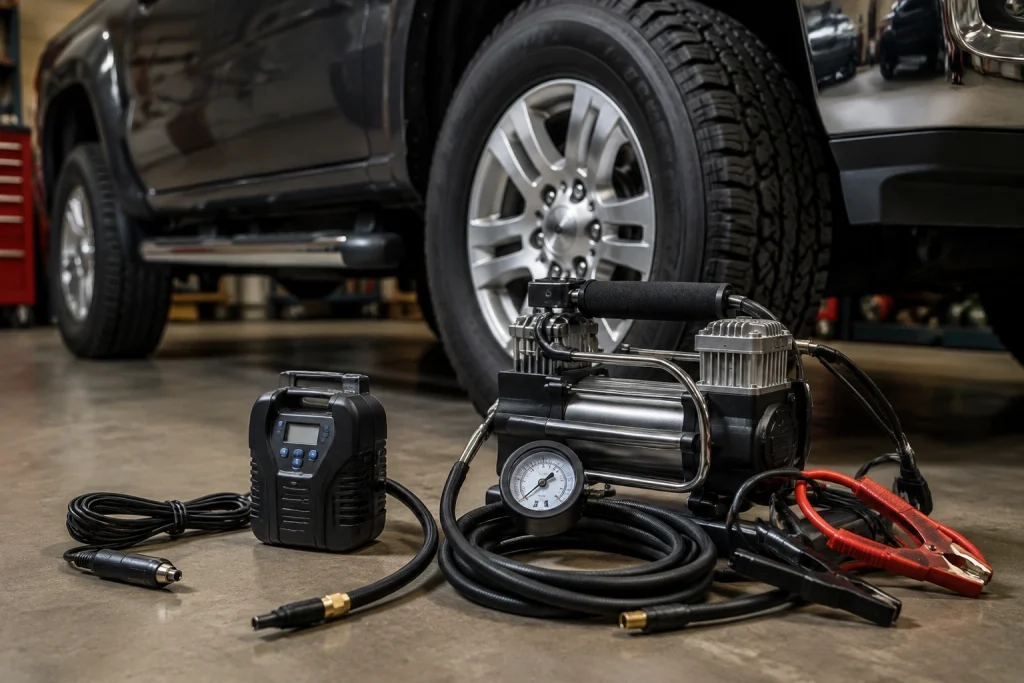
12-Volt Accessory-Socket Inflator
This type plugs into the truck’s interior outlet. It is convenient for routine top-offs and stock tires, but the outlet and fuse limit current.
Check the inflator’s amperage against the outlet rating. A high-draw unit can blow the fuse or overheat the plug.
Direct-Battery Inflator
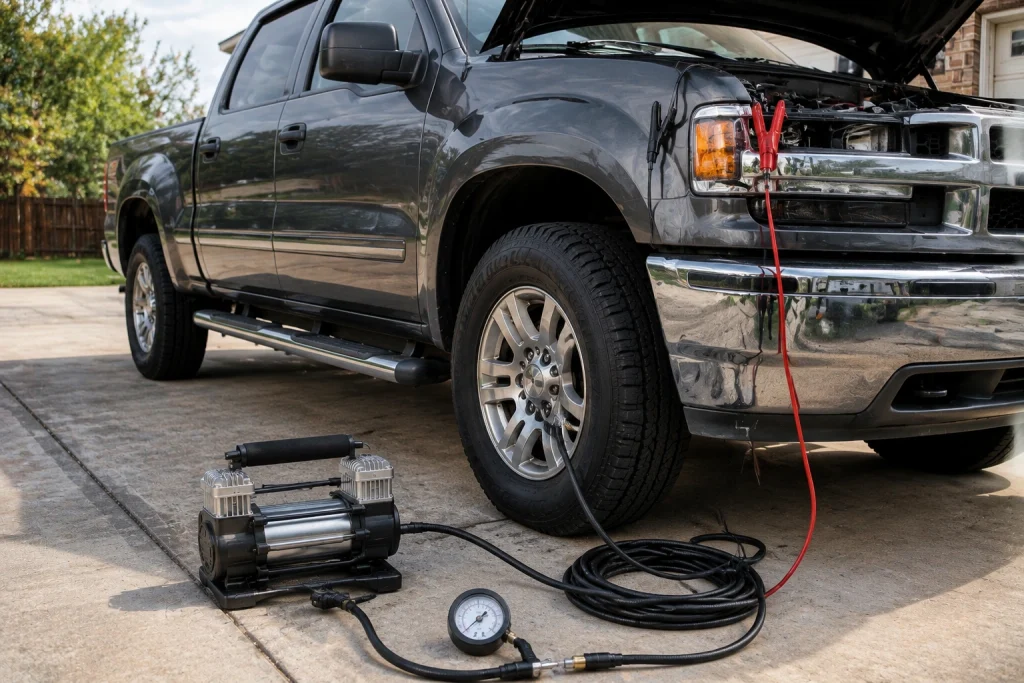
This compressor connects to the battery with clamps. It can draw more current and is usually better for full-size pickups, LT tires, towing vehicles, and oversized tires.
Look for thick cables, an inline fuse, clear clamp markings, thermal protection, and enough cable length. Keep the hose and wires away from belts, fans, and hot exhaust parts.
Cordless Inflator
Cordless models are convenient for small adjustments. Confirm the recommended battery capacity, estimated fill time, number of tires per charge, and whether a 12-volt backup cord is included.
A cordless inflator is useful for top-offs, but a direct-battery compressor is often more dependable for major pressure corrections.
Onboard Air
An onboard system suits frequent off-road use, work trucks, and air-spring adjustments. It offers convenience but costs more and requires safe wiring, protected air lines, and secure mounting.
4. Check the Duty Cycle
Duty cycle tells you how long a compressor can run before it must cool. A low-duty-cycle unit may handle a 3-PSI top-off but shut down while reinflating four large tires.
Manufacturers may describe duty cycle as a percentage or as minutes on and off. Check the pressure and temperature used for the rating. Hot roadside conditions can shorten practical runtime.
For towing, large tires, or repeated inflation, choose the longest realistic duty cycle you can afford and store.
5. Evaluate the Hose, Chuck, and Gauge
Hose and Cable Reach
Measure from the compressor’s intended position to the farthest valve stem. A crew-cab long-bed or dual-rear-wheel truck may require an extension hose.
Do not choose a setup that forces you to stretch the hose tightly or place the compressor near moving or hot engine parts.
Air Chuck
Screw-on chucks usually seal well. Clip-on and locking chucks attach faster but must grip securely. The chuck should not leak or require constant hand pressure.
Gauge Accuracy
A built-in gauge is useful, but compare it with a separate quality gauge. A bleeder valve is also helpful when you add too much air.
6. Look for Safety and Durability Features
Compressed air stores significant energy. Tire or wheel failure can cause serious injury, especially with damaged rims or commercial wheel assemblies. OSHA’s tire-servicing safety standard addresses overinflation, component failure, and safe positioning during inflation. (OSHA)
Useful features include:
- Thermal overload protection
- Inline fuse
- Heat-resistant hose near the compressor
- Stable rubber feet
- Protected gauge and fittings
- Replaceable hose, chuck, or fuse
- Clear cooling instructions
Do not inflate a tire with exposed cords, a large sidewall bulge, bead damage, a cracked wheel, or signs it was driven while flat. Have it professionally inspected.
Expert Tip: Test the inflator at home. Lower one cool tire by about 5 PSI, time the refill, compare gauges, and confirm that the cables and hose reach every wheel and the spare.
7. Match the Inflator to Your Use
Daily Driving
For stock tires and occasional top-offs, a quality compact inflator may be enough. Prioritize easy storage, auto shutoff, a clear display, and reliable gauge accuracy.
Towing and Heavy Loads
Towing increases the importance of correct pressure because tires carry more load and generate heat. Check the truck manual, door placard, trailer label, and approved tire-load information.
The FMCSA commercial tire safety guidance explains the relationship among pressure, axle load, speed, heat, and tire failure risk. The same basic lesson helps personal tow-vehicle owners: use approved pressures and do not guess. (FMCSA)
Choose a compressor that can service both the truck and trailer tires without overheating.
Off-Road Driving
Drivers who air down for trail traction must replace much more air before highway driving. Prioritize high airflow, long duty cycle, hose reach, dust-resistant construction, and clean storage.
Commercial Use
A consumer inflator should not be the primary tool for repeated commercial tire service. Use commercial-rated equipment, load-specific pressure data, trained personnel, and written procedures.
8. Compare Cost and Long-Term Value
A cheaper inflator may have slower fill times, a short duty cycle, thin wiring, limited parts support, or a less accurate gauge. Compare more than the purchase price.
Ask:
- Is tire-size capability clearly stated?
- Is airflow listed at a useful pressure?
- Is the duty cycle explained?
- Are the hose and cable long enough?
- Can replacement parts be purchased?
- Is the warranty clear?
- Does the case protect the fittings?
Paying more makes sense when you tow, travel remotely, use oversized tires, or depend on the truck for work. A dependable mid-level inflator may be enough for a lightly used pickup near service stations.
Proper inflation also supports tire life, safety, and efficiency. The U.S. Department of Energy’s efficient-driving guidance notes that correctly inflated tires last longer and can improve fuel economy. (Alternative Fuels Data Center)
9. Test It Before an Emergency
- Read the duty-cycle and connection instructions.
- Confirm the required fuse and power source.
- Check that the hose reaches all tires and the spare.
- Time a 5- or 10-PSI refill on a cool tire.
- Compare the built-in gauge with a separate gauge.
- Confirm that plugs, clamps, and cables do not overheat.
- Let the compressor cool before packing it away.
Warning Signs the Inflator Is Undersized or Failing
Stop using the unit if you notice:
- Repeated blown fuses
- A hot plug or power cable
- Burning odor
- Sharp airflow loss
- Frequent thermal shutdown
- Excessive rattling
- Cracked or leaking hose
- A gauge that differs widely from a separate gauge
- Much longer inflation times
Never bypass a fuse or install a higher-rated fuse unless the manufacturer requires it.
Common Mistakes Vehicle Owners Should Avoid
- Buying by maximum PSI alone.
- Ignoring airflow and duty cycle.
- Powering a battery-clamp compressor through an accessory outlet.
- Using the tire-sidewall maximum as the normal target pressure.
- Inflating a visibly damaged tire.
- Trusting the built-in gauge without checking it.
- Forgetting the spare or trailer tires.
- Packing the compressor while it is hot.
- Running the hose across sharp or hot parts.
- Leaving the inflator untested until an emergency.
When to Call a Transmission Professional
A tire inflator problem normally does not require a transmission shop. However, incorrect pressure or tire damage can create vibration that some drivers mistake for a drivetrain problem.
Correct the pressure and inspect the tires first. Contact a qualified transmission professional if the truck still has delayed engagement, slipping, harsh shifting, transmission-fluid leakage, a transmission warning message, or shuddering that occurs during a specific gear change.
A tire-pressure adjustment cannot repair a genuine transmission fault. Proper diagnosis may require a scan, fluid inspection, and road test.
FAQs
What PSI should a truck tire inflator have?
Choose a maximum rating comfortably above the required cold pressure. A 120- to 150-PSI rating is common for pickup inflators, but airflow at working pressure and duty cycle are more important than the headline number.
Is a 12-volt inflator strong enough for a truck?
It can be for stock tires and small top-offs. For full-size pickups, LT tires, towing, or oversized tires, a direct-battery 12-volt compressor is usually more suitable than an accessory-socket model.
How much CFM is good for a truck inflator?
There is no single correct number. Larger tires need more airflow. Compare CFM at a stated pressure, fill time for a similar tire size, and duty cycle rather than free-flow CFM alone.
Single-cylinder or dual-cylinder: which is better?
A quality single-cylinder unit can handle normal pickup tires. Dual-cylinder compressors often fill large tires faster but cost more, take more storage space, and draw more current.
Can I store an inflator in my truck year-round?
Usually, if the manufacturer’s storage-temperature limits allow it. Keep it dry, protect the hose and gauge, and periodically test the battery, fuse, cable, and seals.
Is automatic shutoff useful?
Yes. It helps prevent overshooting during routine top-offs. Still verify pressure with a separate gauge, especially before towing or carrying a heavy load.
Can an inflator fix a slow leak?
No. It only replaces lost air. Repeated pressure loss may come from a puncture, valve, bead, wheel, or internal tire problem that needs inspection and repair.
Conclusion
Knowing how to choose tire inflator for truck use starts with tire size, cold-pressure requirements, and driving conditions. Then compare airflow, duty cycle, power source, hose reach, gauge accuracy, thermal protection, and construction quality.
A compact unit may suit a stock midsize pickup. LT tires, towing, off-road use, and heavy-duty trucks usually need a stronger direct-battery compressor with proven airflow and runtime.
Check your truck’s tire placard, record the correct pressures, and choose an inflator that can safely reach every tire before your next trip.
