
How to Use a Tire Inflator at a Gas Station Safely and Correctly

A low tire can make your car feel unstable, reduce fuel efficiency, and increase tire wear. However, using a public air pump can feel confusing when the machine has unfamiliar buttons, a short operating timer, or an inaccurate pressure gauge.
Learning how to use a tire inflator at a gas station takes only a few minutes. The key is knowing your vehicle’s recommended tire pressure, checking the tires before adding air, and confirming the final pressure with a reliable gauge.
This guide explains the complete process, including how to use digital and manual inflators, avoid overinflation, handle warm tires, and recognize problems that require professional service.
Quick Answer
To use a tire inflator at a gas station, find the recommended PSI on the driver’s door label, park close to the air machine, remove each valve cap, and connect the hose firmly. Add air until the tire reaches the recommended pressure, verify it with a tire gauge, and reinstall the valve cap.
What You Need Before Using a Gas Station Tire Inflator
Most gas station air pumps include a hose, nozzle, and pressure display. Some machines automatically stop at a selected PSI, while older units require you to add air manually.
Bring these items when possible:
- A reliable digital or pencil-style tire pressure gauge
- Your vehicle owner’s manual
- Coins or a payment card if the machine charges a fee
- A small flashlight for nighttime use
- Replacement valve caps in case one is missing
Gas station gauges may be exposed to weather, impacts, and frequent use. AAA recommends carrying your own pressure gauge because public pump gauges may not always provide accurate readings. Its guide to checking tire pressure also recommends positioning the vehicle close enough for the hose to reach every tire. (AAA International Relations)
Find the Correct Tire Pressure
Before adding air, determine the correct pressure for your vehicle.
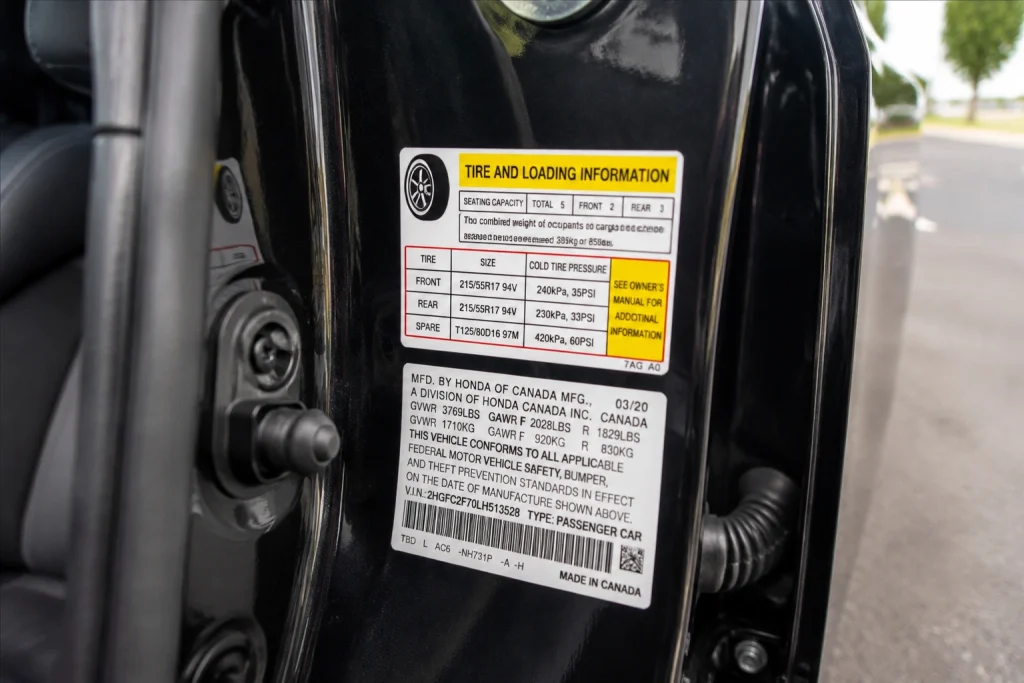
Open the driver’s door and look for the Tire and Loading Information label on the doorjamb. It normally lists separate recommended pressures for:
- Front tires
- Rear tires
- Spare tire, when applicable
- Normal or heavily loaded driving conditions
You can also find this information in the owner’s manual.
Do not use the pressure printed on the tire sidewall as your target. The sidewall number usually represents the tire’s maximum allowable pressure, not the vehicle manufacturer’s recommended operating pressure.
The NHTSA tire safety guidance confirms that the correct cold inflation pressure appears on the driver-side label or in the owner’s manual—not on the tire itself. (NHTSA)
What Does PSI Mean?
PSI means pounds per square inch. It measures the air pressure inside the tire.
Many passenger vehicles recommend approximately 30–36 PSI, but your vehicle may require a different amount. Some cars also specify different pressures for the front and rear tires.
Always follow the number provided by the vehicle manufacturer.
Check Tire Pressure While the Tires Are Cold
A “cold” tire is one that has not been driven for at least three hours or has traveled only a very short distance at moderate speed.
Driving creates heat, and heat increases tire pressure. A warm tire may show several PSI more than it would after cooling.
For the most accurate result:
- Check the pressure at home before driving.
- Record the PSI for each tire.
- Calculate how much air each tire needs.
- Add that amount when you reach the gas station.
For example, suppose your vehicle requires 35 PSI. If a cold tire reads 31 PSI at home, it needs approximately four additional PSI. Add four PSI at the station rather than releasing air because the warm reading appears higher.
NHTSA recommends checking tire pressure at least monthly while the tires are cold. It also advises rechecking warm tires later rather than deliberately reducing them below the manufacturer’s cold-pressure specification. (NHTSA)
How to Use a Tire Inflator at a Gas Station: Step by Step
1. Park Close to the Air Machine
Position your vehicle so the hose can reach all four wheels without being pulled tightly.
Avoid blocking traffic, fuel pumps, sidewalks, or other vehicles. Turn off the engine, apply the parking brake, and switch on the hazard lights when visibility is poor.
2. Confirm the Recommended PSI
Review the driver-side door label before starting. Do not assume every tire requires the same pressure.
For example, a vehicle might specify:
- Front tires: 35 PSI
- Rear tires: 33 PSI
Follow those separate values when programming or checking the machine.
3. Check the Current Pressure
Remove the valve cap from the first tire by turning it counterclockwise.
Press your tire gauge firmly onto the valve stem. A brief hiss is normal, but continuous hissing usually means the gauge is not seated correctly.
Record the reading and compare it with the recommended PSI.
4. Activate the Air Pump
Gas station machines may start using:
- A push button
- Coins
- A credit or debit card
- A payment terminal inside the station
- A free-air activation button
Some pumps run for only a few minutes. Remove all valve caps and keep them somewhere safe before starting the timer.
5. Set the Desired PSI on a Digital Pump
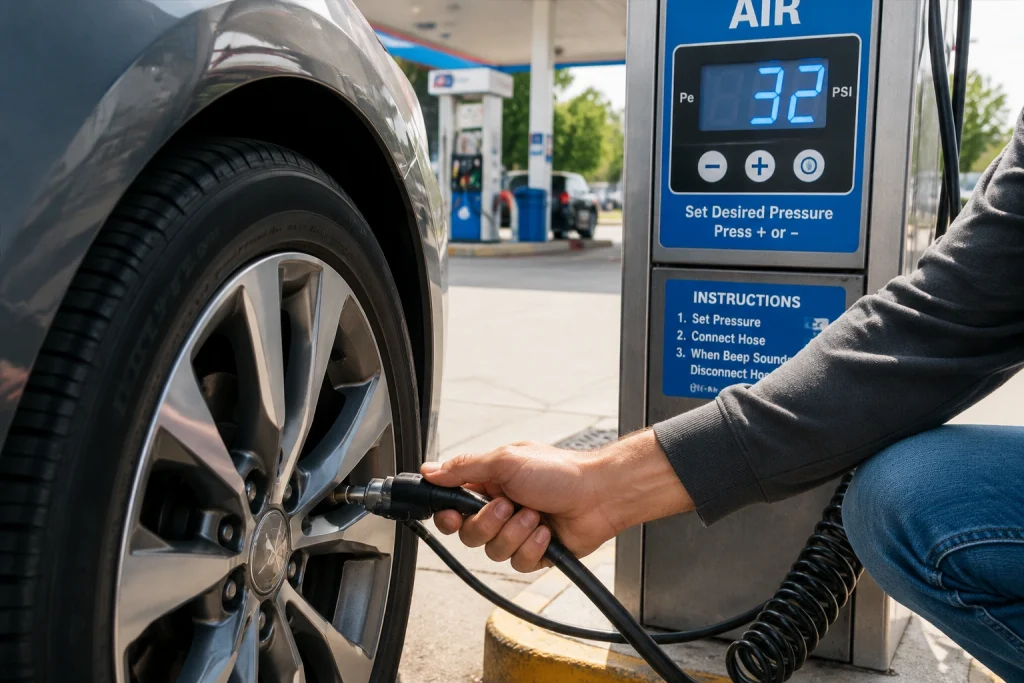
For an automatic machine, use the plus and minus buttons to select the required PSI.
Confirm that the display is using PSI rather than kPa or another unit. Connect the hose nozzle firmly to the valve stem.
The machine may beep while inflating and signal when the selected pressure is reached.
6. Add Air in Short Bursts on a Manual Pump
If the machine does not have automatic shutoff, press the nozzle onto the valve stem and operate the trigger or lever.
Add air for several seconds, then stop and check the pressure. Repeat until the tire reaches the recommended PSI.
Do not hold the inflator continuously for a long period without checking. Gas station compressors can add air quickly, especially to smaller tires.
7. Recheck the Pressure
Remove the hose and check the tire with your own gauge.
If the pressure is low, add another short burst. If it is slightly high, press the small pin inside the valve stem with the pressure gauge’s release tool or another suitable blunt tool.
Release only a small amount at a time, then measure again.
8. Replace the Valve Cap
Turn the valve cap clockwise until it is secure. The cap helps protect the valve from dirt, moisture, and road debris.
Repeat the process for every tire, including the spare when it is accessible.
9. Confirm the TPMS Warning Light
After properly inflating the tires, the Tire Pressure Monitoring System light may turn off immediately or after several minutes of driving.
If the light remains on:
- Recheck all four tires
- Check the spare if it contains a pressure sensor
- Confirm that the pressures match the door label
- Look for a puncture or leaking valve
- Consider a TPMS sensor malfunction
A flashing TPMS light usually indicates a system or sensor problem rather than simple low pressure. NHTSA notes that TPMS is not a replacement for monthly manual pressure checks because the warning may not appear until a tire is already significantly underinflated. (NHTSA)
Digital vs. Manual Gas Station Air Pumps
| Pump Type | How It Works | Main Benefit | Main Limitation |
|---|---|---|---|
| Automatic digital pump | You select the desired PSI, and the machine stops automatically | Easy for beginners and reduces overinflation risk | Display or sensor may be inaccurate |
| Manual trigger pump | You control how long air enters the tire | Fast and simple | Requires frequent pressure checks |
| Built-in gauge pump | The hose includes a dial or sliding pressure indicator | No separate gauge required | Public gauges may be worn or damaged |
| Coin-operated timed pump | Runs for a fixed period after payment | Widely available | Timer may expire before all tires are finished |
| Free station compressor | Activated by a button or station employee | No direct cost | Availability and operating condition vary |
Even when using an automatic machine, confirm the result with your own gauge.
What If the Tires Are Warm?
Sometimes you cannot avoid driving to the air pump. In that situation, do not leave a tire significantly underinflated simply because the tire is warm.
Inflate it to the vehicle’s recommended cold PSI as a temporary safety measure. Then check it again the next morning after the vehicle has been parked for at least three hours.
You may need to release or add a small amount once the tire is cold.
Never intentionally drive on a visibly soft tire to obtain a perfect cold reading. A safe temporary inflation is better than continuing with dangerously low pressure.
How Much Does Gas Station Air Cost?
Air-pump pricing varies by location and station policy.
You may encounter:
- Free customer air
- Coin-operated machines
- Card-operated compressors
- Pumps activated by a cashier
- State or local rules requiring free air under certain conditions
AAA notes that some stations charge a small fee, commonly around $0.50–$1, although prices and free-air policies vary. (AAA International Relations)
A basic personal tire gauge is inexpensive and can prevent inaccurate inflation. A portable 12-volt inflator costs more but allows you to check and adjust pressure at home while the tires are cold.
Why Correct Tire Pressure Matters
Proper inflation affects more than ride comfort.
Correct pressure helps support:
- Predictable steering and braking
- Proper tire load capacity
- Even tread wear
- Better fuel efficiency
- Lower heat buildup
- Longer tire life
- Reduced risk of tire damage
Underinflated tires flex more as they roll. This creates heat and can accelerate shoulder wear. Overinflated tires may produce a harsher ride and concentrate wear near the center of the tread.
NHTSA’s summer driving and tire-pressure guidance advises drivers to use the manufacturer’s recommended pressure and inspect tires for damage before travel. (NHTSA)
Signs the Tire Needs More Than Air
Adding air will not repair a damaged tire. Seek tire service when you notice:
- Pressure drops again within hours or days
- A screw, nail, or sharp object in the tread
- Cracks, exposed cords, or deep cuts
- A bulge or bubble in the sidewall
- Bent or damaged valve stems
- Air leaking around the wheel rim
- Repeated TPMS warnings
- Vibration that continues after correcting pressure
- A tire that will not accept or retain air
Do not inflate a tire with a large sidewall bulge, exposed internal cords, or obvious structural damage. Install the spare tire or arrange roadside assistance.
Expert Tip
Expert Tip: Keep a digital pressure gauge in the glove box and record each tire’s cold reading before driving to the station. At the pump, add only the missing amount instead of relying completely on the public machine’s gauge.
Common Mistakes Vehicle Owners Should Avoid
- Using the sidewall number: This is normally a maximum tire rating, not the vehicle’s target PSI.
- Ignoring front and rear differences: Some vehicles specify different pressures by axle.
- Checking only the visibly low tire: Another tire may also be underinflated.
- Releasing air from warm tires: Heat raises pressure temporarily, so the tire may become too low after cooling.
- Trusting the pump gauge completely: Confirm the result with a personal gauge.
- Adding air without inspecting the tire: A bulge, cut, puncture, or damaged valve may require immediate service.
- Forgetting valve caps: Replace them to protect the valve mechanism.
- Ignoring repeated pressure loss: A slow leak will not be solved by repeated inflation.
- Overinflating for better fuel economy: Excess pressure can reduce ride quality and alter tread contact.
- Relying only on TPMS: The dashboard warning is not a substitute for routine manual checks.
When to Call a Transmission Professional
Low tire pressure normally requires a tire shop, roadside service provider, or general automotive technician—not a transmission specialist.
However, schedule a driveline or transmission inspection if correcting the tire pressure does not eliminate symptoms such as:
- Shuddering during acceleration
- Vibration that changes with gear selection
- Delayed engagement into Drive or Reverse
- Transmission slipping
- Clunking during shifts
- Fluid leaking beneath the center of the vehicle
- Warning lights related to the powertrain
Uneven tire pressure can sometimes make a vehicle feel rough or unstable, but it does not cause internal transmission slipping. Correct the tire pressures first. If the symptoms remain, have the vehicle diagnosed rather than authorizing expensive transmission work based on guesswork.
When choosing a shop, request a written diagnosis and estimate. The FTC’s auto repair guidance recommends comparing repair shops, checking warranty policies, and selecting a facility before an emergency forces a rushed decision. (Consumer Advice)
DIY Tire Inflation vs. Professional Tire Service
| Situation | Gas Station Inflation | Professional Service |
|---|---|---|
| Tire is 2–5 PSI low with no visible damage | Appropriate | Usually unnecessary |
| Pressure dropped after a cold-weather change | Appropriate | Usually unnecessary |
| TPMS light appears but tire looks normal | Check and inflate first | Needed if warning remains |
| Tire repeatedly loses pressure | Temporary measure only | Recommended |
| Nail or screw is visible | Do not remove it at the pump | Recommended |
| Sidewall has a cut or bulge | Do not continue inflating | Immediate service |
| Valve stem is leaking | Temporary inflation may not hold | Recommended |
| Wheel is bent or damaged | Not a safe DIY repair | Required |
| Tire is completely flat | Inflation may cause further damage | Inspection required |
FAQs
Can I use a gas station tire inflator without a pressure gauge?
You can use the machine’s built-in gauge, but carrying your own gauge is safer. Public equipment may be worn, damaged, or inaccurate. Verify the final pressure before driving away.
Should the engine be running while inflating tires?
No. Park safely, turn off the engine, apply the parking brake, and keep the vehicle stationary while using the air pump.
How long should I put air in each tire?
There is no fixed time. It depends on tire size, starting pressure, and compressor strength. Add air in short bursts and check the PSI frequently.
What happens if I put too much air in the tire?
Release a small amount by gently pressing the valve-stem pin. Recheck the pressure after each brief release until it matches the manufacturer’s recommendation.
Can I inflate a completely flat tire at a gas station?
Only when there is no major damage and the tire bead remains seated against the wheel. A tire driven while flat may have hidden internal damage and should be professionally inspected.
Why is the TPMS light still on after adding air?
One tire may still be low, the spare may have a sensor, or the system may need several minutes of driving to update. A flashing or persistent light may indicate a faulty sensor.
How often should I check my tire pressure?
Check all tires at least once a month, before long trips, and whenever temperatures change significantly. Check the spare according to the owner’s manual.
Conclusion
Knowing how to use a tire inflator at a gas station helps you correct low pressure before it causes poor handling, unnecessary tire wear, or roadside trouble.
Start with the recommended PSI on the driver-side door label. Check the tires while cold whenever possible, connect the inflator securely, add air gradually, and confirm the final reading with your own gauge.
Remember that adding air is maintenance—not a permanent repair for punctures, damaged valves, or tires that repeatedly lose pressure. Inspect the tire carefully, monitor it afterward, and contact a qualified shop when the pressure will not remain stable.
Before your next drive, check all four tires and the spare so your vehicle is ready for the road.
