A low tire can appear at the worst possible time—before work, during a road trip, or in an unfamiliar parking lot. A portable inflator that plugs into your vehicle’s 12-volt accessory outlet can provide a quick and convenient solution. However, many drivers reasonably ask: Are 12V tire inflators safe for the vehicle, tire, and electrical system?
In most cases, they are safe when the inflator is compatible with the vehicle’s power outlet and used according to the manufacturer’s instructions. Problems usually occur when drivers overload the outlet, overinflate a tire, run the compressor too long, use damaged equipment, or operate the vehicle in an unsafe location.
This guide explains the main risks, safe operating steps, warning signs, quality considerations, and situations that require professional help.
Quick Answer
Yes, most 12V tire inflators are safe when properly matched to the vehicle’s accessory outlet and used according to their instructions. Check the outlet’s amperage limit, inflate to the pressure listed on the vehicle’s door label, monitor compressor heat, and never run the vehicle inside an attached garage.
How a 12V Tire Inflator Works
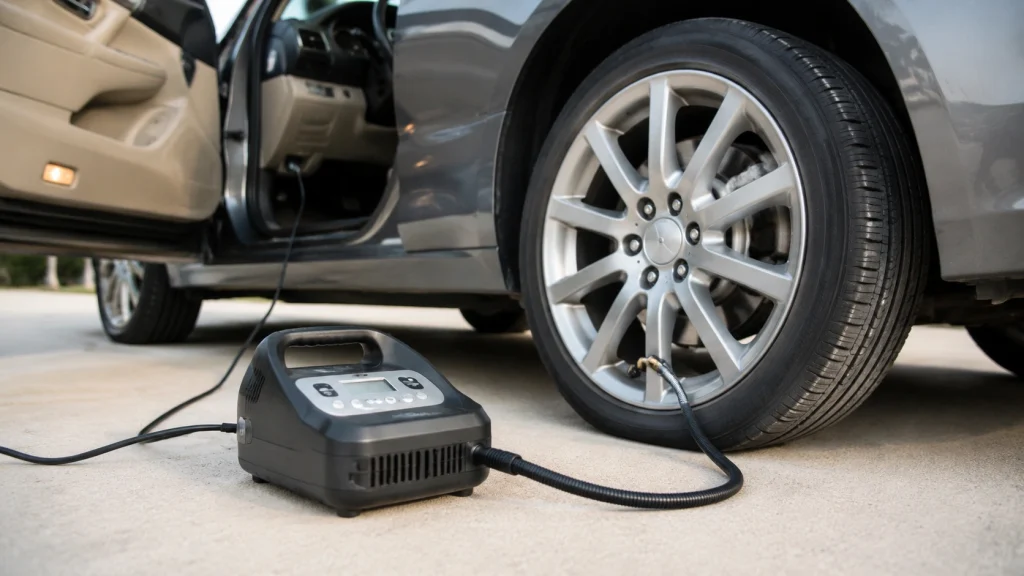
12V tire inflator safely connected to a passenger car tire
A 12V tire inflator is a small electric air compressor. It receives power from a vehicle’s 12-volt accessory socket, which many drivers still call the cigarette-lighter outlet.
Inside the unit, a small motor moves a piston or diaphragm. This movement compresses outside air and sends it through the hose into the tire.
Most portable models include:
A 12V power plug
An air hose and valve connector
A pressure gauge
A power switch
Cooling vents
A built-in light
An automatic shutoff feature on some models
The compressor does not normally interact with the engine, transmission, or driveline. Its main connection to the vehicle is through the low-voltage electrical system.
What Makes a 12V Tire Inflator Safe or Unsafe?
The equipment itself is generally safe. The real question is whether the inflator is being used within the limits of the vehicle, tire, and compressor.
Safety concern
What may cause it
How to reduce the risk
Blown accessory-outlet fuse
Inflator draws more current than the circuit allows
Compare the inflator’s amp rating with the vehicle manual
Compressor overheating
Running beyond its recommended duty cycle
Stop and allow the unit to cool
Tire overinflation
Using the wrong pressure or inaccurate gauge
Follow the doorjamb pressure label and verify with a separate gauge
Battery drain
Operating too long with the engine off
Follow the vehicle and inflator instructions
Damaged cord or plug
Cracked insulation, loose wiring, or melted contacts
Stop using the inflator and replace it
Roadside injury
Working close to moving traffic
Move to a safe, level location whenever possible
Carbon monoxide exposure
Running the engine inside an attached garage
Operate outdoors and away from enclosed spaces
Can a 12V Inflator Damage the Vehicle’s Electrical System?
A correctly matched inflator should not damage a healthy electrical system. The accessory circuit is normally protected by a fuse. If the device demands more current than the circuit allows, the fuse may blow and disconnect the power.
However, a blown fuse should not be treated as an inconvenience to bypass. It is a warning that something may be wrong.
Possible causes include:
An inflator with excessive current demand
A short circuit inside the inflator
A damaged power plug
A weak or contaminated accessory socket
Other devices sharing the same circuit
An incorrect fuse installed previously
Some accessory outlets are limited to approximately 10 amps, while others support 15 or 20 amps. The exact capacity varies by vehicle and outlet. Never assume that every 12V socket can power every 12V inflator.
Check the electrical specifications in your owner’s manual before connecting a high-output compressor. Manufacturer instructions for factory kits, such as the Ford tire inflator and sealant kit guidance, also demonstrate the importance of following the correct connection and operating procedure. (https://www.ford.com/)
Do Not Install a Larger Fuse
If the accessory-outlet fuse blows, replace it only with a fuse of the same approved rating.
Installing a higher-amperage fuse can allow the wiring to overheat before the fuse disconnects the circuit. That creates a much more serious risk than simply losing power to the accessory socket.
If the replacement fuse blows again, stop using the inflator and have the circuit inspected.
Can a 12V Tire Inflator Overheat?
Yes. Small portable compressors create considerable heat because their motors and compression chambers are compact.
Many inflators have a duty cycle. This tells you how long the compressor can run before it needs to cool.
For example, an inflator might be designed to run for 10 minutes and then cool for 15 or 20 minutes. The actual limits depend on the product.
Signs of excessive heat include:
A strong hot-plastic smell
Smoke
The casing becoming unusually hot
The unit slowing down
Repeated automatic shutdowns
A power cord or plug becoming hot
Melted or discolored plastic
Some warmth is normal. Smoke, melting, sparking, or a burning odor is not normal.
Place the unit on a firm surface where its cooling vents remain open. Do not operate it while it is buried under luggage, resting on deep carpet, or covered with clothing.
Can a 12V Inflator Overinflate a Tire?
A tire inflator can overinflate a tire if the driver uses the wrong pressure or does not monitor the gauge.
The correct pressure is normally printed on the Tire and Loading Information label inside the driver-side door or door frame. It may also appear in the owner’s manual.
Do not use the maximum pressure molded into the tire’s sidewall as the everyday inflation target. That number describes a tire limit under specified conditions, not necessarily the pressure selected by the vehicle manufacturer.
The NHTSA TireWise safety guidance recommends using the vehicle manufacturer’s pressure shown on the door label or in the owner’s manual rather than relying on the number printed on the tire. (NHTSA)
Why Gauge Accuracy Matters
Built-in inflator gauges are convenient, but inexpensive models may not always be perfectly accurate. Pressure can also change slightly when the compressor stops or when the hose is disconnected.
A practical approach is to:
Inflate close to the recommended pressure.
Turn off the compressor.
Wait several seconds.
Check the pressure with a separate quality tire gauge.
Add or release air as needed.
Check tire pressure when the tires are cold whenever possible. A tire is considered cold when the vehicle has been parked long enough for the tire temperature to settle or has only been driven a very short distance.
Is It Safe to Leave the Engine Running?
Some inflator manufacturers instruct drivers to keep the engine running to protect the battery from excessive discharge. Other models may be used with the engine off for a limited period.
Follow both the vehicle manual and inflator manual. However, one rule applies in every case:
Never leave a gasoline or diesel vehicle running inside an attached garage, even when the garage door is open.
Place the transmission in Park or Neutral as directed.
Keep the exhaust outlet clear.
Keep children and pets away.
Avoid touching belts, fans, and other moving components.
For hybrids and electric vehicles, follow the manufacturer’s instructions for placing the vehicle in the correct powered mode. A hybrid may start its gasoline engine automatically even when it initially appears silent.
How to Use a 12V Tire Inflator Safely
Use the following process for normal pressure correction.
1. Move to a Safe Location
Park on a stable, level surface away from traffic. Turn on the hazard lights if you are near a roadway.
Do not attempt to inflate a tire while the vehicle is stopped in an active traffic lane or on an unstable shoulder.
2. Inspect the Tire
Look for:
Sidewall cuts
Exposed cords
A separated tread
A damaged wheel
A large puncture
A tire that has come off the wheel bead
Smoke or signs of overheating
A small compressor cannot make a structurally damaged tire safe.
3. Find the Correct Pressure
Read the driver-side doorjamb label. Front and rear tires may require different pressures.
Also check whether the vehicle is carrying an unusually heavy load that requires a different manufacturer-approved pressure.
4. Inspect the Inflator
Do not use the unit if the cord, plug, housing, hose, or valve connector is cracked, melted, wet, or badly worn.
5. Confirm Electrical Compatibility
Compare the inflator’s current or wattage rating with the accessory outlet rating in the owner’s manual.
Turn off other high-draw accessories connected to the same circuit.
6. Connect the Hose Securely
Remove the valve cap and attach the air chuck straight onto the valve stem. A poor connection can leak air and cause an inaccurate reading.
7. Connect the Power Plug
Insert the plug fully into the approved 12V outlet. Avoid trapping the cord in a door or window.
OEM instructions for portable repair kits also warn against pinching the power cord and direct drivers to use the specified doorjamb tire pressure. (Honda Owners)
8. Inflate in Short, Controlled Intervals
Turn on the compressor and watch the gauge. Do not walk away while it is operating.
Stop periodically to check the pressure and compressor temperature.
9. Verify the Final Pressure
Turn off the inflator before taking the final reading. Confirm the pressure with a separate gauge when available.
10. Disconnect and Inspect
Remove the hose, reinstall the valve cap, unplug the inflator, and store the cord loosely.
Listen for air leakage around the valve. If the tire quickly loses pressure again, it likely needs professional inspection.
Are 12V Inflators Safe for All Vehicles?
Passenger Cars and Small Crossovers
Most standard 12V inflators are designed for passenger-car tires. They are generally suitable for adding a few pounds of pressure or filling a moderately low tire.
Pickup Trucks and Large SUVs
Large tires contain more air and may require greater pressure. A small inflator may run too long, overheat, or fail before completing the job.
Truck and large-SUV owners should consider a higher-duty compressor that matches the vehicle outlet or connects directly to the battery using approved clamps.
Motorcycles
A 12V inflator can work for motorcycle tires, but pressure rises quickly because the tires have less internal volume.
Use short bursts and an accurate low-range gauge. A difference of only a few PSI can noticeably affect motorcycle handling.
Recreational Vehicles and Trailers
Many RV and trailer tires require higher pressures than ordinary passenger tires. Confirm that the inflator’s maximum working pressure and duty cycle are suitable.
A compressor that advertises a high maximum PSI may still inflate slowly at higher pressure.
Electric and Hybrid Vehicles
A normal 12V inflator does not connect directly to the high-voltage traction battery. It generally uses the vehicle’s separate 12V accessory system.
However, power-mode instructions differ between vehicles. Consult the owner’s manual before leaving an EV or hybrid in an accessory or ready mode for extended inflation.
Temporary Spare Tires
Temporary spare tires often require substantially more pressure than regular tires. Read the pressure printed on the spare-tire label or in the vehicle manual rather than assuming it uses the same setting as the other tires.
Quality, Cost, and Durability Considerations
Basic 12V inflators may cost approximately $20 to $40, while better-built digital or heavy-duty models can cost considerably more.
Price alone does not guarantee safety. Look for useful features such as:
Clear amperage or wattage information
Overheat protection
Automatic pressure shutoff
A readable pressure gauge
A fused power plug
A long enough power cord
A secure air connector
Stable feet that reduce movement
Clearly stated duty-cycle limits
Replacement fuse availability
A recognized independent safety certification where applicable
A cheaper inflator may be adequate for occasional pressure adjustments. Drivers with trucks, larger tires, frequent travel, or extreme weather may benefit from a more durable model.
Do not buy solely based on an advertised maximum PSI. Inflation speed, operating time, current demand, cooling capacity, and gauge accuracy are often more useful.
Warning Signs That Mean You Should Stop
Turn off and unplug the inflator immediately if you notice:
Smoke or sparks
A burning electrical smell
A melted plug or socket
Severe vibration
Unusual grinding noises
A rapidly overheating cord
A pressure gauge that behaves unpredictably
Repeated fuse failure
Air leaking from a split hose
The tire sidewall bulging
The tire separating from the wheel
Pressure that will not increase despite continuous operation
Continuing to run a struggling compressor can damage the device, drain the battery, or overheat the electrical connection.
Expert Tip: Test your 12V inflator at home before relying on it during an emergency. Confirm that it reaches all four tires, fits the valve stems, works with the vehicle outlet, and gives a reading close to a separate tire gauge.
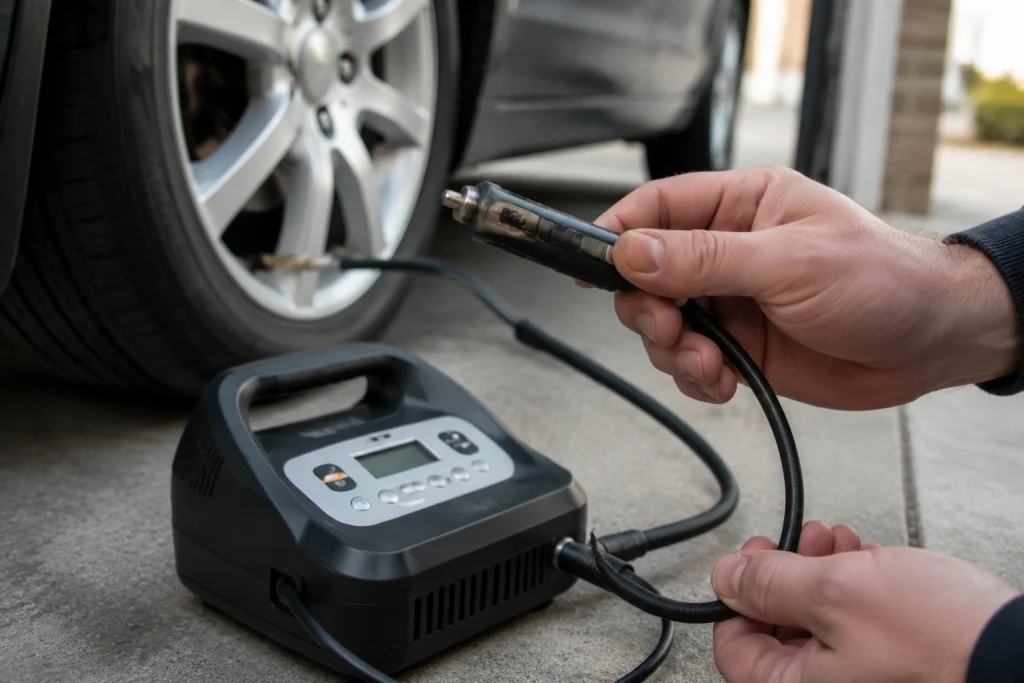
Unsafe damaged 12V tire inflator power plug and hose
Common Mistakes Vehicle Owners Should Avoid
Using the tire-sidewall maximum as the target pressure: Use the vehicle’s doorjamb label instead.
Ignoring the outlet rating: A 12V plug does not automatically mean the device is compatible.
Replacing a blown fuse with a larger fuse: This may expose the wiring to excessive current.
Running the compressor continuously: Follow its duty-cycle and cooling instructions.
Leaving the inflator unattended: Pressure can rise faster than expected.
Operating on grass, bedding, or deep carpet: Soft materials may block cooling vents.
Using damaged cords or homemade adapters: Poor connections create resistance and heat.
Pinching the power cord in a closed door: This can damage the insulation or internal wires.
Running the vehicle in an attached garage: Carbon monoxide can enter the home.
Trying to repair major tire damage with air alone: A sidewall cut, separated tread, or damaged wheel requires professional service.
Assuming air solves the underlying problem: A tire that repeatedly loses pressure has a leak or another fault.
Driving immediately on a nearly flat tire: The sidewall may already have internal damage, even after reinflation.
When to Call a Transmission Professional
Using a 12V tire inflator normally has no effect on the transmission. It does not create hydraulic pressure, change transmission fluid, or mechanically interact with the gearbox.
However, seek professional diagnosis if using the accessory outlet is followed by:
A transmission warning message
Multiple dashboard warning lights
The engine stalling
The vehicle failing to shift out of Park
Erratic electronic shifting
A major voltage-drop warning
Repeated accessory-circuit fuse failures
A burning smell inside the cabin
Modern automatic transmissions, CVTs, and dual-clutch transmissions use electronic control modules. Low system voltage or electrical faults can sometimes trigger warning lights or temporary control problems.
Start with a qualified automotive electrical technician if the problem appears related to the accessory circuit or charging system. Consult a transmission professional when a transmission warning remains active, shifting becomes abnormal, or diagnostic codes point to the transmission control system.
Do not approve an expensive transmission repair until the shop has checked the battery, alternator or DC-to-DC converter, fuses, grounds, and charging voltage. A weak electrical supply can sometimes imitate a more expensive control-system problem.
FAQs
Are cheap 12V tire inflators safe?
Some inexpensive inflators are safe for occasional use, but quality varies. Choose a model with clear electrical specifications, overheat protection, a fused plug, reliable reviews, and understandable operating instructions. Stop using any unit that overheats, sparks, or gives inconsistent pressure readings.
Can a tire inflator blow my car’s fuse?
Yes. A fuse can blow if the inflator draws more current than the accessory circuit permits or if the inflator has an electrical fault. Replace the fuse only with the same specified rating. Repeated failure requires diagnosis.
Should the engine be running while using a 12V inflator?
Follow the instructions for both the inflator and vehicle. Some manufacturers recommend keeping the vehicle powered to prevent battery drain. When the engine must run, keep the vehicle outdoors and never inside an attached garage.
Can I use a 12V inflator in the rain?
Avoid operating a standard inflator in rain, standing water, or very wet conditions unless its manufacturer specifically rates it for that environment. Water can damage the motor, plug, switch, and electrical connections.
Can a 12V inflator completely fill a flat tire?
It may fill a tire that has lost air from a small puncture or slow leak, but it cannot make structural damage safe. If the tire has a sidewall cut, damaged bead, separated tread, or large hole, arrange roadside assistance or professional tire service.
How long can I run a portable tire inflator?
The safe operating time depends on its duty cycle. Some compact models require a cooling break after only several minutes. Check the product manual and stop earlier if the housing, cord, or plug becomes excessively hot.
Can a tire inflator damage the TPMS sensor?
Normal inflation through the valve stem should not damage the tire-pressure monitoring sensor. Damage is more likely from forcing the connector, bending the valve stem, using incompatible sealant, or performing improper tire service.
Conclusion
So, are 12V tire inflators safe? For most vehicle owners, the answer is yes—provided the equipment matches the vehicle’s electrical limits and is used carefully.
Check the recommended tire pressure, inspect the cord and hose, follow the compressor’s duty cycle, monitor heat, and verify the final pressure with a reliable gauge. Never bypass a fuse, ignore tire damage, or operate a running vehicle in an attached garage.
A dependable inflator is a useful emergency tool, but it is not a substitute for proper tire repair or accurate vehicle diagnosis. Test your inflator before an emergency, keep it accessible, and have any recurring pressure loss inspected by a qualified tire or automotive professional.
I’m Ryan Carter, an automotive writer passionate about helping drivers understand their vehicles better. I research and share practical guides on transmission problems, maintenance, fluids, and repair solutions to make complex automotive topics simple and easy to understand.