
Are Cordless Tire Inflators Worth It? A Practical Guide for Vehicle Owners

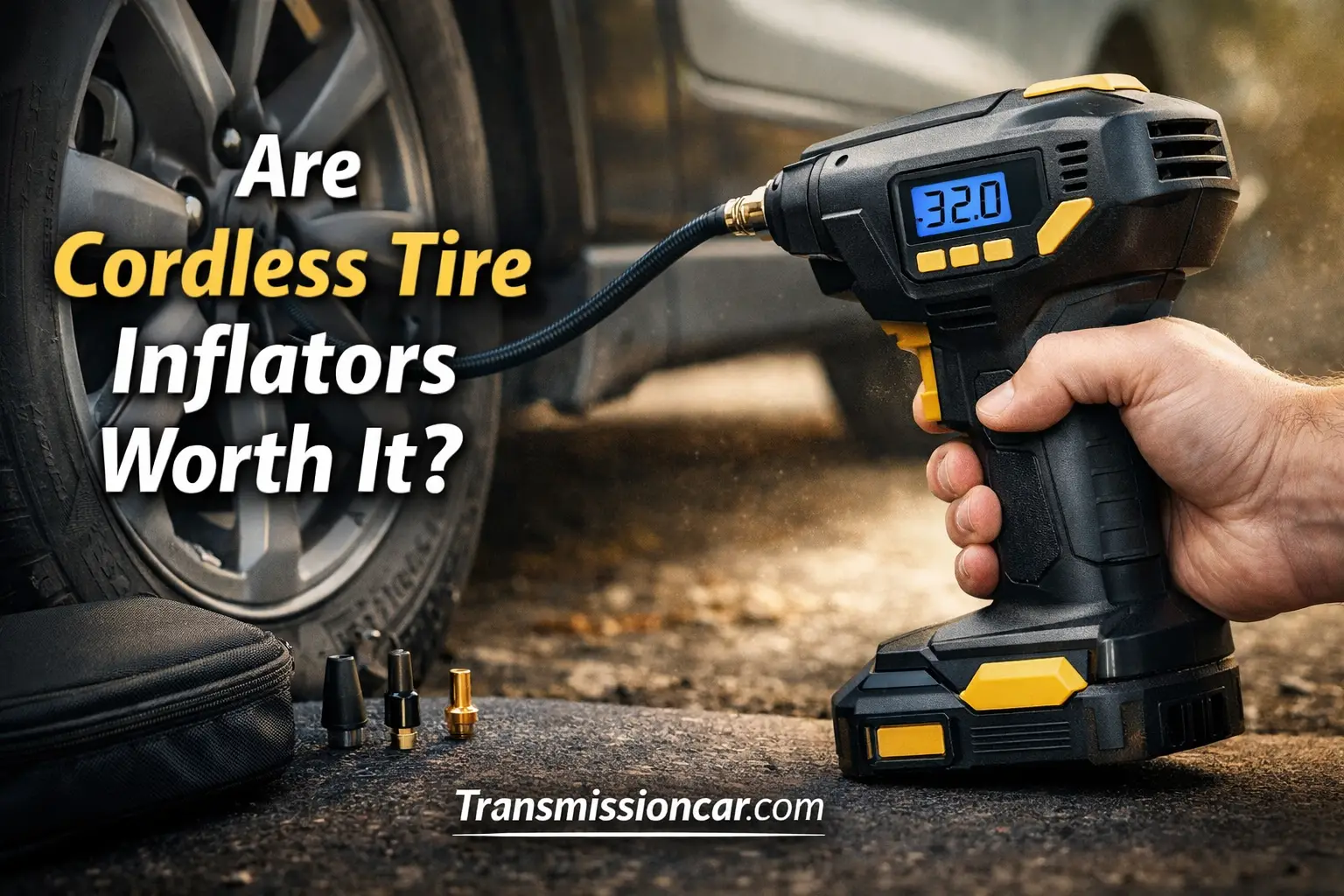
A low tire can appear at the worst possible time—before work, during a road trip, or in a parking lot far from a gas station. A cordless tire inflator promises a simple solution: connect the hose, set the pressure, and inflate the tire without searching for an electrical outlet.
But are cordless tire inflators worth it, or are they another tool that may sit unused in your trunk? The answer depends on the inflator’s battery, accuracy, airflow, durability, and the type of vehicle you drive.
This guide explains the real advantages and limitations, what features matter, how to use one safely, and when a cordless inflator cannot replace professional tire or driveline service.
Quick Answer
Yes, cordless tire inflators are worth it for most vehicle owners who want a convenient way to correct minor tire-pressure loss at home or on the road. They are portable, easy to use, and do not need a running vehicle. However, they are not designed to repair punctures, inflate severely damaged tires, or replace a full-size air compressor.
What Is a Cordless Tire Inflator?
A cordless tire inflator is a small, battery-powered air compressor. Most models use either:
- A built-in rechargeable lithium-ion battery
- A removable power-tool-style battery
- A rechargeable battery with optional 12-volt vehicle power
The inflator compresses outside air and pushes it into the tire through a hose. Many modern units include a digital pressure display, automatic shutoff, preset pressure settings, and an emergency light.
The main difference between a cordless inflator and a traditional portable compressor is the power source. A traditional unit normally plugs into the vehicle’s 12-volt accessory outlet. A cordless model can operate independently after its battery has been charged.
Are Cordless Tire Inflators Worth the Money?
For routine tire maintenance and minor roadside pressure loss, a good cordless tire inflator is usually worth buying. It can save time, reduce dependence on gas-station air pumps, and help you maintain proper tire pressure more consistently.
The value is not simply about how often the inflator is used. It is also about having a working tool available during an unexpected pressure-loss warning.
A cordless inflator is most valuable when you:
- Drive long distances regularly
- Live far from service stations
- Experience large seasonal temperature changes
- Own multiple vehicles, bicycles, or lawn equipment
- Frequently receive low-pressure warnings
- Want to check and adjust pressure at home
- Do not want to run a power cable through the vehicle
However, a cordless inflator may not be the best choice for frequent heavy-duty use. Owners of large trucks, trailers, recreational vehicles, and vehicles with high-pressure tires may need a larger corded compressor.
Cordless Tire Inflator Pros and Cons
| Factor | Advantages | Limitations |
|---|---|---|
| Portability | No outlet or vehicle connection is required | The battery can lose charge during storage |
| Convenience | Fast setup and simple operation | Smaller models may inflate slowly |
| Pressure control | Digital presets and automatic shutoff are common | Built-in gauges may not always be perfectly accurate |
| Emergency use | Useful in driveways, parking lots, and remote areas | Cannot repair a puncture or damaged tire |
| Noise | Usually quieter than large shop compressors | Still produces noticeable compressor noise |
| Maintenance | Requires little mechanical maintenance | Battery capacity decreases as the unit ages |
| Versatility | Can inflate car tires, bicycles, and sports equipment | Not every model is suitable for truck or trailer tires |
| Cost | Can reduce paid air-pump visits | Quality models cost more than basic 12-volt units |
The Main Benefits of a Cordless Tire Inflator
You Can Use It Almost Anywhere
The greatest advantage is freedom from a power cord. You do not need to park near an outlet or leave the vehicle running to power the compressor.
This is particularly useful when the tire valve is difficult to reach with a short electrical cable. It also makes the inflator easier to use on trailers, bicycles, wheelbarrows, and lawn equipment.
It Makes Routine Pressure Checks Easier
Drivers are more likely to correct low tire pressure when the equipment is easy to access. A cordless model can be stored in a garage, trunk, or utility cabinet and used within minutes.
The NHTSA TireWise safety guidance recommends checking tire pressure monthly rather than depending entirely on the tire pressure monitoring system. A TPMS warning may not appear until a tire is already significantly underinflated. (NHTSA)
It Can Help During Minor Roadside Emergencies
A cordless inflator can provide enough air to move a vehicle to a safer location or nearby tire shop when a tire has developed a slow leak.
This does not mean the tire is repaired. If pressure continues to drop, the tire may have a puncture, damaged valve, wheel leak, or internal structural problem.
Automatic Shutoff Reduces Guesswork
Many cordless models allow you to enter a target pressure. The compressor then stops automatically after reaching that setting.
This feature is especially helpful for drivers who are uncomfortable reading an analog gauge. It also reduces the chance of accidentally leaving the inflator running too long.
Proper Inflation Supports Tire Life and Efficiency
Correct tire pressure supports predictable handling, even tread wear, and fuel efficiency. The U.S. Department of Energy explains that properly inflated tires are safer, last longer, and help improve fuel economy. (Alternative Fuels Data Center)
A cordless inflator does not create these benefits by itself. Its value comes from making regular pressure maintenance more convenient.
Important Limitations to Understand
Small Inflators Can Be Slow
Compact inflators normally prioritize portability over airflow. They may correct a tire that is a few pounds low reasonably quickly, but filling a nearly empty tire can take much longer.
Inflation time also increases with:
- Larger tire volume
- Higher required pressure
- Low battery charge
- Cold weather
- Restricted airflow around the compressor
- A loose valve connection
Do not judge an inflator only by its advertised maximum pressure. Airflow and duty cycle are often more important for passenger-vehicle use.
The Battery May Be Dead When You Need It
Rechargeable batteries slowly lose charge while stored. Heat, cold, age, and repeated charging can also reduce their capacity.
A cordless inflator that has remained in the trunk for several months may not have enough power to inflate multiple tires. For that reason, the battery should be checked and recharged periodically.
A model with both battery and 12-volt operation provides useful backup protection.
Built-In Gauges Can Differ
The inflator’s displayed pressure may differ slightly from a separate handheld gauge or the vehicle’s TPMS reading. Differences can occur because of gauge calibration, tire temperature, measurement timing, and pressure lost when disconnecting the hose.
For routine maintenance, compare the inflator against a reliable separate gauge. The U.S. Tire Manufacturers Association’s tire-care guidance also emphasizes checking pressure regularly and not relying solely on TPMS warnings. (U.S. Tire Manufacturers Association)
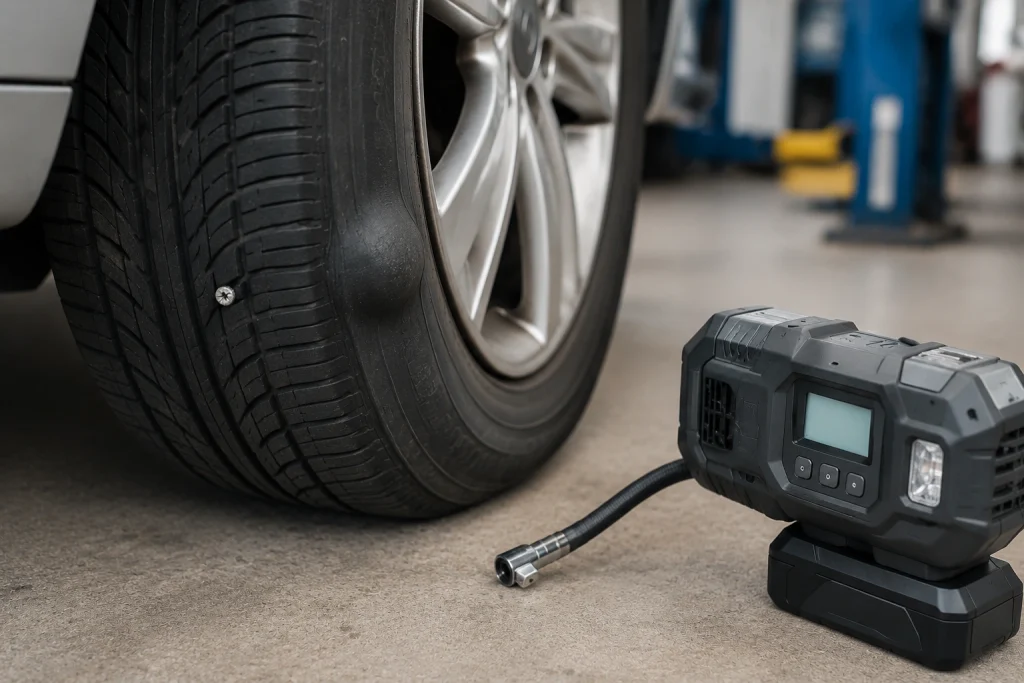
It Cannot Fix Tire Damage
An inflator adds air. It does not repair:
- Nails or screws in the tread
- Sidewall cuts
- Bulges or bubbles
- Cracked rubber
- Bent wheels
- Damaged valve stems
- Tire bead leaks
- Internal belt separation
A tire with visible structural damage should not simply be reinflated and driven normally.
How to Choose a Good Cordless Tire Inflator
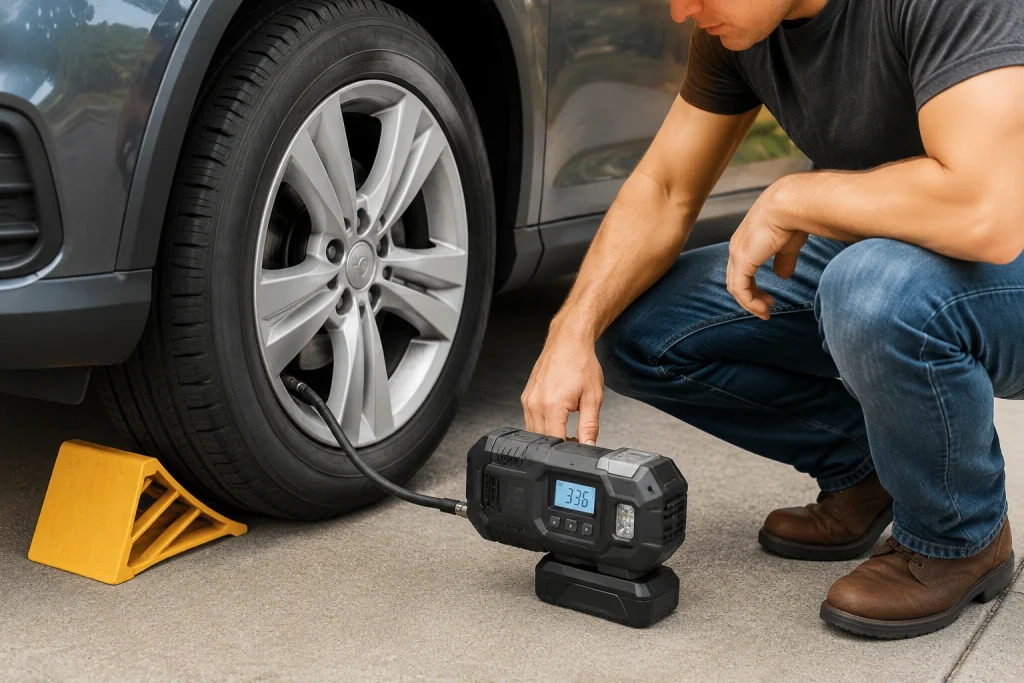
Check the Battery System
Battery capacity affects runtime and how many tires the unit can service between charges.
A removable battery may be useful if you already own compatible tools from the same manufacturer. A built-in battery creates a smaller package but may be harder to replace after it wears out.
Look for:
- A visible battery-level indicator
- Reasonable charging time
- Overheating protection
- Replacement-battery availability
- Optional 12-volt power
- A charger designed for the unit
Look Beyond Maximum PSI
A very high maximum-pressure number does not guarantee fast inflation. Passenger cars usually require far less pressure than the maximum advertised by many inflators.
More useful specifications include:
- Inflation time for a typical car tire
- Airflow rate
- Recommended tire size
- Continuous operating time
- Required cooling period
- Maximum supported tire pressure
For an SUV, pickup, or trailer, verify that the manufacturer specifically lists the inflator as suitable for those tire sizes.
Choose a Secure Air Chuck
The air chuck is the fitting that connects the hose to the tire valve.
Threaded connectors usually create a secure seal but take longer to attach. Lever-style chucks are faster but must fit tightly. A poor connection allows air to escape and can make the pressure reading unstable.
The hose should also be long enough to reach the valve comfortably when it is near the top of the wheel.
Prioritize an Easy-to-Read Display
A clear digital display is useful at night and in poor weather. The buttons should be understandable without repeatedly checking the instructions.
Helpful controls include:
- PSI, kPa, and bar selection
- Target-pressure presets
- Automatic shutoff
- Memory for the previous setting
- A separate power button
- A built-in work light
Consider Storage Conditions
A tire inflator stored in a vehicle may experience extreme heat and cold. These conditions can affect battery performance and long-term durability.
Keep the unit inside its protective case. Avoid storing it where it can be crushed by luggage, tools, or loose cargo.
Never charge a swollen, leaking, cracked, or unusually hot battery.
Cost, Quality, and Durability
Cordless inflators range from compact emergency models to more powerful units that use removable tool batteries. Price often increases with battery capacity, airflow, build quality, hose length, and accessory support.
A low-cost model may be sufficient for occasional pressure adjustments. However, extremely small inflators may overheat quickly or struggle with larger tires.
A higher-quality model is more appropriate when:
- The inflator will be used frequently
- The vehicle has large tires
- Several family vehicles share the tool
- Reliable roadside performance is important
- Replacement batteries are available
- The inflator must work in difficult weather
Durability also depends on how the unit is used. Running a small compressor beyond its recommended operating cycle can damage the motor, seals, or battery.
How to Use a Cordless Tire Inflator Safely
- Park on a stable, level surface.
Apply the parking brake and keep the vehicle away from moving traffic. - Find the correct pressure.
Use the tire-information placard on the driver’s doorjamb or the owner’s manual. Do not use the maximum pressure printed on the tire sidewall as the normal target. - Check the tires while cold when possible.
NHTSA recommends monthly checks when the tires are cold, generally after the vehicle has been parked for several hours. (NHTSA) - Inspect the tire before adding air.
Look for cuts, bulges, exposed cords, embedded objects, or wheel damage. - Connect the hose securely.
Listen for continuous air leakage. Reattach the chuck if the seal is poor. - Set the recommended pressure.
Confirm that the display is using PSI rather than another measurement unit. - Start the inflator and monitor it.
Do not leave the compressor unattended. - Stop if the unit overheats.
Follow the manufacturer’s duty-cycle and cooling instructions. - Verify the final pressure.
Recheck with a reliable handheld gauge, especially before a long trip. - Replace the valve cap.
The cap helps protect the valve from dirt, water, and road debris.
Expert Tip: Check the inflator’s battery and compare its gauge with a trusted handheld gauge every few months. A perfectly stored inflator is not useful if its battery is empty or its reading is inaccurate.
Who Should Buy a Cordless Tire Inflator?
A cordless model is a strong choice for:
- Commuters
- Apartment residents
- Families with multiple vehicles
- Drivers who take long road trips
- Owners who regularly adjust pressure for seasonal changes
- Older drivers who want a simpler setup
- Drivers with limited access to gas-station air pumps
It is also useful for vehicles stored for long periods because tire pressure may gradually decrease during storage.
Who May Be Better With a Corded Compressor?
A corded 12-volt or heavy-duty compressor may be better for:
- Full-size trucks with large tires
- Off-road vehicles that frequently air down their tires
- Travel trailers and recreational vehicles
- Commercial vehicles
- Repeated inflation work
- Drivers who may forget to recharge a battery
A shop-style compressor is a better choice when speed, continuous use, and high airflow are more important than portability.
Some owners choose a hybrid approach: a cordless inflator for everyday convenience and a 12-volt backup for longer trips.
Warning Signs the Inflator Is Not the Real Solution
Stop repeatedly adding air and arrange an inspection when:
- The same tire becomes low every few days
- Pressure falls immediately after inflation
- The tire has a sidewall bulge
- A valve stem is cracked or loose
- The wheel is visibly bent
- The vehicle vibrates after the pressure is corrected
- The tread is separating or wearing unevenly
- The tire will not hold the recommended pressure
- The inflator runs but pressure does not increase
Repeated pressure loss is not normal maintenance. It indicates a leak or damaged component that needs to be located.
When to Call a Transmission Professional
Most tire-pressure problems should be handled by a qualified tire shop rather than a transmission shop. However, tire condition can sometimes affect how a driveline behaves, especially on all-wheel-drive and four-wheel-drive vehicles.
Contact a transmission or driveline professional when:
- The vehicle shudders or binds during turns after tires were replaced
- An AWD or four-wheel-drive warning appears
- Tires of different sizes or significantly different tread depths are installed
- A humming or vibration remains after tire pressure and wheel balance are corrected
- The transmission slips, delays engagement, or shifts harshly
- A transfer case or differential noise develops
Unequal tire rolling sizes can force some AWD systems to compensate continuously. Check the owner’s manual before replacing only one tire on an AWD vehicle.
A cordless inflator can correct pressure, but it cannot diagnose transmission, transfer-case, differential, wheel-bearing, or suspension problems.
Common Mistakes Vehicle Owners Should Avoid
- Inflating to the sidewall maximum: The sidewall number is not normally the vehicle’s recommended everyday pressure.
- Relying only on TPMS: The warning system may not alert you to a modest pressure loss.
- Checking immediately after highway driving: Warm tires naturally show higher pressure than cold tires.
- Ignoring repeated air loss: A tire that repeatedly becomes low needs an inspection.
- Running the inflator continuously: Small compressors often require cooling periods.
- Blocking the cooling vents: Soft surfaces, clothing, or carpet can restrict airflow and cause overheating.
- Leaving the battery uncharged: Check it before road trips and recharge it periodically.
- Using a damaged hose or battery: Cracks, swelling, unusual heat, or burning smells are warning signs.
- Assuming air makes a damaged tire safe: Sidewall damage, exposed cords, and severe bulges require professional attention.
- Buying only by maximum PSI: Tire-size compatibility, airflow, runtime, and gauge accuracy matter more.
FAQs
How long does a cordless tire inflator take to inflate a car tire?
It depends on the tire size, starting pressure, airflow, battery charge, and inflator design. Correcting a tire that is slightly low may take only a few minutes, while filling a nearly empty large tire can take much longer.
Can a cordless inflator fill a completely flat tire?
It may inflate a tire that has lost most of its air if the bead is still sealed and the tire is undamaged. It cannot safely restore a tire with a large puncture, separated bead, torn sidewall, or structural failure.
How often should I charge a cordless tire inflator?
Check its charge every one to three months and before long trips. Follow the manufacturer’s storage instructions because charging requirements vary by battery type and design.
Are cordless tire-inflator gauges accurate?
Many are accurate enough for routine pressure adjustments, but readings can vary. Compare the built-in display with a reliable handheld pressure gauge and replace or service the inflator if the difference is consistently large.
Can I keep a cordless tire inflator in my trunk?
Yes, provided the manufacturer permits vehicle storage. Keep it protected from moisture, direct sunlight, loose cargo, and extreme temperatures. Check the battery more often during very hot or cold weather.
Is a cordless inflator powerful enough for an SUV or pickup truck?
Some models are, but small units may be slow or overheat. Check the supported tire size, airflow, duty cycle, and inflation-time specifications rather than relying only on maximum PSI.
Should I buy cordless or 12-volt?
Choose cordless for convenience and quick setup. Choose 12-volt for dependable power without remembering to charge a battery. A dual-power model offers the advantages of both systems.
Conclusion
So, are cordless tire inflators worth it? For most vehicle owners, the answer is yes. A quality cordless inflator provides convenient pressure correction, simple operation, and useful roadside support without requiring a power cable.
Its limitations must still be respected. It cannot repair a leak, make a damaged tire safe, or replace professional diagnostics. Battery condition, gauge accuracy, airflow, tire-size compatibility, and duty cycle should guide your purchase.
Choose a model that matches your vehicle, keep it charged, and test it before an emergency. Most importantly, investigate repeated pressure loss instead of continually adding air. That approach protects your tires, your driveline, and your safety on the road.
