
Can a Tire Inflator Inflate Truck Tires? What Truck Owners Need to Know

A low truck tire can quickly turn into a roadside problem, especially when the nearest service station is miles away. You may already own a small portable compressor and wonder: Can a tire inflator inflate truck tires safely and completely?
In many cases, the answer is yes. However, not every tire inflator has enough airflow, pressure capacity, power, or durability for large truck tires. A compact inflator that works well on a sedan may overheat or take too long when connected to an LT tire, heavy-duty pickup tire, or commercial truck tire.
This guide explains which inflators work, how to match one to your truck, how long inflation may take, and when professional help is safer.
Quick Answer
Yes, a tire inflator can inflate truck tires if it can reach the required pressure and deliver enough airflow without overheating. Light-duty pickups may work with a quality portable inflator. Heavy-duty pickups, dual-rear-wheel trucks, and commercial trucks usually need a high-output compressor with a longer duty cycle.
Why Truck Tires Are Harder to Inflate
Truck tires generally contain more air than passenger-car tires. Some also operate at significantly higher pressures.
A passenger vehicle may use approximately 30–36 PSI, while many heavy-duty pickups use pressures near 60–80 PSI. Commercial truck tires may require even higher pressures, depending on the axle load, tire size, and manufacturer specifications.
The inflator must therefore do more than produce a high maximum pressure. It must move enough air into a much larger tire.
Pressure and Airflow Are Different
Two inflator specifications matter:
- Maximum pressure: The highest pressure the machine can theoretically produce, measured in PSI.
- Airflow: The amount of air it can move, commonly measured in cubic feet per minute, or CFM.
A small inflator may advertise a maximum output of 150 PSI. That does not necessarily mean it is suitable for truck tires.
It might eventually reach 80 PSI, but the process could take 20 minutes or longer. The motor may also overheat before the tire reaches its required pressure.
For truck use, airflow and duty cycle are often more important than an unusually high advertised PSI rating.
What Size Truck Tire Can a Portable Inflator Handle?
The answer depends on the truck and the inflator.
| Truck or tire type | Common cold-pressure range* | Inflator generally needed | Practical suitability |
|---|---|---|---|
| Compact or midsize pickup | 30–40 PSI | Quality 12-volt portable inflator | Usually suitable |
| Half-ton pickup with standard tires | 35–45 PSI | Medium-output portable inflator | Usually suitable |
| Pickup with LT tires | 45–80 PSI | Heavy-duty 12-volt compressor | Suitable if properly rated |
| Three-quarter-ton or one-ton pickup | 60–80 PSI | Battery-connected high-output compressor | Recommended |
| Dual-rear-wheel truck | 60–80 PSI or more | High-duty-cycle compressor | Strongly recommended |
| Medium-duty or commercial truck | 80–120 PSI in many applications | Commercial compressor or shop air system | Small inflators are usually unsuitable |
These are general examples, not inflation recommendations. Always use the pressure specified for your vehicle and load.
The correct cold tire pressure is usually printed on the truck’s driver-side doorjamb label or listed in the owner’s manual. The NHTSA tire safety guidance advises drivers to follow the vehicle manufacturer’s pressure recommendation rather than automatically using the number molded on the tire sidewall. (NHTSA)
How to Know Whether Your Inflator Is Strong Enough
Before connecting an inflator to a truck tire, check its specifications and operating instructions.
1. Confirm Its Maximum Working Pressure
The inflator’s maximum pressure must be higher than the truck’s required tire pressure.
For example, an inflator limited to 60 PSI is not appropriate for a tire that must be inflated to 80 PSI. Even when the inflator is rated for 100 or 150 PSI, confirm that it can operate effectively at higher pressures.
Some small compressors move air reasonably well at 30 PSI but become extremely slow above 50 or 60 PSI.
2. Check the Recommended Tire Size
Many manufacturers state the largest tire size their inflator is intended to handle. You may see recommendations such as:
- Up to 31-inch tires
- Up to 33-inch tires
- Suitable for light trucks and SUVs
- Suitable for Class A motorhomes or commercial vehicles
Choose an inflator rated for at least your truck’s tire size. A higher capacity provides a useful safety margin.
3. Look at the Duty Cycle
The duty cycle tells you how long the compressor can run before it needs to cool.
For example, a 30% duty cycle may allow the compressor to operate for only a few minutes during a specified period. A 100% duty-cycle compressor can operate continuously under the conditions stated by the manufacturer.
Truck tires may require extended inflation time. A low-duty-cycle unit can trigger thermal protection, shut down, or suffer premature motor damage.
4. Check the Power Connection
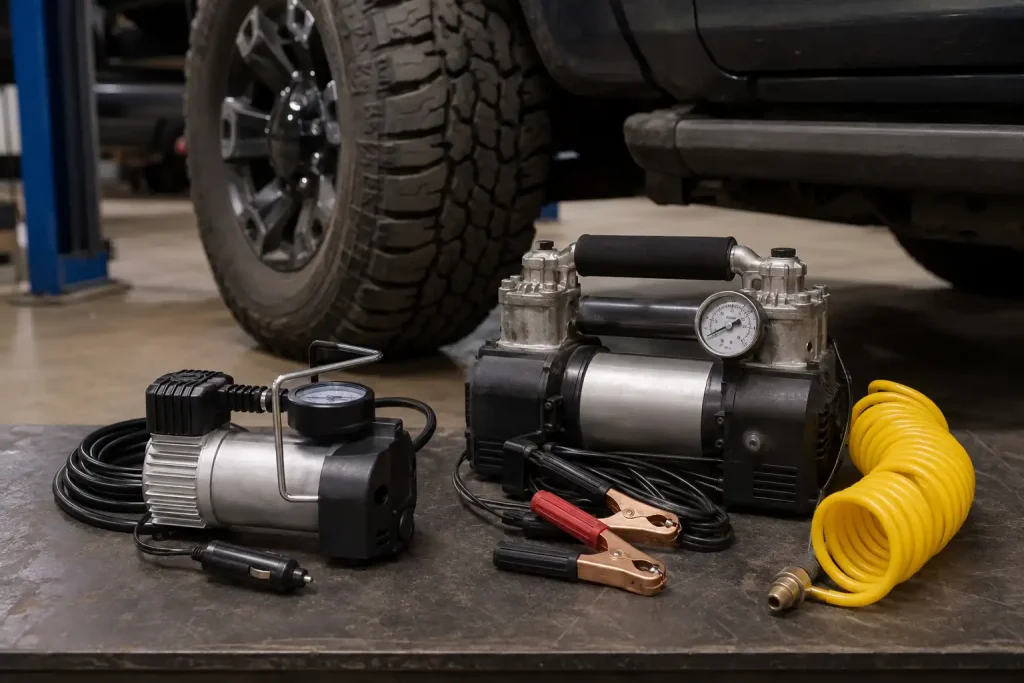
Small inflators often plug into a 12-volt accessory outlet. These outlets have limited electrical capacity.
Higher-output truck inflators normally use:
- Battery clamps connected directly to the truck battery
- A dedicated high-amperage 12-volt circuit
- A permanently mounted onboard air system
- A 120-volt household or shop outlet
Never replace a blown fuse with a higher-rated fuse just to operate a larger inflator. The wiring may overheat and create a fire risk.
5. Evaluate the Hose and Gauge
Truck wheels, dual rear wheels, and valve stems can be difficult to reach. Look for:
- A long, heat-resistant air hose
- A locking or screw-on air chuck
- An accurate pressure gauge
- A dual-head chuck for inner and outer dual tires
- A pressure-release valve for small adjustments
A compressor may be powerful enough but still frustrating to use if its hose cannot reach the inner valve stem.
How Long Does It Take to Inflate a Truck Tire?
Inflation time depends on several factors:
- Tire diameter and width
- Starting pressure
- Target pressure
- Compressor airflow
- Hose restrictions
- Battery voltage
- Outside temperature
- Whether the compressor must stop to cool
Adding five PSI to a half-ton pickup tire may take only a few minutes with a good portable inflator. Inflating a large LT tire from 20 PSI to 70 or 80 PSI can take considerably longer.
A completely flat tire takes the longest because the compressor must replace almost the entire air volume.
Stop the process if the compressor smells hot, repeatedly shuts down, melts a connector, or becomes hotter than its instructions describe as normal.
How to Inflate a Truck Tire Safely
Use the following process when the tire is low but not visibly damaged.
- Park safely.
Move to a level area away from traffic. Apply the parking brake and switch on the hazard lights when necessary. - Inspect the tire.
Look for cuts, exposed cords, sidewall bulges, cracked rubber, a separated tread, or objects lodged in the tire. - Find the correct pressure.
Read the driver-side doorjamb label or owner’s manual. Do not assume that the front and rear tires use the same pressure. - Check the cold pressure.
Tires are considered cold when the vehicle has been parked long enough for heat from driving to dissipate. Pressure normally rises as the tire warms. - Connect the inflator properly.
Follow the manufacturer’s power instructions. Start the engine only if the inflator instructions specifically recommend it and the truck is outdoors. - Inflate in controlled intervals.
Watch the pressure and the compressor temperature. Pause if the machine reaches its operating limit. - Verify with a separate gauge.
Built-in gauges can vary in accuracy. A reliable handheld gauge provides a useful second reading. - Replace the valve cap.
The cap helps keep dirt and moisture out of the valve.
According to the Michelin explanation of tire sidewall markings, the maximum pressure marked on the sidewall identifies a tire limit; it is not automatically the correct operating pressure for every vehicle or load. (Michelin Man)
Can a Small Tire Inflator Fill a Completely Flat Truck Tire?
Possibly, but a completely flat tire requires additional caution.
First, determine why it is flat. Common causes include:
- A nail or screw puncture
- A damaged valve stem
- A leaking wheel rim
- A separated tire bead
- Sidewall damage
- Impact damage from a pothole
- Driving while severely underinflated
If the tire bead has separated from the wheel, a small inflator may not move air quickly enough to reseat it. Bead seating also involves significant risk and should not be attempted with flammable sprays or improvised methods.
A tire that has been driven while flat may have internal structural damage even if it later holds air. It should be removed and inspected by a qualified tire technician.
Warning Signs That Inflation Is Not Safe
Do not continue inflating if you notice:
- A sidewall bulge
- Exposed steel cords or fabric
- A split sidewall
- Severe cracking
- The tread pulling away from the casing
- The tire making popping or snapping sounds
- The wheel being visibly bent
- Air escaping as quickly as the compressor adds it
Do not place your face or body directly beside a damaged tire while inflating it. A weakened tire can fail suddenly.
Using an Inflator on a Loaded or Towing Truck
A truck carrying a heavy payload or towing a trailer places more stress on its tires. Correct pressure becomes especially important because underinflation creates extra heat and sidewall flex.
Do not simply increase the pressure to the sidewall maximum because the bed is loaded. Use the vehicle manufacturer’s guidance, an approved load-inflation table, or instructions from the tire manufacturer.
Also confirm that the truck is not overloaded. Pressure cannot compensate for exceeding the tire, axle, wheel, or vehicle weight rating.
For commercial vehicles, the FMCSA Motor Carrier Safety Planner emphasizes that tires must satisfy inflation, loading, and condition requirements and remain free from specified safety defects. (CSA Compliance)
Choosing the Best Tire Inflator for a Truck
A suitable truck inflator should be selected for reliability rather than simply choosing the cheapest unit with the highest PSI printed on its box.
For Occasional Pressure Adjustments
A medium-duty portable inflator may be enough when:
- You drive a compact, midsize, or half-ton pickup
- Your tires normally operate below approximately 45 PSI
- You only need to add a few PSI
- You are not repeatedly airing tires down for off-road use
For Heavy-Duty Pickups and LT Tires
Choose a stronger compressor when:
- The truck uses LT tires at 60–80 PSI
- Tire diameter is 33 inches or larger
- You tow frequently
- You have dual rear wheels
- You may need to inflate more than one tire
- You regularly drive off-road and air down the tires
Useful features include direct battery clamps, thermal protection, a long hose, a high duty cycle, replaceable air filters, and a clear pressure gauge.
For Commercial Trucks
A small consumer inflator should not be treated as the primary inflation system for a commercial truck.
Commercial applications generally require:
- High-volume shop air
- A commercial portable compressor
- Calibrated inflation equipment
- Proper tire cages for certain service procedures
- Technicians trained in commercial tire safety
A portable compressor may be useful for a minor pressure correction, but it should not replace scheduled inspections or professional tire service.
Cost, Quality, and Durability Considerations
Portable tire inflators range from inexpensive emergency units to professional compressors costing several hundred dollars.
Lower-cost inflators may be acceptable for topping up ordinary pickup tires, but they often have:
- Slower inflation speed
- Shorter hoses
- Lower duty cycles
- Less accurate gauges
- Plastic fittings
- Limited replacement parts
A higher-quality compressor usually provides better heat management, stronger electrical connections, faster airflow, and more durable hoses.
For a truck owner who frequently tows, travels in remote areas, or drives on large tires, reliability is more important than saving a small amount on the initial purchase.
Proper inflation can also support fuel economy and tire life. The U.S. Department of Energy’s gas-saving tire guidance explains that keeping tires at the correct pressure can improve efficiency while helping tires operate more safely and last longer. (Alternative Fuels Data Center)
Expert Tip
 portable tire inflator inflating a truck tire safely” class=”wp-image-9401″/>
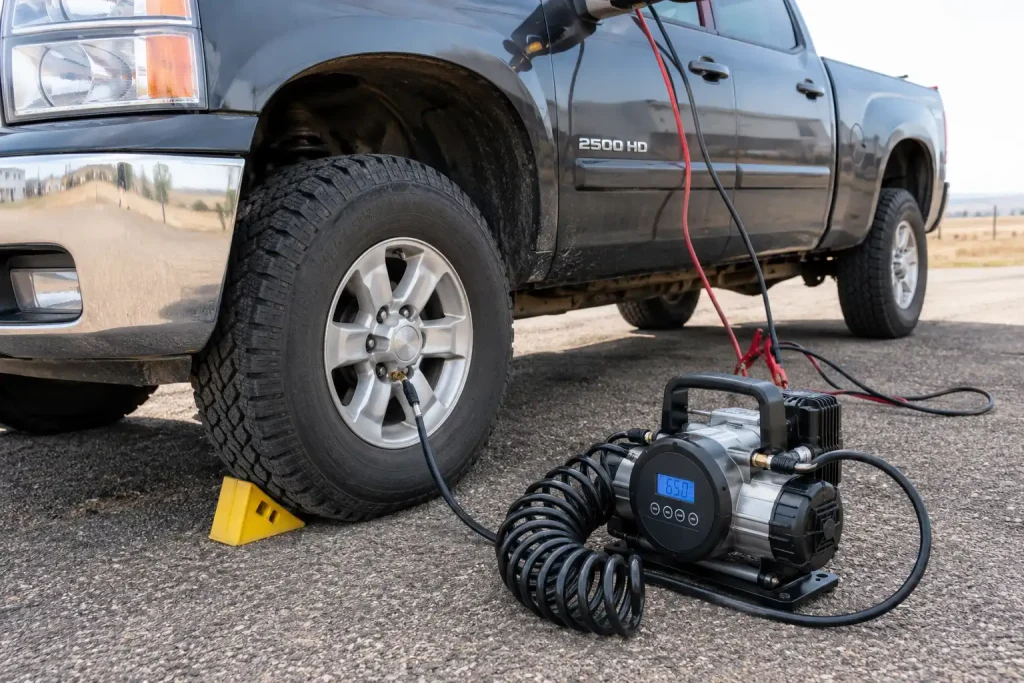
Expert Tip: Run the compressor at home before relying on it during a trip. Confirm that the hose reaches every valve stem, the power cable fits your truck, and the inflator can reach the required rear-tire pressure without overheating.
Can Low Truck Tire Pressure Affect the Transmission?
Low tire pressure does not normally damage a transmission immediately. However, severely underinflated tires increase rolling resistance, meaning the engine and transmission must work harder to move the truck.
The truck may feel:
- Slower during acceleration
- Less responsive when towing
- More likely to downshift on hills
- Unstable or heavy while steering
- Rough or uneven at highway speed
Unequal tire pressure can also create different effective tire diameters. On four-wheel-drive and all-wheel-drive vehicles, large differences in tire circumference may place unnecessary stress on driveline components.
Correct the tire pressure first. If poor acceleration, unusual shifting, vibration, or drivetrain noise remains, the problem may require professional diagnosis.
When to Call a Transmission Professional
Contact a transmission or driveline professional when the truck continues to show symptoms after all tires have been inflated correctly.
Professional diagnosis is appropriate if you notice:
- Delayed engagement into Drive or Reverse
- Engine RPM rising without matching acceleration
- Hard, erratic, or repeated shifting
- Transmission fluid leaks
- A burning smell
- Grinding, whining, or clunking from the drivetrain
- Warning lights or transmission-related diagnostic codes
- Vibration that remains after tire pressure and wheel condition are checked
A technician can determine whether the problem comes from the transmission, transfer case, differential, wheel bearing, driveshaft, tire, or another component.
Do not approve an expensive transmission replacement based only on sluggish performance or vibration. Ask for diagnostic results and confirmation that tire, wheel, brake, and driveline problems have been ruled out.
Common Mistakes Vehicle Owners Should Avoid
- Buying based only on maximum PSI. High pressure does not guarantee fast airflow or truck-tire capability.
- Using the pressure molded on the tire as the normal target. Follow the truck’s placard, owner’s manual, or approved load guidance.
- Ignoring the duty cycle. Running a compressor continuously beyond its limit can damage the motor.
- Using an undersized accessory outlet. A high-current compressor may blow a fuse or overheat the wiring.
- Inflating a visibly damaged tire. Sidewall bulges, exposed cords, and tread separation require professional inspection.
- Trusting only the built-in gauge. Verify the final pressure with a reliable separate gauge.
- Inflating hot tires to the cold specification. Recheck them when cold to avoid an inaccurate final setting.
- Assuming inflation repairs the leak. Added air is temporary when a puncture, valve, rim, or bead is leaking.
- Continuing to drive on a tire that repeatedly loses pressure. Repeated air loss is a defect that needs diagnosis.
- Ignoring the spare tire. A flat or underinflated spare will not help during an emergency.
FAQs
Can a regular car tire inflator inflate a pickup truck tire?
It may inflate a compact or half-ton pickup tire, especially when only a few PSI are needed. Check the inflator’s tire-size rating, pressure capability, airflow, duty cycle, and power requirements before using it.
Is a 150-PSI tire inflator enough for truck tires?
The pressure rating may be high enough, but PSI alone does not confirm suitability. A low-airflow 150-PSI inflator can still be extremely slow and may overheat while filling a large truck tire.
What PSI should I use for my truck tires?
Use the cold pressure listed on the driver-side doorjamb label or in the owner’s manual. Front and rear recommendations may differ, particularly on heavy-duty pickups.
Can I use a cordless tire inflator on truck tires?
Yes, when the cordless unit is specifically rated for the tire size and target pressure. Battery capacity may limit how many large tires it can inflate before recharging.
Should the truck engine be running while using the inflator?
Follow the inflator manufacturer’s instructions. Some high-output 12-volt compressors recommend a running engine to maintain voltage. Operate the vehicle outdoors and keep cables, hoses, clothing, and tools away from moving engine parts.
Can a portable inflator repair a leaking truck tire?
No. It can only add air. A puncture, damaged valve, leaking rim, or bead problem must still be repaired. A tire that loses pressure repeatedly should be inspected before further highway driving or towing.
What type of inflator is best for an 80-PSI truck tire?
Choose a heavy-duty compressor designed for LT tires, with direct battery clamps, strong airflow at higher pressure, a long duty cycle, thermal protection, and a hose that reaches every valve stem.
Conclusion
A tire inflator can inflate truck tires, but only when the inflator matches the tire’s size, pressure, and air-volume requirements. Small portable units may be adequate for light pickups and minor pressure adjustments. Heavy-duty pickups, dual-rear-wheel trucks, and commercial vehicles need stronger equipment.
Check the truck’s recommended cold pressure, inspect the tire before inflation, respect the compressor’s duty cycle, and never continue inflating a visibly damaged tire.
Before your next trip or towing job, test your inflator on every truck tire. If it cannot reach the required pressure safely and efficiently, replace it with a properly rated compressor or have the tires serviced by a qualified shop.
