
Can a Portable Tire Inflator Run From a Power Bank? A Practical Guide for Vehicle Owners

A portable tire inflator can be extremely useful when a tire loses pressure far from a gas station or repair shop. However, many vehicle owners wonder whether they can portable tire inflator run from power bank power when the vehicle’s 12-volt outlet is unavailable.
The answer depends on the inflator’s voltage, current demand, connector, and internal battery design. A regular phone power bank usually cannot operate a conventional 12-volt tire inflator. Some USB-C Power Delivery power banks may work with specially designed inflators, while rechargeable cordless inflators can often be recharged from a power bank.
This guide explains how to identify compatible equipment, calculate power requirements, avoid unsafe adapters, and choose the most reliable emergency setup.
Quick Answer
A portable tire inflator can run from a power bank only when the inflator is designed for USB power or the power bank provides the exact voltage, wattage, connector, and current required. Most standard phone power banks cannot directly operate a 12-volt automotive inflator, although they may recharge a cordless inflator’s internal battery.
The Answer Depends on the Type of Tire Inflator
Not every portable tire inflator uses the same power source. Before connecting anything, identify which of the following designs you own.
| Tire inflator type | Can a power bank operate it? | Best power source |
|---|---|---|
| 12-volt plug-in inflator | Usually no | Vehicle 12-volt accessory outlet |
| USB-rechargeable cordless inflator | Usually rechargeable from a power bank | Internal battery |
| USB-C PD inflator designed for direct power | Possibly, when specifications match | Compatible USB-C PD power bank |
| Tool-battery inflator | Normally no | Manufacturer-approved tool battery |
| 120-volt AC inflator | Not from a regular power bank | Portable power station with AC outlet |
| Inflator with built-in jump starter | Uses its own battery | Manufacturer-supplied charger |
Some inflators support multiple power sources. For example, the manufacturer specifications for a DEWALT corded and cordless inflator list a compatible tool battery, a 12-volt vehicle connection, and an AC power source. This demonstrates why checking the exact model manual matters more than assuming that every portable inflator works the same way. (DeWalt)
Why a Standard Phone Power Bank Usually Cannot Run an Inflator
The connector may physically fit an adapter, but that does not mean the power bank can safely operate the compressor.
Voltage must match
Many small automotive inflators are designed for a vehicle’s 12-volt electrical system. A basic USB-A power bank may supply only 5 volts unless it supports a higher-voltage charging protocol.
Connecting a 12-volt inflator to an ordinary 5-volt source may cause:
- The motor to run slowly
- The inflator to start and stop
- The power bank to shut down
- The adapter or cable to overheat
- The compressor to fail under load
A voltage converter can raise 5 volts to 12 volts, but it cannot create extra energy. Increasing the voltage reduces the current available on the output side and adds conversion losses.
Tire inflators require substantial current
Electric compressor motors draw much more current than phones, earbuds, or small electronic accessories. A phone may charge with relatively modest power, while an inflator motor may need considerably more power when starting and compressing air.
Electrical power can be estimated with this formula:
Watts = Volts × Amps
For example:
- A 5-volt, 2-amp USB output provides 10 watts.
- A 12-volt inflator drawing 10 amps requires about 120 watts.
- A 12-volt inflator drawing 15 amps requires about 180 watts.
These are examples only. Always use the voltage and amperage printed on your inflator’s rating label.
The compressor may also draw a brief surge of current during startup. A power bank that appears powerful enough based on its normal watt rating may still shut down when the motor starts.
USB-C does not automatically mean high power
USB-C describes the connector. It does not guarantee that a device supports every voltage or power level available under the USB-C standard.
The USB-IF Power Delivery overview explains that modern USB Power Delivery can support much higher power levels, including up to 240 watts under the appropriate specification. However, the power bank, cable, adapter, and receiving device must negotiate and support the same power profile. (USB Implementers Forum)
A 100-watt or 140-watt number printed on a power bank does not automatically make it compatible with a 12-volt inflator.
How to Check Whether Your Inflator and Power Bank Are Compatible
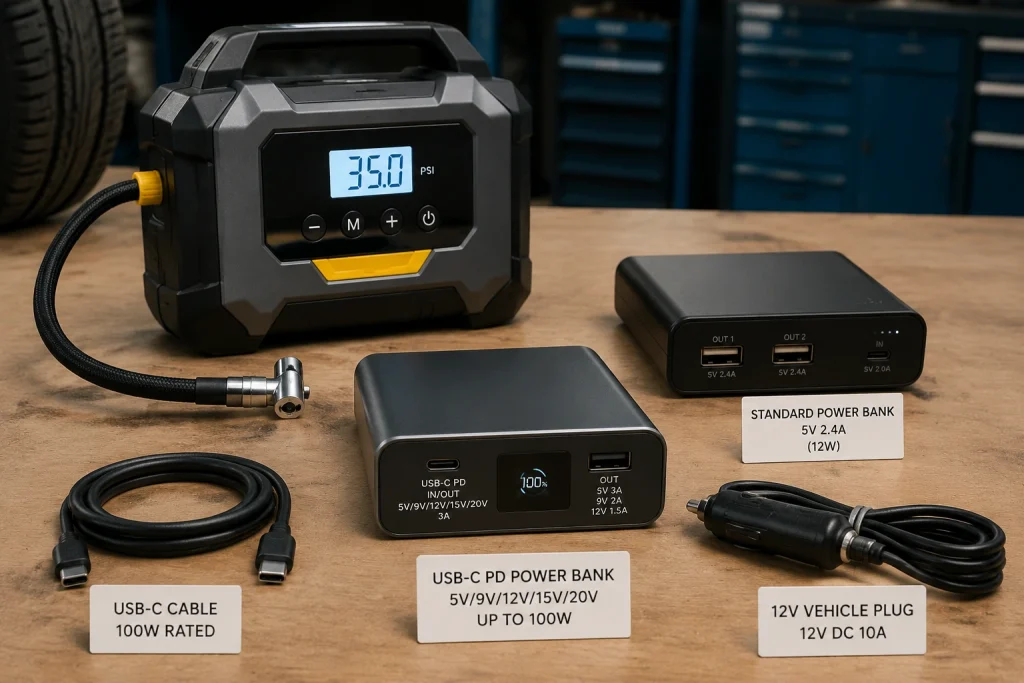
Use the following process before buying an adapter or connecting the equipment.
1. Read the inflator’s input label
Look for information printed on the inflator, charger, battery compartment, or owner’s manual.
You may see ratings such as:
- Input: 12V DC
- Rated current: 10A
- Rated power: 120W
- Charging input: 5V/2A
- USB-C input: 9V/2A
- Battery voltage: 18V or 20V maximum
Do not confuse charging input with operating input. A USB-C port may recharge the internal battery without being able to power the compressor directly.
2. Read the power bank’s output specifications
Find the output table printed on the power bank or in its manual. Check the output for the exact port you plan to use.
A USB-C port might offer several profiles, such as:
- 5 volts
- 9 volts
- 12 volts
- 15 volts
- 20 volts
Not every power bank includes a 12-volt profile. Even when it does, the available amperage may be too low for the inflator.
3. Compare wattage and current
The power bank’s continuous output should meet the inflator’s requirements. It should also tolerate motor startup demand.
Do not rely only on the power bank’s total combined output. A product may advertise 100 watts across all ports while providing less through the individual port being used.
4. Confirm the connector and polarity
Barrel-style DC connectors have different sizes and polarity arrangements. One adapter may physically fit while placing positive and negative voltage on the wrong contacts.
Reverse polarity can damage the inflator immediately.
Use only:
- The manufacturer-supplied cable
- An officially approved adapter
- A cable specifically documented for both devices
5. Check whether simultaneous charging and operation are allowed
Some rechargeable inflators will not run while charging. Others may technically start but place excessive heat and stress on the internal battery.
The manual should clearly state whether pass-through operation is supported. When the manual is silent, charge the inflator first and disconnect the power bank before running the compressor.
The Safest Ways to Power a Portable Tire Inflator
Use the vehicle’s 12-volt outlet
For a conventional 12-volt inflator, the vehicle accessory outlet is normally the simplest solution. Make sure the outlet’s fuse rating can support the inflator’s current requirement.
Some vehicles require the ignition to be in accessory mode or the engine to be running before the outlet receives power. Follow the vehicle and inflator manuals.
Never replace a blown vehicle fuse with a higher-rated fuse. A larger fuse can allow the wiring to overheat before the circuit is interrupted.
Use a rechargeable inflator as intended
A cordless inflator with an internal battery is often the best choice for drivers who want power-bank compatibility. In this setup, the power bank recharges the inflator instead of directly operating the motor.
This arrangement provides several advantages:
- No improvised voltage converter
- Fewer loose adapters
- Easier roadside use
- Lower risk of overloading a USB cable
- Continued operation when the vehicle battery is weak
Recharge the inflator regularly. Leaving it in a hot vehicle for long periods can accelerate battery aging.
Use the correct tool battery
Inflators from cordless tool systems are designed around approved battery packs. These packs can deliver the high current required by the compressor motor.
Do not connect loose lithium-ion cells or homemade battery adapters. Use the battery platform and charger specified by the manufacturer.
Use a portable power station
A portable power station is larger than a phone power bank and may include:
- A regulated 12-volt outlet
- A high-output USB-C port
- A 120-volt AC outlet
- Higher continuous and surge capacity
This may be suitable for an AC or 12-volt inflator when the output rating matches. However, the power station should still be treated as an electrical source with defined limits—not as unlimited power.
Expert Tip:
Choose the simplest approved power path. A fully charged cordless inflator or a direct 12-volt vehicle connection is usually more dependable than combining a phone power bank, voltage converter, trigger cable, and multiple adapters.
How to Use a Compatible Power Bank Safely
When the inflator manufacturer specifically approves power-bank or USB-C operation, use these steps:
- Inspect the power bank. Do not use one that is swollen, cracked, leaking, unusually hot, or previously water-damaged.
- Confirm the output profile. Match the required voltage, amperage, and wattage.
- Use a correctly rated cable. A low-quality USB-C cable may overheat or limit power.
- Place the power bank on a hard surface. Keep it away from carpeting, paper, direct sunlight, and the engine compartment.
- Connect the hose before starting. Secure the tire chuck to reduce unnecessary compressor runtime.
- Set the correct pressure. Use the pressure listed on the driver’s door placard or in the owner’s manual.
- Watch the equipment continuously. Stop immediately if the cable, adapter, inflator, or power bank becomes excessively hot.
- Respect the duty cycle. Let the compressor cool after the operating period specified by the manufacturer.
- Disconnect after inflation. Do not leave the equipment energized inside the vehicle.
The NHTSA tire safety guidance recommends checking tire pressure regularly and using the vehicle manufacturer’s recommended pressure. The number molded into the tire sidewall is generally the tire’s maximum pressure rating, not necessarily the correct operating pressure for the vehicle. (NHTSA)
How Long Could a Power Bank Run an Inflator?
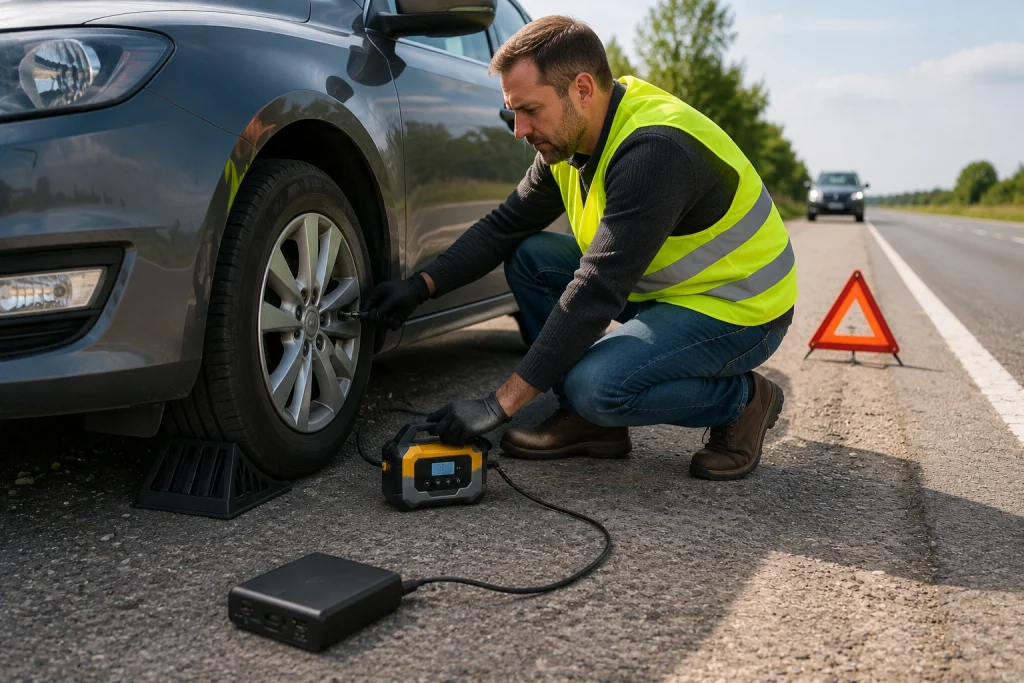
Power-bank capacity is commonly advertised in milliamp-hours, or mAh. This number can be misleading when comparing devices that operate at different voltages.
Watt-hours provide a more useful estimate:
Watt-hours = Battery voltage × Amp-hours
A 20,000 mAh power bank may contain roughly 20 amp-hours at an internal cell voltage near 3.7 volts. That equals approximately 74 watt-hours before conversion losses.
To estimate theoretical runtime:
Runtime in hours = Usable watt-hours ÷ Inflator wattage
A 60-watt load connected to a 74-watt-hour battery would have a theoretical runtime slightly above one hour. Real runtime would be shorter because of:
- Voltage conversion losses
- Battery protection limits
- Compressor startup demand
- Heat
- Battery age
- Power bank shutdown settings
Tire inflators are also not intended to run continuously for long periods. Their duty cycles may require cooling breaks after several minutes.
Warning Signs That the Power Source Is Not Suitable
Stop using the setup when you notice any of these signs:
- The power bank repeatedly shuts off
- The compressor starts but cannot build pressure
- The motor speed rises and falls
- The USB or adapter cable becomes hot
- The connector produces sparks
- You smell hot plastic or electrical insulation
- The power bank swells or changes shape
- The inflator displays a low-voltage error
- The tire pressure reading becomes unstable
Do not keep restarting a system that repeatedly trips its protection circuit. The shutdown may be preventing cable damage, overheating, or battery failure.
Lithium-ion power banks can present fire and burn hazards when damaged or defective. Vehicle owners can check the CPSC recall database for safety notices involving their power bank or battery equipment. (U.S. Consumer Product Safety Commission)
Cost, Quality, and Durability Considerations
The least expensive option is usually a basic 12-volt inflator that plugs into the vehicle. It can be dependable when the cord, fuse, and accessory outlet are in good condition, but it cannot normally run from a phone power bank.
Rechargeable USB-C inflators provide greater convenience but depend on internal battery health. Their compact motors may also inflate large SUV or truck tires more slowly.
Tool-battery inflators generally cost more, especially when a compatible battery and charger must be purchased separately. Their advantages include replaceable batteries, higher current capability, and potentially longer service life.
Portable power stations provide the most flexibility but are heavier, more expensive, and unnecessary for drivers who only need occasional tire top-offs.
Prioritize:
- Clearly published electrical specifications
- Automatic shutoff
- An accurate pressure gauge
- Overheat protection
- Replaceable fuses or batteries
- A useful warranty
- Available replacement hoses and cables
- Manufacturer support
Common Mistakes Vehicle Owners Should Avoid
- Assuming every USB-C port provides the same output.
- Buying an adapter based only on connector shape.
- Confusing the inflator’s charging port with a direct operating input.
- Using a low-cost voltage booster without checking its continuous current rating.
- Ignoring the compressor’s startup power demand.
- Replacing a blown vehicle fuse with a larger fuse.
- Running the inflator longer than its stated duty cycle.
- Inflating to the maximum PSI printed on the tire sidewall.
- Leaving a lithium power bank on a hot dashboard.
- Operating a compressor while its internal battery is charging when pass-through use is not approved.
- Continuing to use a swollen, damaged, or recalled power bank.
When to Call a Transmission Professional
A tire inflator power problem normally does not require a transmission specialist. A tire shop or automotive electrical technician is usually the correct choice when:
- The vehicle’s 12-volt outlet has no power
- The accessory fuse repeatedly blows
- Tire pressure drops again after inflation
- The valve stem leaks
- The tire has visible damage
- The wheel or tire vibrates at highway speed
- The tire pressure monitoring light remains on
Contact a transmission professional when drivability symptoms continue after the tires have been inspected and correctly inflated. Examples include transmission slipping, delayed engagement, harsh shifting, unusual whining, or a shudder that occurs during specific gear changes.
Low or uneven tire pressure can affect ride quality and vehicle behavior, but it does not usually cause an internal transmission failure. Proper diagnosis prevents spending money on the wrong repair.
FAQs
Can a 20,000 mAh power bank run a tire inflator?
Capacity alone does not determine compatibility. The power bank must provide the inflator’s required voltage, continuous current, wattage, and startup power. Most ordinary 20,000 mAh phone power banks cannot directly run a conventional 12-volt inflator.
Can I use a USB-to-12-volt cable for my inflator?
Only when the cable or converter is specifically rated for the inflator’s current demand and the manufacturer approves the setup. Many inexpensive USB-to-12-volt cables are intended for low-power electronics, not compressor motors.
Can a USB-C laptop power bank operate an inflator?
Possibly, but only when the inflator supports USB-C PD input and the required voltage profile. A laptop power bank with adequate wattage may still fail if it does not provide the correct voltage or handle the motor’s startup demand.
Can I run a rechargeable inflator while charging it?
Some models allow it, while others do not. Check the manual for pass-through operation. When this feature is not clearly approved, fully charge the inflator first and disconnect the charging cable before using the compressor.
Will a power bank damage my tire inflator?
A correctly matched and manufacturer-approved power source should not. Incorrect voltage, reversed polarity, inadequate current, poor-quality adapters, or unstable converters can damage the motor or control electronics.
Is a jump starter power bank suitable for a tire inflator?
Some jump starter units include a regulated 12-volt accessory output or a built-in compressor. Use only the designated output and follow the manufacturer’s instructions. Never connect an inflator directly to exposed jump-start terminals unless the equipment is specifically designed for that connection.
What is the best emergency power option for a tire inflator?
For most drivers, the best options are a reliable 12-volt inflator connected to the vehicle or a fully charged cordless inflator. Both are generally simpler and safer than using adapters to run a compressor from a phone power bank.
Conclusion
So, can portable tire inflator run from power bank power? In some cases, yes—but only when the inflator and power bank are specifically compatible. A normal USB phone power bank usually cannot supply the voltage, current, or startup power required by a conventional 12-volt compressor.
Check the input label, output profiles, connector polarity, wattage, and manufacturer instructions before connecting any equipment. Avoid improvised adapters when the specifications are unclear.
For dependable roadside protection, keep a correctly rated inflator in the vehicle, test it before an emergency, maintain its battery, and check your tire pressure regularly. When a tire continues losing air, have it inspected rather than repeatedly inflating it and continuing to drive.
