
Does a Portable Tire Inflator Need Charging? A Complete Vehicle Owner’s Guide

A portable tire inflator can be extremely useful when a tire loses pressure at home, at work, or during a road trip. However, many vehicle owners discover too late that their inflator has a dead battery—or that it was never designed to be charged at all.
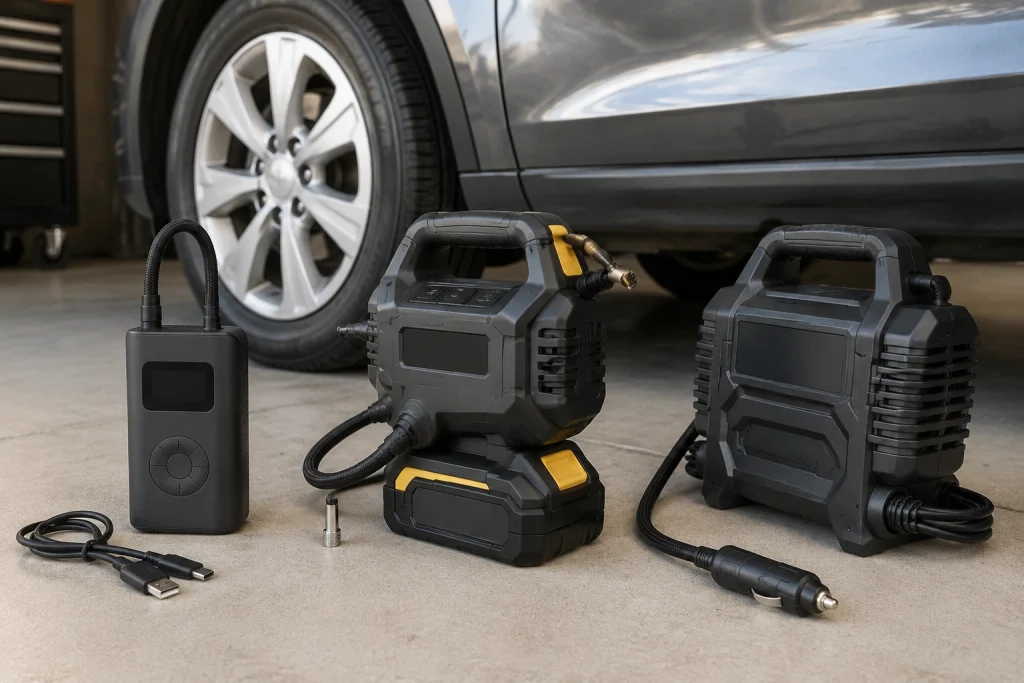
So, does a portable tire inflator need charging? It depends entirely on how the inflator receives power. Rechargeable cordless models need charging, while 12-volt plug-in inflators draw power directly from the vehicle. Some models use removable tool batteries, household outlets, or several power sources.
This guide explains how to identify your inflator type, charge it safely, maintain its battery, and decide which design is most dependable for your vehicle.
Quick Answer
A portable tire inflator needs charging only if it contains a rechargeable battery or uses a removable cordless-tool battery. A 12-volt inflator that plugs into a vehicle accessory outlet does not need charging. Hybrid models may work from a battery, vehicle outlet, or household power, depending on the design.
Do All Portable Tire Inflators Need Charging?
No. The word portable describes the inflator’s size and mobility, not necessarily its power source.
Portable tire inflators generally fall into four categories:
- Rechargeable inflators with built-in batteries
- Cordless inflators with removable batteries
- 12-volt inflators powered by a vehicle
- Hybrid or household-powered inflators
The charging requirement depends on which type you own.
Rechargeable Inflators With Built-In Batteries
These compact inflators contain an internal lithium-ion battery. They usually charge through:
- USB-C
- Micro-USB
- A dedicated charging adapter
- A charging dock
These models must be charged before use. Once the battery is depleted, the inflator normally cannot operate until it receives enough charge.
Rechargeable inflators are convenient because you do not have to unwind a long power cable or keep the vehicle running. However, their usefulness depends on battery condition, temperature, and how long they have been stored.
Cordless Inflators With Removable Batteries
Some inflators use the same removable battery packs found in cordless drills, impact drivers, and other power tools.
For example, the official Milwaukee M12 Compact Inflator Kit includes a removable lithium-ion battery and a separate charger. The battery must be charged outside the inflator before installation. (Milwaukee Tool)
These models can be practical when you already own compatible batteries. You can also carry a second charged battery for backup.
Check the package carefully. A product marked “tool only” may not include a battery or charger.
12-Volt Vehicle-Powered Inflators
A 12-volt inflator plugs into the vehicle’s accessory outlet, sometimes still called the cigarette-lighter socket.
It does not contain a battery that needs charging. Instead, it uses electricity from the vehicle while connected.
Depending on the vehicle, the accessory outlet may work:
- With the engine off
- With the ignition in accessory mode
- Only while the engine is running
Check your owner’s manual before use. Operating a high-draw inflator for too long with the engine off can weaken the vehicle battery.
Never run a vehicle inside a closed garage or other enclosed space just to power an inflator. Move the vehicle outdoors where exhaust gases can disperse safely.
Hybrid Inflators
Hybrid inflators offer more than one power option. A unit may run from:
- A rechargeable battery
- A removable tool battery
- A 12-volt vehicle outlet
- A 110- or 120-volt household outlet
The DEWALT corded and cordless inflator, for example, is designed to operate from a compatible battery, 12-volt DC power, or household AC power. (DEWALT)
A hybrid design provides useful backup. If the battery is empty, you may still be able to power the inflator from the vehicle.
How to Tell Whether Your Tire Inflator Needs Charging
You usually do not need technical knowledge to identify the power system.
Look for the following features:
| Inflator feature | Power type | Does it need charging? |
|---|---|---|
| USB-C or Micro-USB charging port | Built-in rechargeable battery | Yes |
| Removable power-tool battery | Cordless battery system | Yes, charge the battery separately |
| Long cable with 12-volt vehicle plug | Vehicle-powered | No |
| Household wall plug | AC-powered | No internal charging required |
| Battery port plus 12-volt cable | Hybrid | Only for cordless operation |
| Battery-level symbol on the display | Usually rechargeable | Usually yes |
You can also inspect the product label or manual for terms such as:
- Rechargeable
- Lithium-ion
- Battery capacity
- Charging input
- DC input
- AC input
- Battery sold separately
Do not assume that a USB port always charges the inflator. On some emergency devices, a USB port is an output used to charge a phone.
How Often Should You Charge a Portable Tire Inflator?
There is no single charging schedule for every inflator. Battery size, storage temperature, usage frequency, and electronic standby drain all affect how quickly a battery loses power.
A practical routine is to:
- Charge the inflator fully after using it
- Check the battery indicator before a long trip
- Test the inflator every one to three months
- Recharge it when the battery level becomes low
- Follow the storage instructions in the owner’s manual
Do not leave a rechargeable inflator untouched in the trunk for a year and assume it will work during an emergency.
Extreme heat and cold can also reduce battery performance. A unit stored in a very hot vehicle may lose capacity faster, while a cold battery may provide less power until it warms to a safe operating temperature.
How Long Does Charging Take?
Charging time depends on several factors:
- Battery capacity
- Charger output
- USB cable quality
- Charging-port type
- Battery temperature
- Remaining battery level
Small USB-powered inflators may require several hours for a full charge. Larger removable tool batteries may charge faster or slower depending on the charger.
The most reliable answer is in the product manual. Avoid guessing based only on the charging connector.
A USB-C port does not automatically mean fast charging. The inflator and charger must both support compatible charging standards.
How to Charge a Portable Tire Inflator Safely
Use the following process unless the manufacturer provides different instructions.
- Turn the inflator off.
Do not try to operate it while charging unless the manual specifically allows pass-through operation. - Allow a hot inflator to cool.
Inflation creates heat. Charging immediately after heavy use may place additional stress on the battery. - Inspect the charging port and cable.
Do not use damaged, loose, melted, or exposed wiring. - Use the supplied or manufacturer-approved charger.
The charger must provide the correct voltage and current. - Charge on a hard, dry surface.
Keep the inflator away from water, fuel, oil, paper, bedding, and other flammable materials. - Monitor the charging process.
Stop charging if the battery swells, leaks, smells unusual, becomes excessively hot, or makes abnormal sounds. - Disconnect it when charging is complete.
Do not leave the unit permanently connected unless the manual says its charging system supports long-term maintenance.
Although the U.S. Consumer Product Safety Commission’s battery-charging safety guidance addresses micromobility products, its basic lithium-battery principles are also sensible for rechargeable automotive accessories: use the supplied charger, follow manufacturer instructions, remain present during charging, and unplug the product when finished. (U.S. Consumer Product Safety Commission)
Expert Tip: Charge and test your inflator the day before a road trip—not while packing the vehicle. This gives you time to replace a damaged cable, weak battery, or inaccurate gauge before you need the tool.
How to Know When the Inflator Battery Is Fully Charged
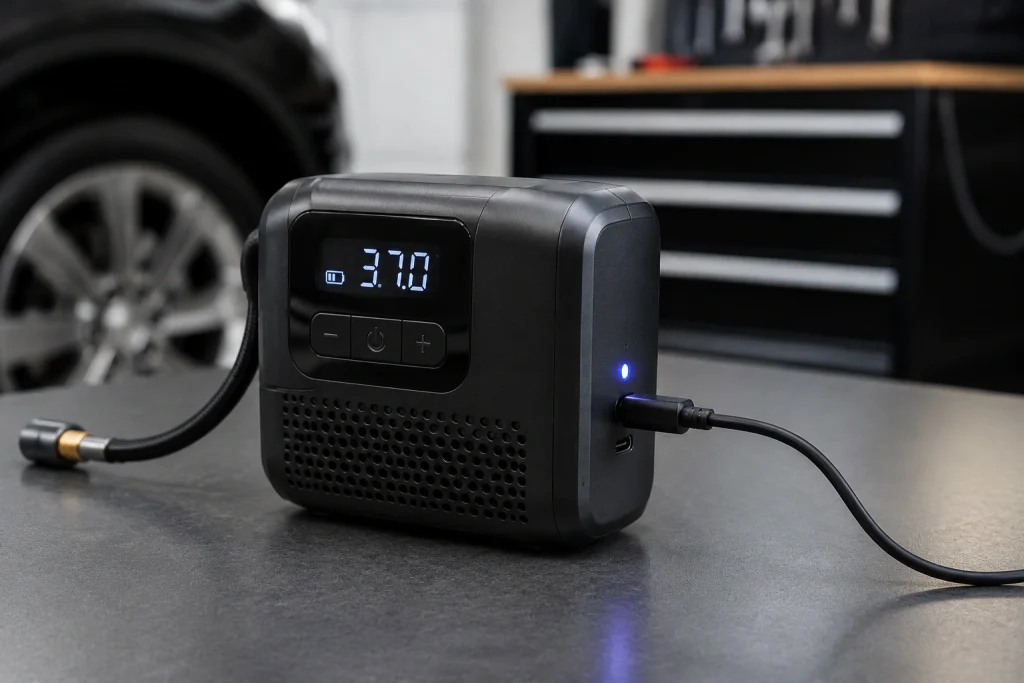
Many rechargeable models use one or more of these indicators:
- A battery icon with full bars
- A green charging light
- A light that stops blinking
- A display showing 100%
- A charger status light
The meaning of each light varies by model. On one inflator, red may mean charging. On another, red may indicate a fault.
Consult the manual rather than relying on color alone.
If the indicator never changes after the expected charging period, disconnect the unit and inspect the charger, cable, port, and battery.
Signs the Inflator Battery May Be Failing
Rechargeable batteries gradually lose capacity. Common warning signs include:
- The battery drains while stored
- Runtime becomes noticeably shorter
- The inflator stops before reaching the selected pressure
- Charging takes much longer than normal
- The unit shuts down under load
- The battery becomes unusually hot
- The case begins to swell
- The charger repeatedly reports an error
Stop using an inflator with a swollen, leaking, cracked, or overheating battery. Do not puncture the battery or place it in household trash.
For a model with a sealed internal battery, replacement may not be economical. A removable-battery inflator may only need a new compatible battery pack.
Can You Use a Portable Tire Inflator While It Is Charging?
Usually, you should not.
Many compact inflators cannot operate while connected to a USB charger. Their charging circuits may not provide enough current to run the compressor motor.
Even when the display turns on, the motor may stop as soon as inflation begins.
Use while charging is appropriate only when the manufacturer specifically supports it. Hybrid models are different because they may have a dedicated 12-volt or AC operating input separate from the battery-charging port.
Do not improvise with adapters or modified wiring. Incorrect voltage or polarity can damage the inflator, overheat the cable, or create a fire risk.
How Much Battery Power Does Tire Inflation Use?
Adding two or three pounds of pressure to a passenger-car tire uses less energy than inflating a nearly flat tire.
Battery usage increases when:
- The tire is large
- The starting pressure is very low
- The target pressure is high
- The weather is cold
- The hose or valve connection leaks
- Several tires are inflated in one session
- The battery is old or partially charged
A small cordless inflator may be excellent for pressure adjustments but poorly suited to inflating four large truck tires from a very low pressure.
Pay attention to the manufacturer’s stated duty cycle. The duty cycle tells you how long the compressor can run before it needs to cool.
Continuing beyond that limit can overheat the motor, hose, fittings, or internal wiring.
Correct Tire Pressure Matters More Than Maximum Inflator PSI
An inflator advertised as capable of producing 120 or 150 PSI is not telling you how much pressure your passenger-car tires need.
Use the pressure printed on:
- The driver-side doorjamb label
- The Tire and Loading Information label
- The vehicle owner’s manual
Do not use the maximum pressure molded into the tire sidewall as your normal target.
The NHTSA tire-safety guidance recommends checking all tires, including the spare, at least once a month when they are cold. It also explains that the vehicle manufacturer’s recommended pressure—not the tire’s sidewall maximum—is the correct setting. (NHTSA)
For the most accurate reading, check pressure before driving or after the vehicle has remained parked for at least three hours.
Safe Steps for Using a Portable Tire Inflator
- Park on a firm, level surface away from traffic.
- Shift into Park or select neutral in a manual vehicle.
- Apply the parking brake.
- Find the recommended cold tire pressure.
- Inspect the tire for cuts, bulges, exposed cords, or major damage.
- Connect the hose securely to the valve stem.
- Select the correct pressure unit, such as PSI.
- Set the target pressure if the inflator has automatic shutoff.
- Start the inflator and monitor it.
- Stop if the unit, cable, plug, or hose becomes excessively hot.
- Confirm the final pressure with a reliable gauge.
- Replace the valve cap.
Do not attempt to inflate a tire with severe sidewall damage, exposed reinforcement cords, a separated tread, or a tire that has come off the wheel rim. Arrange roadside assistance or professional service.
Choosing the Best Power Type for Your Vehicle
The best design depends on where and how you drive.
Choose a Rechargeable Inflator When:
- You value cordless convenience
- You routinely top off passenger-car tires
- You can remember to recharge it
- You want a compact unit for bicycles or sports equipment
- You store it where temperatures remain moderate
Choose a 12-Volt Inflator When:
- You want dependable power without battery maintenance
- The unit will remain in the vehicle
- You take long road trips
- You do not already own compatible tool batteries
- You are comfortable managing a power cord
Choose a Removable-Battery Inflator When:
- You already own batteries from the same tool system
- You want to carry spare battery packs
- You need more runtime than a small built-in battery offers
- You prefer replacing the battery instead of the entire inflator
Choose a Hybrid Inflator When:
- You want multiple backup power options
- You maintain more than one vehicle
- You may use the inflator in both a garage and roadside setting
- Reliability is more important than minimum size
Cost, Quality, and Durability Considerations
Basic 12-volt inflators are often the least expensive because they do not require an internal battery or charger.
Rechargeable and hybrid models generally cost more because they may include:
- Lithium-ion batteries
- Digital controls
- Automatic shutoff
- LED lights
- USB charging
- Higher-output motors
- Thermal protection
Do not judge an inflator only by its maximum PSI rating. For normal vehicle use, these factors are often more useful:
- Inflation speed
- Gauge accuracy
- Hose length
- Power-cord length
- Duty cycle
- Replacement-battery availability
- Warranty coverage
- Overheat protection
- Quality of the valve connector
A durable 12-volt inflator may be a better emergency tool than a low-quality rechargeable model with an impressive feature list.
Common Mistakes Vehicle Owners Should Avoid
- Assuming every portable inflator is rechargeable: Check the power connection before storing it in the vehicle.
- Leaving a cordless inflator untested for months: The battery may discharge during storage.
- Using a random charger: Incorrect charging equipment can damage the battery or charging circuit.
- Inflating to the tire sidewall pressure: Use the vehicle manufacturer’s recommended pressure.
- Ignoring the duty cycle: Small compressors need cooling periods.
- Running the vehicle in an enclosed garage: Exhaust gases can accumulate quickly.
- Using an accessory outlet with an incorrect fuse rating: Check the vehicle manual and inflator requirements.
- Continuing when cables or plugs become hot: Disconnect the inflator and inspect the electrical connection.
- Trying to repair serious tire damage with air: An inflator cannot make a cut, bulge, failed bead, or damaged sidewall safe.
- Relying only on the TPMS warning: A tire-pressure monitoring system may not alert you until pressure is already significantly low.
When to Call a Transmission Professional
A portable tire inflator problem normally does not require a transmission specialist. For tire damage, repeated air loss, a bent wheel, or an inaccurate TPMS reading, contact a tire shop or qualified general mechanic.
However, low tire pressure can sometimes appear alongside symptoms that owners mistake for a transmission problem. Call a transmission professional when the vehicle also has:
- Engine speed increasing without normal acceleration
- Delayed engagement after selecting Drive or Reverse
- Harsh, slipping, or missed gear changes
- Transmission-fluid leakage
- Grinding or abnormal driveline noises
- A transmission warning message
- A vehicle that will not move despite normal engine operation
Do not assume that slow acceleration is caused only by a soft tire. Check the tire pressure first, then arrange proper diagnosis if the drivability problem remains.
When selecting a shop, ask for a written diagnosis and itemized estimate before approving major transmission work. A reputable technician should explain the test results, recommended repair, parts, labor, warranty, and whether less expensive corrective work is possible.
FAQs
Does a portable tire inflator need charging before first use?
A rechargeable model usually should be fully charged before its first use. A 12-volt inflator does not need charging because it receives power from the vehicle.
Can I leave a rechargeable tire inflator in my car?
You can store one in a vehicle if the manufacturer permits it, but extreme heat and cold may reduce battery performance and lifespan. Inspect and test it regularly.
Will a 12-volt tire inflator drain my car battery?
It can weaken the battery if operated for an extended period with the engine off. Follow the inflator and vehicle instructions. Never run the engine in an enclosed area.
Can I charge my tire inflator with any USB charger?
Not necessarily. Use the supplied charger or one that meets the manufacturer’s voltage, current, and charging-standard requirements.
How do I know whether my inflator is rechargeable?
Look for a charging port, battery-level indicator, internal battery specification, or removable battery pack. A long cable ending in a vehicle accessory plug usually indicates a non-rechargeable 12-volt model.
Why does my tire inflator lose charge while stored?
Rechargeable batteries slowly lose energy over time. Electronic displays, temperature exposure, battery age, and internal standby circuits can increase the loss.
Can a portable inflator repair a flat tire?
No. It can add air, but it cannot repair a puncture, damaged sidewall, failed valve, separated tread, or wheel problem. A tire that quickly loses the added air needs professional inspection.
Conclusion
Whether a portable tire inflator needs charging depends on its power system. Built-in and removable-battery models require charging, while 12-volt vehicle-powered and household-powered models do not. Hybrid inflators may offer both cordless operation and a wired backup.
Before relying on any inflator, identify its power source, read the charging instructions, test its gauge, and check its condition. Keep rechargeable models charged, respect the compressor’s duty cycle, and always inflate tires to the vehicle manufacturer’s recommended pressure.
Check your inflator today, confirm that it powers on, and store its correct cable, charger, hose, and adapters together. A few minutes of preparation can prevent an uncharged inflator from becoming useless when you need it most.
