
Does a Tire Inflator Work Without the Car Running?

A low-pressure warning often appears at the worst possible time—before work, during a road trip, or when your vehicle has been parked overnight. This raises a practical question: does a tire inflator work without the car running?
In many cases, it does. However, the answer depends on the inflator’s power source, whether your vehicle’s 12-volt outlet remains active, the condition of the battery, and the manufacturer’s instructions.
Using the wrong setup can drain a weak battery, blow an accessory-outlet fuse, overheat the inflator, or expose you to dangerous exhaust fumes. This guide explains when you can inflate a tire with the engine off, when the engine should be running, and how to use the inflator safely.
Quick Answer
Yes, many tire inflators work without the car running. Cordless and household-powered models operate independently. A 12-volt plug-in inflator works with the engine off only when the accessory socket has power and the battery has enough charge. Always check the inflator manual and your vehicle owner’s manual before use.
Why the Answer Depends on the Inflator’s Power Source
Not every portable tire inflator receives electricity in the same way. Identifying the power source is the first step.
12-Volt Plug-In Tire Inflators
A 12-volt inflator plugs into the vehicle’s accessory outlet, sometimes called the cigarette-lighter socket.
It may work with the engine off when:
- The outlet remains powered after the vehicle is turned off.
- The ignition is placed in Accessory or On mode.
- The battery has enough charge.
- The outlet and fuse can handle the inflator’s current demand.
- The inflator manufacturer permits engine-off operation.
Some vehicles automatically turn off their accessory outlets when the ignition is off. Others keep one or more outlets powered continuously. Certain vehicles also shut the outlet down after several minutes to protect the battery.
Therefore, a 12-volt inflator that works with the engine off in one vehicle may not work the same way in another.
Cordless Tire Inflators
A cordless inflator contains a rechargeable battery or uses a removable power-tool battery.
These models normally work with the vehicle completely off. They are useful when:
- The vehicle battery is weak.
- The 12-volt outlet is not working.
- You need to inflate bicycle, trailer, or lawn-equipment tires away from the car.
- You do not want to leave the engine running.
The main limitation is battery capacity. A partially charged cordless inflator may handle a small pressure adjustment but fail while filling a large or completely flat tire.
Household AC Inflators
An inflator powered by a standard household outlet does not depend on the vehicle’s battery or engine. It can be used with the vehicle off, provided the power cord and equipment are rated for outdoor use.
This type is practical for home garages and routine pressure checks, but it is less useful during roadside emergencies.
Direct-to-Battery Inflators
Larger inflators may connect directly to the vehicle battery with positive and negative clamps.
They can often operate with the engine off, but they usually draw more current than a small accessory-socket model. Follow the manufacturer’s instructions carefully regarding engine operation, clamp placement, polarity, and duty cycle.
Connecting the clamps backward can damage the inflator or the vehicle’s electrical system.
Do Manufacturers Recommend Running the Engine?
Recommendations differ by inflator model.
For example, the official Slime 12V Digital Tire Inflator instructions recommend operating the inflator with the engine running for optimal performance. The manual also requires a 12-volt outlet rated at 15 amps or higher and warns against starting the vehicle while the inflator is already plugged in.
By comparison, the official DEWALT cordless and 12V inflator manual allows operation from a rechargeable battery, an AC power supply, or a vehicle’s 12-volt accessory socket. When using the vehicle outlet, DEWALT specifies that the socket must be rated for at least 10 amps.
These examples show why there is no universal answer. The instructions for your specific inflator take priority over general advice.
When It Is Reasonable to Leave the Engine Off
Engine-off operation is generally reasonable when:
- You are using a charged cordless inflator.
- You are using household AC power.
- The 12-volt outlet remains active with the engine off.
- The inflator manual allows engine-off use.
- The vehicle battery is healthy.
- You are adding only a few pounds of pressure.
- The inflator runs normally without slowing or overheating.
A brief pressure correction normally places less demand on the battery than filling a completely flat tire. Even so, battery age, temperature, inflator current draw, and run time all affect the result.
When Running the Engine May Be Better
Running the engine may provide more stable electrical power when:
- The inflator manual specifically recommends it.
- You are filling several tires.
- You are inflating large truck or SUV tires.
- A tire is significantly underinflated.
- The weather is very cold.
- The compressor motor sounds weak with the engine off.
- The battery is healthy enough to start the vehicle but may not support a long inflation cycle.
When engine operation is recommended, start the vehicle before plugging in or switching on the inflator, unless the product manual states otherwise.
Never Run the Engine in a Garage
Do not operate a running vehicle in a garage, even with the garage door open. The Environmental Protection Agency warns that carbon monoxide from an idling vehicle can build up quickly in a garage and enter nearby living areas. Use the inflator outdoors in an open, well-ventilated location. Read the EPA’s carbon monoxide prevention guidance for additional safety information. (US EPA)ower Options Compared
| Inflator type | Works with engine off? | Main limitation | Best use |
|---|---|---|---|
| 12-volt accessory inflator | Sometimes | Outlet may switch off or battery may drain | Roadside pressure adjustments |
| Cordless inflator | Yes | Battery must be charged | Portable emergency use |
| Household AC inflator | Yes | Requires access to an electrical outlet | Routine home maintenance |
| Direct-to-battery inflator | Usually | Higher current draw and clamp risks | Trucks, SUVs, and larger tires |
| Dual-power inflator | Yes, depending on selected source | Usually larger and more expensive | Home and roadside versatility |
How Long Can a Tire Inflator Run With the Engine Off?
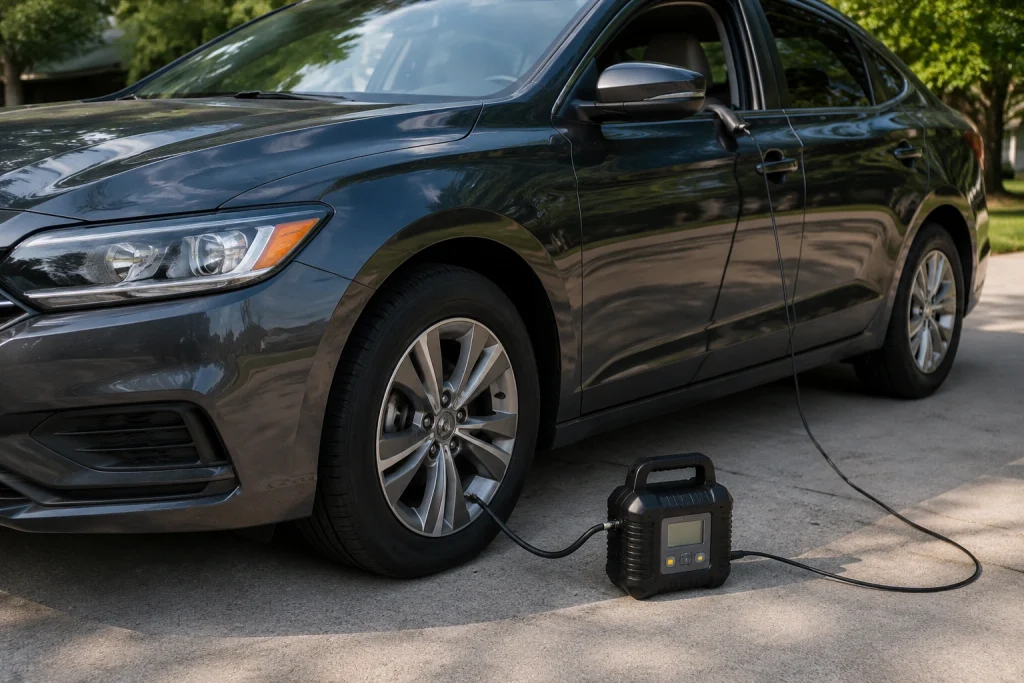
There is no single safe run time for every vehicle and inflator.
A compact inflator may need only a few minutes to add several PSI to a passenger-car tire. Inflating a completely flat SUV or truck tire can take much longer and place significantly more demand on the battery and compressor motor.
Stop using the inflator if you notice:
- The compressor slowing noticeably.
- Headlights or interior lights becoming dim.
- A low-battery warning.
- A hot electrical plug or accessory socket.
- A burning smell.
- Smoke, sparks, or damaged insulation.
- A fuse that repeatedly blows.
- The inflator shutting down from heat.
Also follow the inflator’s duty cycle. The duty cycle tells you how long the compressor can run before it needs to cool.
For example, some compact Slime inflators limit continuous operation to 10 minutes and require approximately 25 minutes of cooling afterward. Continuing beyond the stated limit can damage the motor, hose, seals, or electrical components.
How to Use a Tire Inflator Safely
1. Read Both Manuals
Check the tire inflator instructions and the vehicle owner’s manual.
Confirm:
- Whether the engine should be running.
- The inflator’s amperage requirement.
- The accessory outlet’s fuse rating.
- Maximum continuous operating time.
- Recommended tire pressure.
- Whether the outlet works with the ignition off.
2. Park in a Safe Location
Park on a hard, level surface away from traffic.
Place an automatic vehicle in Park or a manual vehicle in Neutral, apply the parking brake, and switch on the hazard lights when working near a roadway.
3. Inspect the Tire Before Adding Air
Do not rely on an inflator when the tire has:
- A large sidewall cut.
- Exposed cords.
- A visible bulge.
- Severe rim damage.
- A tire bead separated from the wheel.
- Smoke, unusual heat, or shredded rubber.
- Damage caused by driving while completely flat.
An inflator can add air. It cannot restore the structural strength of a damaged tire.
4. Find the Correct Pressure
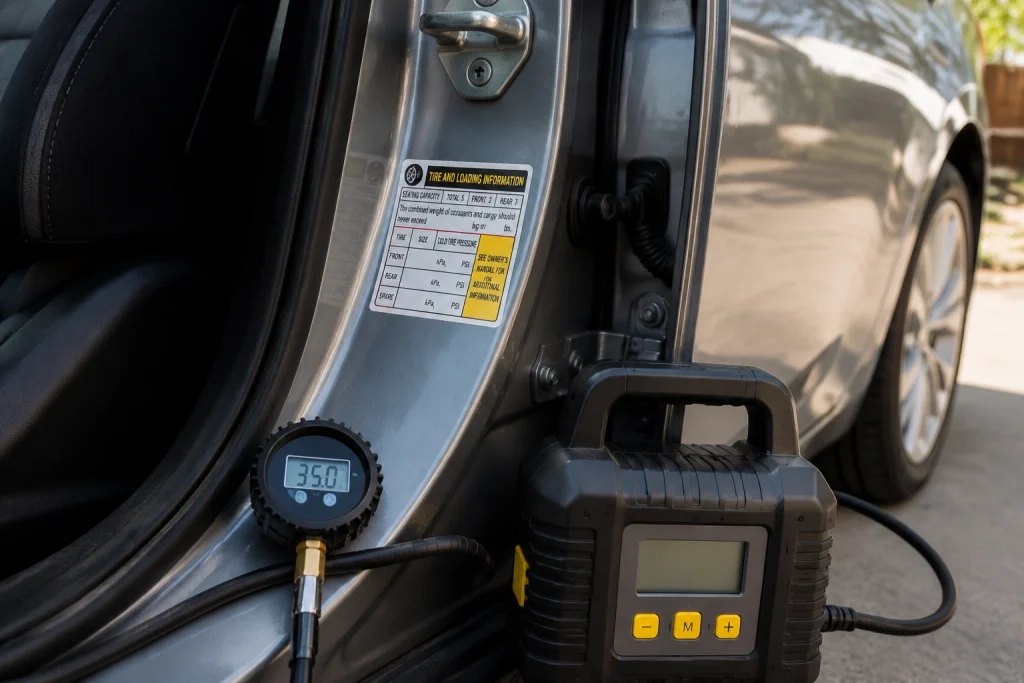
Use the recommended pressure on the driver-side doorjamb label or in the owner’s manual. Do not use the maximum PSI molded onto the tire sidewall as the normal operating pressure.
The NHTSA TireWise pressure guidance recommends checking tires when they are cold, meaning the vehicle has generally been parked for at least three hours. NHTSA also explains that the correct pressure comes from the vehicle manufacturer’s label, not the maximum pressure printed on the tire. (NHTSA)
5. Choose the Correct Power Method
For a 12-volt inflator:
- Confirm that the outlet’s rating meets the inflator requirement.
- Start the engine first when required by the manual.
- Insert the plug fully into the outlet.
- Do not use an unapproved splitter or extension.
- Keep the cord away from hot or moving components.
For a cordless inflator, check its battery level before attaching it to the tire.
6. Connect the Hose Securely
Remove the valve-stem cap and attach the hose connector straight onto the valve.
Avoid forcing the connector sideways. Excessive pressure can damage the valve stem or the tire-pressure monitoring sensor attached inside the wheel.
7. Set and Monitor the Pressure
Set the target PSI if the inflator has automatic shutoff. Stay close to the unit while it is operating.
Do not leave a running inflator unattended. Automatic shutoff is useful, but it does not eliminate the possibility of an incorrect setting, loose connection, inaccurate gauge, or equipment failure.
8. Verify the Final Pressure
After the compressor stops:
- Switch off and unplug the inflator.
- Remove the air hose carefully.
- Check the pressure with a separate tire gauge when possible.
- Reinstall the valve cap.
- Check the tire again after driving or after several hours.
Can a Tire Inflator Drain the Car Battery?
Yes, especially if the battery is old, weak, cold, or partially discharged.
The risk increases when:
- The inflator runs for an extended period.
- Several tires need substantial inflation.
- The vehicle has a large tire volume.
- Lights, audio, climate controls, or other accessories remain on.
- The vehicle has already been sitting unused.
- The battery is near the end of its service life.
Adding two or three PSI to one tire is less demanding than filling a tire from nearly zero. However, there is no guarantee that a weak battery will still have enough energy to start the engine afterward.
If you are unsure about the battery’s condition, start the vehicle outdoors before operating a plug-in inflator—provided the inflator manual permits or recommends that procedure.
Can an Inflator Blow the Accessory-Outlet Fuse?
Yes. An accessory-outlet fuse may blow when:
- The inflator draws more current than the outlet supports.
- The plug is loose or damaged.
- The cord has an internal short.
- An unapproved extension or splitter is used.
- The accessory socket is dirty, corroded, or worn.
- The compressor motor is failing and drawing excessive current.
Check the amperage printed on the inflator label or listed in its manual. Then compare it with the outlet rating in the vehicle owner’s manual.
Do not replace a blown fuse with one that has a higher amperage rating. A larger fuse can allow wiring to overheat before the circuit is interrupted.
Can a Tire Inflator Fix a Completely Flat Tire?
An inflator may restore pressure when the tire has a small puncture or slow leak. However, it does not repair the leak.
Professional inspection is needed when:
- The tire loses pressure again within hours or days.
- Air can be heard escaping.
- A nail or screw is visible.
- The tire will not build pressure.
- The sidewall is damaged.
- The wheel is bent or cracked.
- The tire was driven while flat.
- The valve stem leaks.
A tread puncture may be repairable depending on its size and location. Sidewall and shoulder damage normally require tire replacement rather than a plug.
Choosing a Reliable Tire Inflator
Price alone does not determine quality. Compare the features that affect real-world performance and durability.
Look for:
- A power requirement compatible with your vehicle.
- A clear digital or analog pressure gauge.
- Automatic shutoff.
- Thermal-overload protection.
- A stated duty cycle.
- A replaceable plug fuse.
- A hose and cord long enough to reach every tire.
- A stable base that keeps the unit off hot pavement.
- A secure valve connector.
- Sufficient airflow for your tire size.
- A rechargeable battery or secondary power option.
- Readily available warranty and replacement parts.
A high maximum-PSI number does not automatically mean the inflator fills tires quickly. Airflow, motor quality, cooling, hose size, and duty cycle are also important.
Expert Tip: Check the inflator’s required amperage before buying it. A powerful 15-amp inflator is not a good match for a vehicle outlet protected by a 10-amp fuse, even when the plug physically fits.
Common Mistakes Vehicle Owners Should Avoid
- Assuming every 12-volt outlet works with the ignition off.
- Running the engine inside a garage or enclosed parking area.
- Using the maximum PSI printed on the tire sidewall as the target pressure.
- Starting the engine while the inflator is already running.
- Ignoring the inflator’s cooling period or duty cycle.
- Leaving the compressor unattended because it has automatic shutoff.
- Using an oversized fuse after the original fuse blows.
- Holding a hot inflator in your hand while it is operating.
- Driving on a tire that loses pressure immediately after inflation.
- Assuming added air permanently repairs a puncture.
- Forcing the hose connector onto the valve stem at an angle.
- Inflating a visibly damaged, bulging, or overheated tire.
When to Call a Transmission Professional
A tire inflator problem normally requires a tire technician, general repair shop, or automotive electrician—not a transmission specialist.
Contact a tire professional when the tire will not hold pressure, has sidewall damage, or has been driven while flat. Contact an automotive electrician when the inflator repeatedly blows fuses, the accessory outlet overheats, or several electrical systems stop working.
A transmission professional may be appropriate only when the vehicle also develops persistent driveline symptoms, such as:
- Delayed engagement into Drive or Reverse.
- Harsh or irregular shifting.
- A transmission warning message.
- Limp mode.
- Failure to move normally after the battery has been discharged or jump-started.
Low voltage can sometimes produce temporary electronic warnings. Have the battery and charging system tested first. If transmission symptoms remain after normal voltage is restored and fault codes are cleared, schedule a proper transmission diagnostic rather than replacing parts based on guesswork.
FAQs
Does a tire inflator work without the car running?
Yes, it can. Cordless and AC-powered inflators work independently. A 12-volt inflator works with the engine off only if the vehicle outlet remains powered and the battery can supply enough current.
Should the ignition be in Accessory mode?
Accessory mode may be necessary when the 12-volt outlet turns off with the ignition. However, Accessory mode also powers other electronics, which can increase battery drain. Check the vehicle manual.
Is it better to inflate tires with the engine running?
It depends on the inflator. Some manufacturers recommend a running engine for stronger, more stable power. Others allow engine-off operation. Always operate a running vehicle outdoors.
How quickly will an inflator drain the battery?
There is no fixed time. Battery condition, temperature, compressor current, tire size, starting pressure, and operating time all matter. A small top-up is less demanding than filling a completely flat tire.
Why does my tire inflator not turn on?
Possible causes include a switched-off accessory outlet, blown fuse, loose plug, weak vehicle battery, damaged cord, overheated compressor, or failed inflator motor. Test the outlet with another approved accessory and inspect the fuse.
Can I use the PSI printed on the tire?
Use the recommended cold pressure on the driver-side doorjamb label or in the owner’s manual. The number molded into the tire sidewall is generally the tire’s maximum pressure under specified conditions, not the vehicle’s normal target pressure.
Can I drive after inflating a completely flat tire?
Only when the tire has no visible structural damage, holds the correct pressure, and has not been damaged by being driven while flat. If pressure falls again, install the spare or arrange roadside assistance.
Conclusion
So, does a tire inflator work without the car running? Usually, yes—but only when the inflator has an independent battery, uses household power, or receives sufficient electricity from an active 12-volt outlet.
The safest approach is to check the inflator manual, confirm the accessory outlet’s amperage rating, and inspect the vehicle battery before beginning. Run the engine only when the manufacturer recommends it, and always move the vehicle outdoors first.
Before your next trip, test the inflator at home, confirm that its cord reaches all four tires, and store a dependable pressure gauge beside it. A few minutes of preparation can prevent a weak battery, blown fuse, damaged tire, or unnecessary roadside repair.
