
What PSI Should I Set My Tire Inflator To?

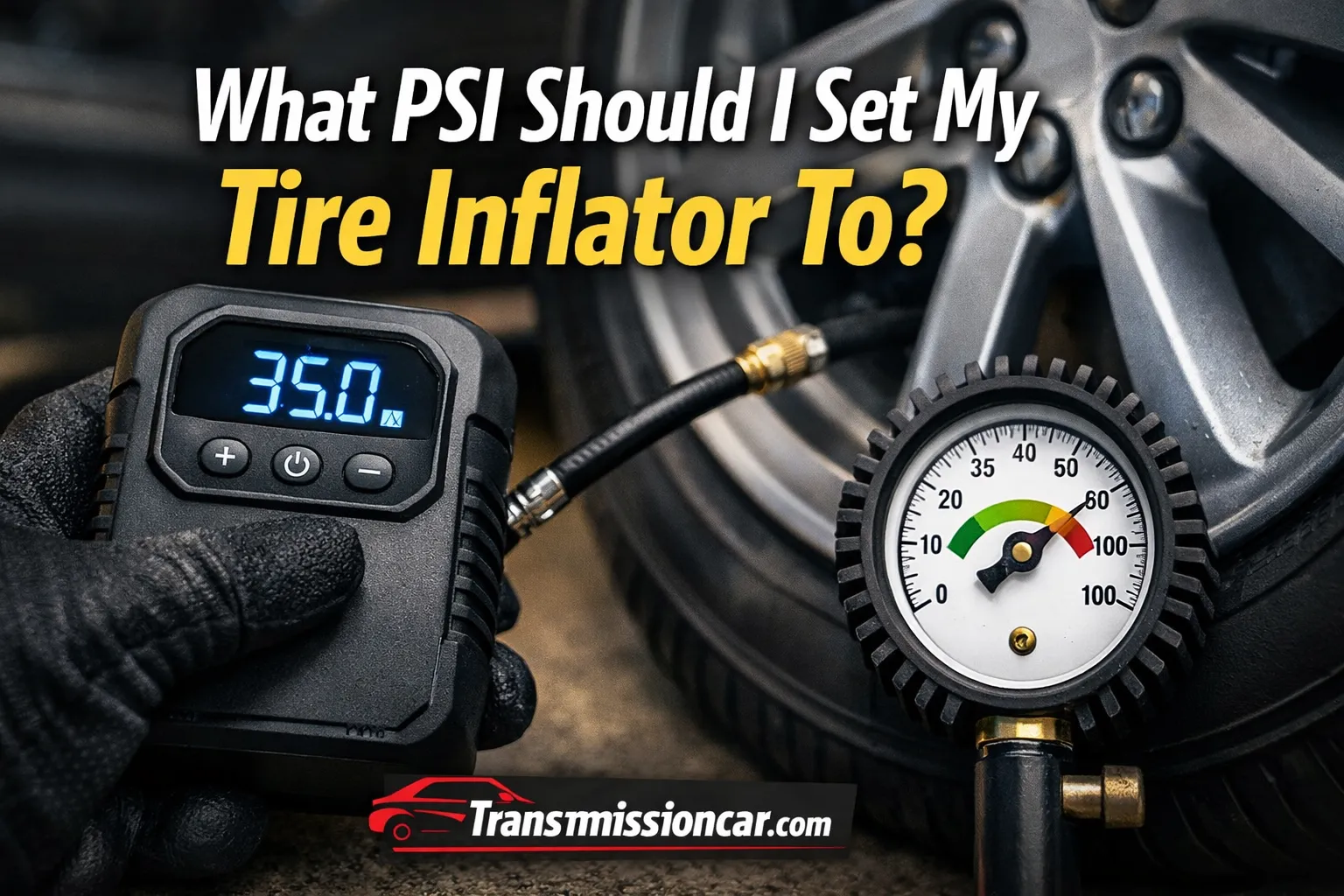
You are ready to add air to your tires, but the inflator asks you to choose a PSI. Should you enter the number on the tire, copy the pressure shown on the dashboard, or choose a common setting such as 32 PSI?
When asking, “What PSI should I set my tire inflator to?”, the correct answer comes from your vehicle—not from the inflator or the tire sidewall. Using the right pressure supports safer handling, predictable braking, longer tire life, and better fuel economy.
This guide explains where to find the correct PSI, how to set an automatic inflator, what to do when the tires are warm, and when low pressure may indicate a leak or a larger driveline problem.
Quick Answer
Set your tire inflator to the cold tire pressure listed on the driver-side doorjamb label or in your owner’s manual. Do not use the maximum PSI printed on the tire sidewall. Front and rear tires may require different pressures, so check the label carefully before inflating each tire.
What Does PSI Mean?
PSI stands for pounds per square inch. It measures the amount of air pressure inside the tire.
The correct pressure allows the tire to maintain its intended shape while supporting the vehicle’s weight. Too little or too much pressure changes how the tire contacts the road.
Incorrect pressure can affect:
- Steering response
- Braking performance
- Ride comfort
- Tire temperature
- Tread wear
- Fuel consumption
- Vehicle stability
A difference of a few PSI may not always be obvious by looking at the tire. That is why pressure should be measured with a gauge rather than estimated visually.
Where to Find the Correct Tire Pressure
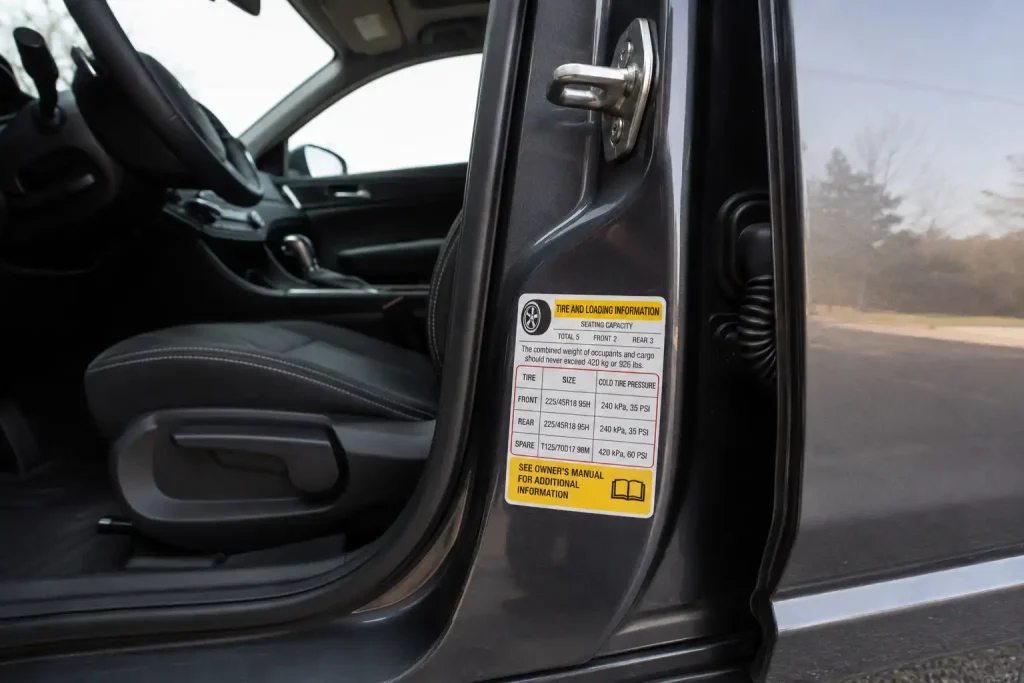
The recommended PSI is normally printed on the vehicle’s Tire and Loading Information label. Open the driver’s door and inspect the doorjamb, door edge, or nearby pillar.
The label usually shows:
- Original tire size
- Recommended front-tire pressure
- Recommended rear-tire pressure
- Vehicle seating or loading information
- Pressure in PSI and sometimes kPa
The NHTSA TireWise safety guidance confirms that the proper pressure is found on the driver-side tire information label or in the owner’s manual. It also recommends checking the pressure monthly when the tires are cold. (NHTSA)
If the label is missing or unreadable, check:
- The owner’s manual
- The manufacturer’s digital owner’s manual
- An authorized dealership
- A qualified tire shop
Do not guess based only on the vehicle’s size or tire appearance. Two similar SUVs, trucks, or sedans may require different pressures.
Should You Use the PSI Printed on the Tire?
No. The PSI molded into the tire’s sidewall is generally the tire’s maximum cold inflation pressure, not the normal operating pressure recommended for your vehicle.
The vehicle manufacturer chooses the recommended pressure after considering:
- Vehicle weight
- Suspension design
- Tire size
- Load distribution
- Steering and braking behavior
- Ride quality
- Maximum intended load
For example, a tire sidewall might display a maximum pressure of 44 PSI while the vehicle label recommends 33 PSI. In that case, set the inflator to 33 PSI, not 44 PSI.
NHTSA’s summer driving and tire-pressure guidance specifically warns drivers not to inflate tires to the pressure printed on the tire itself. (NHTSA)
The sidewall number is a limit, not a universal target.
What Does “Cold Tire Pressure” Mean?
Recommended pressures are normally cold inflation pressures. A cold tire is one that has not been heated significantly by driving.
For the most accurate reading, check the tires:
- Before driving in the morning
- After the vehicle has been parked for at least three hours
- Before a long highway trip
- Away from direct heat when possible
Driving causes the tire to flex and warm up. As the air inside warms, pressure naturally rises. A tire set to 33 PSI while cold might read several PSI higher after highway driving.
Do not release air from a warm tire simply because its pressure is above the cold specification. Doing so may leave the tire underinflated after it cools.
If a tire is seriously low while you are traveling, add air for safety. Recheck and adjust it accurately after the vehicle has been parked long enough for the tires to cool.
What PSI Should I Set My Tire Inflator To for Front and Rear Tires?
Use the exact front and rear pressures shown on the vehicle label.
Some vehicles use the same setting at all four corners. Others require different pressures because of engine location, vehicle weight distribution, towing design, or rear cargo capacity.
For example, the placard may state:
- Front: 35 PSI
- Rear: 33 PSI
In that situation, inflate the front tires to 35 PSI and the rear tires to 33 PSI. Do not automatically make all four tires equal.
Tire Pressure Source Priority
| Pressure source | Should you use it? | Reason |
|---|---|---|
| Driver-side doorjamb label | Yes | Shows the vehicle manufacturer’s recommended cold pressure |
| Owner’s manual | Yes | Provides model-specific instructions and special conditions |
| Tire sidewall maximum | No | Shows a tire limit, not the normal vehicle setting |
| Dashboard TPMS display | Use for checking | Helpful, but verify against the placard |
| Online forum or social media | No | May refer to a different trim, tire size, or load |
| Previous owner’s setting | No | May be incorrect or based on nonstandard tires |
How to Set PSI on a Digital Tire Inflator
Many portable inflators allow you to enter a target PSI and automatically stop when that pressure is reached.
1. Park Safely
Park on a level surface away from moving traffic. Apply the parking brake and turn off the engine unless the inflator’s instructions require the vehicle to be running.
For 12-volt inflators, follow the manufacturer’s power instructions. Some units may drain a weak battery if operated for an extended period.
2. Find the Recommended PSI
Read the doorjamb label and note whether the front and rear settings differ.
Do this before attaching the hose so you do not make a rushed guess.
3. Check the Current Pressure
Remove the valve cap and connect the inflator hose securely. The display should show the existing tire pressure.
If the reading appears unusually high or low, disconnect and reconnect the hose. A poor connection can cause an inaccurate reading or allow air to escape.
4. Select PSI as the Unit
Digital inflators may display PSI, bar, kPa, or kg/cm². Make sure the screen is set to PSI before entering the target.
For reference, 1 bar is approximately 14.5 PSI, but it is safer to use the same unit shown on the vehicle label rather than perform a hurried conversion.
5. Enter the Target Pressure
Use the plus and minus buttons to select the vehicle manufacturer’s recommended cold PSI.
If the front and rear pressures differ, change the target before moving to the next axle.
6. Start the Inflator
Activate the inflator and monitor it while it runs. Keep the unit on a stable surface with its ventilation openings uncovered.
Portable compressors become hot during use. Follow the recommended duty cycle, which tells you how long the unit may run before it needs to cool.
7. Verify the Final Reading
After the inflator stops, check the pressure again. For better confidence, compare it with a separate, good-quality tire gauge.
Replace the valve cap after finishing. The cap helps keep dirt and moisture away from the valve core.
Expert Tip: Set an automatic inflator to the exact placard pressure, then verify the result with a separate gauge. Some compact inflators stop slightly above or below their displayed target.
What If the Inflator Stops Above the Selected PSI?
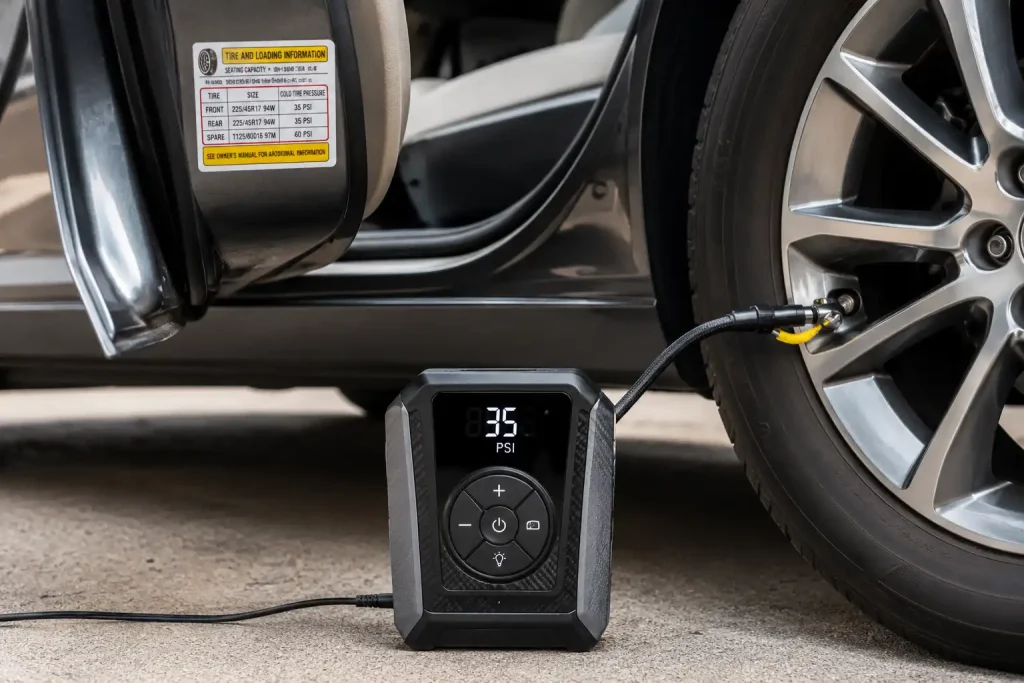 Portable tire inflator set to recommended vehicle tire PSI” class=”wp-image-9399″/>
A small difference may occur because pressure changes slightly when the hose disconnects or because the inflator’s built-in gauge has limited accuracy.
If the placard says 35 PSI and the final cold reading is 35 or 36 PSI, that small difference is usually less concerning than a large error. However, consistently stopping several PSI above the target suggests that the inflator should be checked against another gauge.
Possible reasons include:
- A low-quality or poorly calibrated gauge
- Air trapped in the inflator hose
- Heat generated during inflation
- A loose valve connection
- Incorrect measurement units
- A damaged tire valve
Avoid repeatedly adding and releasing air while relying on an unstable reading. Use a separate gauge or visit a tire shop for confirmation.
Why Correct Tire Pressure Matters
Safety and Handling
An underinflated tire flexes more as it rolls. Excessive flex can generate heat, reduce steering precision, and increase the risk of tire damage.
An overinflated tire may provide a harsher ride and reduce the tire’s ability to absorb bumps. Excessive pressure can also contribute to uneven center tread wear.
Tire Life
Incorrect pressure can cause uneven tread wear:
- Low pressure often increases wear near the outer shoulders.
- Excessive pressure may increase wear near the center.
- Different pressures across the same axle may contribute to pulling or inconsistent handling.
Pressure is not the only cause of uneven wear. Wheel alignment, worn suspension parts, tire imbalance, and damaged wheels can produce similar patterns.
Fuel Economy
Underinflated tires create more rolling resistance, meaning the engine must work harder to move the vehicle. The U.S. Department of Energy’s efficient-driving guidance states that properly inflated tires can improve fuel economy and help tires last longer. (Alternative Fuels Data Center)
Correct inflation will not produce a dramatic fuel-economy increase by itself, but it is an inexpensive part of routine vehicle maintenance.
How Temperature Changes Tire Pressure
Outside temperature affects pressure even when the tire has no puncture. Tire pressure commonly decreases as weather becomes colder and increases as conditions become warmer.
This is why the TPMS warning may appear during the first cold morning of the season. The light may disappear after driving because the tires warm up, but that does not mean the cold pressure was correct.
Check and adjust the pressure whenever:
- Temperatures change sharply
- A TPMS warning appears
- The vehicle has been parked for a long period
- You are preparing for a road trip
- The vehicle begins pulling or handling differently
Do not intentionally overinflate tires in warm weather to prepare for winter. Check them cold and adjust them as seasonal temperatures change.
What If the TPMS Light Is On?
A steady Tire Pressure Monitoring System light normally means at least one tire is significantly underinflated. Check all four tires and the spare if it is monitored.
Do not assume the warning identifies the exact tire unless your vehicle displays individual pressure readings.
A TPMS system is a warning device, not a replacement for monthly pressure checks. NHTSA notes that the warning may not activate until a tire is already significantly underinflated. (NHTSA)
If the light flashes for approximately a minute and then stays on, the system may have a sensor or communication fault. A tire shop or qualified repair facility can diagnose the problem.
When Low Pressure Suggests a Leak
A tire that loses one or two PSI gradually over a long period may be responding to temperature changes or normal air loss. A tire that repeatedly loses pressure over days needs inspection.
Possible causes include:
- A nail or screw in the tread
- A leaking valve core
- A cracked valve stem
- Corrosion where the tire seals against the wheel
- A bent or cracked wheel
- Sidewall or tread damage
- A previous repair that is leaking
Do not continue inflating a damaged tire indefinitely. Adding air treats the symptom but does not repair the cause.
Stop driving and arrange professional assistance if the tire has:
- A visible bulge
- Exposed cords
- A deep cut
- Severe cracking
- Rapid air loss
- Damage near the sidewall
- Pressure that drops immediately after inflation
Choosing a Reliable Tire Inflator
The best inflator is not necessarily the one with the highest advertised PSI. Passenger vehicles usually benefit more from accurate measurement, dependable construction, and adequate airflow.
Look for:
- A clear digital or analog gauge
- Automatic shutoff
- A secure valve connector
- A long enough power cord or hose
- Overheat protection
- An understandable duty-cycle rating
- A carrying case
- Replacement fuse availability
- A pressure-release button
- A work light for nighttime use
For trucks, SUVs, or high-volume tires, a small emergency compressor may inflate too slowly or overheat. Choose a unit designed for your tire size and expected use.
Battery-powered inflators are convenient, but their batteries must remain charged. A 12-volt inflator may be more dependable for storage in a vehicle, provided its plug, fuse, and cord are in good condition.
Common Mistakes Vehicle Owners Should Avoid
- Using the sidewall maximum: This is not the vehicle’s recommended operating pressure.
- Inflating all four tires equally: Some vehicles specify different front and rear pressures.
- Checking immediately after highway driving: Warm pressure is higher than cold pressure.
- Releasing air from hot tires: The tires may become underinflated after cooling.
- Trusting the TPMS light alone: The system may not warn you about smaller pressure losses.
- Ignoring repeated pressure loss: A recurring low reading often indicates a leak.
- Using the wrong display unit: Confusing PSI, bar, and kPa can cause dangerous inflation errors.
- Leaving the compressor unattended: Inflators can move, overheat, or develop a poor connection.
- Running the compressor beyond its duty cycle: This can shorten motor life or cause shutdown.
- Assuming pressure fixes vibration: Tire imbalance, wheel damage, alignment problems, or driveline faults may still require diagnosis.
When to Call a Transmission Professional
Most tire-pressure problems should be handled by a tire technician, not a transmission specialist. However, tire and wheel issues can sometimes be confused with driveline or transmission symptoms.
Start with a tire shop if you notice:
- Steering-wheel vibration at a certain speed
- Uneven tread wear
- A recurring pressure loss
- Vehicle pulling
- A damaged wheel
- A TPMS warning that will not clear
Consult a transmission or driveline professional when the tires are correctly inflated and inspected, but the vehicle still has:
- Shuddering during acceleration
- Jerking during gear changes
- Delayed engagement
- Grinding or clunking from the driveline
- Transmission or all-wheel-drive warning messages
- Binding after installing different-size tires
- Symptoms that change with gear selection rather than road speed
This is especially important on some AWD and 4WD vehicles. Incorrectly matched tire sizes or substantially different tread depths can create ongoing speed differences between the wheels. Depending on the vehicle’s design, that may place additional stress on the transfer case, differential, or AWD system.
A transmission professional can determine whether the sensation comes from the transmission, torque converter, driveshaft, axle, differential, transfer case, wheel, or tire. Getting the source identified before authorizing repairs helps prevent unnecessary transmission work.
FAQs
What PSI should I set my tire inflator to?
Set it to the cold pressure printed on the driver-side doorjamb label or listed in the owner’s manual. Check whether the front and rear tires require different settings.
Is 32 PSI correct for every car?
No. Although some vehicles specify a pressure near 32 PSI, others require more or less. Always use the manufacturer’s label rather than a universal number.
Should I set the inflator slightly higher than the recommended PSI?
Normally, no. Set it to the exact cold specification and verify the final pressure. A separate gauge can help identify an inaccurate automatic shutoff.
Can I inflate my tires when they are hot?
You can add air if a tire is dangerously low, but a hot reading cannot be compared directly with the cold specification. Recheck the tire after it has cooled.
Why is my tire still low after using an automatic inflator?
The hose may have leaked during connection, the inflator gauge may be inaccurate, or the tire may have a puncture or valve leak. Check it with another gauge.
Can I drive with the TPMS light on?
Check the tires as soon as it is safe. Driving on a significantly underinflated tire can affect handling, generate excess heat, and damage the tire.
How often should I check tire pressure?
Check all tires at least once a month and before long trips. Also inspect them after major temperature changes, pothole impacts, or a TPMS warning.
Conclusion
When deciding what PSI should I set my tire inflator to, use the recommended cold pressure on the driver-side doorjamb label or in the owner’s manual. Do not use the maximum pressure molded into the tire sidewall, and do not assume every tire should receive the same setting.
Check the pressure when the tires are cold, confirm the inflator’s reading with a reliable gauge, and investigate any tire that repeatedly loses air. Correct tire pressure improves safety, tire durability, handling, and fuel efficiency.
Before your next drive, locate your vehicle’s pressure label, inspect all four tires, and set your inflator to the manufacturer’s exact front and rear specifications.
