
Why Does My Tire Inflator Shut Off? Common Causes and Practical Fixes

You connect your portable inflator, start filling the tire, and the machine suddenly stops. Sometimes it restarts after a few minutes. Other times, the display remains on but the compressor will not run.
So, why does my tire inflator shut off? The cause may be completely normal, such as the automatic pressure setting being reached. It may also point to overheating, a weak battery, a blown vehicle fuse, restricted airflow, or internal damage.
This guide explains how to identify the cause, troubleshoot the inflator safely, and decide whether the problem is with the inflator, the tire, or your vehicle’s electrical system.
Quick Answer
A tire inflator may shut off because it reached the selected pressure, overheated, lost electrical power, detected restricted airflow, or has a weak battery. Check the preset PSI, hose connection, power source, fuse, battery charge, and air vents. Allow an overheated inflator to cool before trying again.
Is the Tire Inflator Supposed to Shut Off?
Many modern tire inflators are designed to stop automatically. This feature protects the tire from overinflation and prevents unnecessary compressor wear.
For example, some digital inflators allow you to select a target pressure. The machine runs until it detects that pressure, pauses to verify the reading, and then shuts off.
An automatic shutdown is probably normal when:
- The displayed pressure matches your selected PSI.
- A “target reached” light appears.
- The inflator stops but the display remains active.
- The tire pressure is correct when checked with a separate gauge.
- The machine restarts when you choose a higher pressure.
Manufacturers such as Milwaukee explain that some inflators pause while pressure stabilizes and may restart briefly before shutting off at the selected PSI. You can see this process in the official Milwaukee inflator operator’s manual.
Do not assume the machine is defective simply because it pauses. Digital inflators may stop temporarily to obtain a more accurate reading.
Common Reasons Your Tire Inflator Keeps Shutting Off
1. The Inflator Reached the Preset Pressure
The most common explanation is that the automatic shutoff feature is working correctly.
Suppose your inflator is set to 32 PSI, but the tire already contains 32 PSI. The compressor may turn off immediately or refuse to start.
Check the following:
- Confirm whether the screen shows current pressure or target pressure.
- Review the selected PSI.
- Compare the reading with a separate tire-pressure gauge.
- Increase the target by one or two PSI briefly to test operation.
- Return the setting to the vehicle manufacturer’s recommended pressure.
Use the pressure listed on the driver-side doorjamb label or in the owner’s manual. Do not use the maximum PSI printed on the tire sidewall as your normal inflation target.
According to the NHTSA tire-pressure guidance, pressure should normally be checked when the tires are cold, and the correct setting comes from the vehicle manufacturer’s label rather than the tire sidewall. (NHTSA)
2. The Inflator Is Overheating
Portable inflators create considerable heat because a small electric motor is compressing air inside a compact housing. Long inflation sessions can activate thermal protection.
Signs of overheating include:
- The compressor becomes very hot.
- It runs for several minutes and then stops.
- A temperature warning symbol appears.
- It works again after cooling.
- The fan continues running after the pump stops.
- The problem happens when filling multiple tires in a row.
Every inflator has its own duty cycle. The duty cycle tells you how long it can operate before requiring a cooling period.
One manufacturer’s manual, for example, advises cooling the tool after extended continuous use and explains that temperature protection may stop operation when the tool becomes too hot. The exact operating and cooling periods vary by model, so follow your own manual rather than applying one rule to every inflator.
Never cover the cooling vents or place the inflator on thick carpet, grass, clothing, or another surface that blocks airflow.
Turn it off, disconnect the power source, and place it on a dry, hard surface until it cools.
3. The Cordless Battery Is Weak or Too Hot
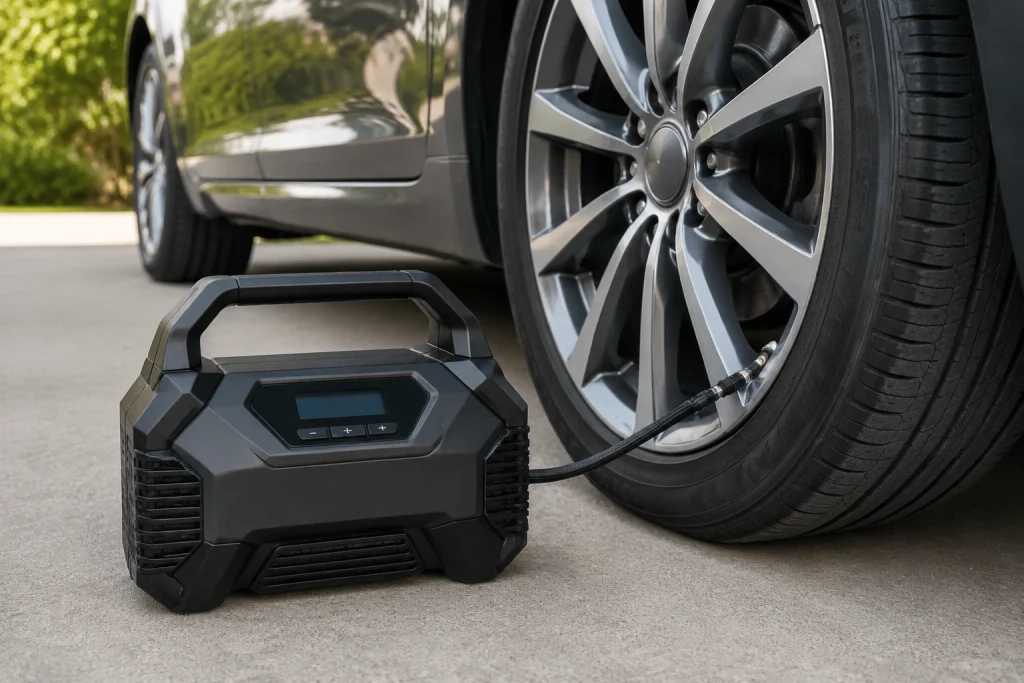
A cordless inflator may display a battery charge but still shut down under load. The compressor requires much more current when it starts or works against higher tire pressure.
A weak battery may power the screen and light but fail when the motor begins running.
Possible signs include:
- The display turns on but the compressor stops immediately.
- Battery bars drop quickly during operation.
- The inflator works with another battery.
- The battery becomes unusually hot.
- The machine shuts off sooner at higher PSI.
- Performance improves after charging.
Recharge the battery fully with the correct charger. Make sure it clicks firmly into place and inspect the terminals for dirt, corrosion, or damage.
Cold batteries may also deliver less power. Allow a very cold battery to reach a suitable operating temperature indoors before using it. Do not heat it with a flame, heater, or hot water.
Stop using any battery that is swollen, cracked, leaking, or producing an unusual odor.
4. The Vehicle’s 12-Volt Outlet Lost Power
A corded inflator may shut off because the vehicle accessory outlet can no longer supply enough power.
Common causes include:
- The ignition is in the wrong position.
- The 12-volt plug is loose.
- The outlet fuse has blown.
- The plug tip or outlet is dirty.
- The inflator draws more current than the outlet supports.
- Vehicle battery voltage is low.
- The power cord is damaged internally.
Some vehicles power the accessory outlet only when the ignition is in accessory or run mode. Others keep the outlet active when the engine is off.
Consult your owner’s manual before running the engine during inflation. When engine operation is permitted, use the inflator outdoors and keep the exhaust area clear.
Ford’s official tire inflator and sealant kit instructions show that vehicle-specific procedures may include applying the parking brake, using the 12-volt outlet, following the doorjamb pressure label, and stopping when the correct pressure is reached. (https://www.ford.com/)
5. A Fuse Has Blown
Many 12-volt inflators contain a fuse inside the plug. Your vehicle also has a fuse protecting the accessory outlet.
A fuse may blow because of:
- Excessive current draw
- A short circuit
- Damaged wiring
- A seized compressor
- An incorrect electrical connection
- Repeated operation beyond the inflator’s capacity
Test the outlet with another suitable accessory. If nothing works, check the vehicle fuse diagram in the owner’s manual.
Some inflator plugs have a threaded tip that opens to reveal a small fuse. Replace it only with the exact type and amperage specified by the inflator manufacturer.
Never install a higher-amperage fuse to prevent it from blowing. A larger fuse can allow wiring to overheat and may create a fire risk.
6. The Air Hose or Valve Connection Is Restricted
An inflator must move air freely through the hose and into the tire. A kinked hose, blocked adapter, damaged valve core, or poorly attached chuck can create abnormal pressure near the compressor.
The sensor may briefly detect high pressure and shut the machine off even though the tire remains low.
Inspect the following:
- Kinks or sharp bends in the hose
- Dirt inside the air chuck
- Incorrect nozzle or adapter
- A loose threaded connection
- A damaged tire valve stem
- A valve core that does not open correctly
- Sealant blocking the valve or hose
Disconnect the machine before inspecting the hose.
Attach the chuck straight onto the valve stem. A screw-on connector should be snug, but excessive force can damage the valve.
7. The Tire Has a Major Leak or Structural Damage
A tire with a large puncture may lose air as quickly as the inflator supplies it. The compressor can run continuously, overheat, and shut down.
Warning signs include:
- Loud air leakage
- A puncture in the sidewall
- Visible cuts, bulges, or exposed cords
- The tire separating from the rim
- Pressure failing to rise
- The tire going flat immediately after inflation
Do not continue operating the inflator indefinitely. A sidewall puncture, large tread injury, damaged rim, or separated tire usually requires roadside assistance or professional tire service.
Inflator-and-sealant kits are temporary solutions with strict limits. Ford advises seeking help when a sidewall is punctured or when the tire cannot reach the required pressure within the kit’s specified operating period. (https://www.ford.com/)
8. The Pressure Sensor Is Giving a False Reading
Digital inflators rely on an internal pressure sensor. If the sensor is inaccurate, the machine may believe the target pressure has already been reached.
Possible symptoms include:
- The screen shows pressure when nothing is connected.
- The displayed PSI jumps suddenly.
- The inflator stops far below the target.
- The reading differs greatly from a reliable gauge.
- The problem started after a drop or impact.
Some models have a calibration or “re-zero” procedure. Follow the manufacturer’s manual exactly. Do not disassemble the pressure sensor unless the product was designed for user servicing.
9. The Compressor Motor Is Worn or Damaged
A failing motor may start, struggle, and shut off as electrical load increases.
Motor-related warning signs include:
- Grinding or scraping noises
- Burning smell
- Heavy vibration
- Slow inflation
- Repeated fuse failure
- Smoke or melted plastic
- Intermittent operation despite a good power source
Stop using the unit when these signs appear. Continuing to run a damaged motor can damage the battery, power outlet, wiring, or internal electronics.
Tire Inflator Shutoff Troubleshooting Table
| What happens | Most likely cause | Best first action |
|---|---|---|
| Stops at the selected PSI | Normal auto shutoff | Verify pressure with a separate gauge |
| Stops after several minutes | Overheating | Turn it off and allow it to cool |
| Display works but motor stops | Weak battery or overload | Recharge or test another battery |
| Entire unit loses power | Loose plug, fuse, or power failure | Inspect the connection and fuses |
| Stops immediately after starting | Incorrect preset or blocked airflow | Check target PSI, hose, and valve |
| Pressure reading jumps rapidly | Poor connection or sensor problem | Reconnect the hose and compare gauges |
| Runs but tire remains flat | Major leak or tire damage | Stop and inspect the tire |
| Smells burned or makes grinding noise | Internal motor damage | Disconnect and replace or service the unit |
How to Troubleshoot a Tire Inflator That Shuts Off
Use this sequence to avoid replacing a working inflator unnecessarily.
Step 1: Stop and Inspect the Area
Park on a stable surface away from moving traffic. Apply the parking brake and turn on the hazard lights when roadside conditions require them.
Look for smoke, melted plastic, damaged cords, a swollen battery, or a badly damaged tire. Do not continue if any serious hazard is visible.
Step 2: Confirm the Correct Tire Pressure
Find the recommended cold pressure on the driver-side doorjamb label.
Check whether the front and rear tires require different pressures. Then compare the inflator display with a separate gauge.
Step 3: Check the Preset
Make sure the target pressure is higher than the tire’s current pressure. Confirm that the inflator is displaying PSI rather than kPa or bar.
For reference:
- PSI means pounds per square inch.
- kPa means kilopascals.
- Bar is another pressure unit used by some inflators.
Selecting the wrong unit can produce a setting that appears correct but is not.
Step 4: Inspect the Hose and Valve Connection
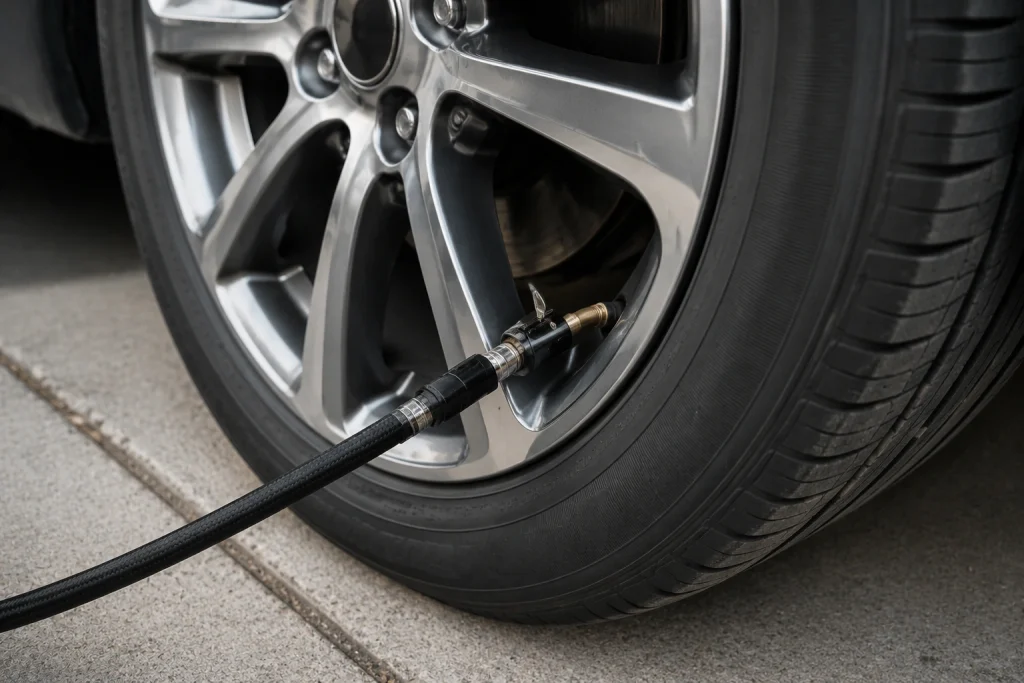
Straighten the hose and remove any unnecessary adapter. Connect the chuck securely to the tire’s Schrader valve.
Listen for escaping air. A slight release while connecting may be normal, but continuous leakage suggests a poor seal.
Step 5: Test the Power Source
For a cordless model:
- Charge the battery fully.
- Remove and reinstall it.
- Clean dry contacts carefully.
- Test another compatible battery when available.
For a 12-volt model:
- Push the plug firmly into the outlet.
- Set the ignition as directed by the vehicle manual.
- Test the outlet with another approved accessory.
- Check the vehicle and inflator fuses.
- Inspect the cable for cuts or heat damage.
Step 6: Allow the Inflator to Cool
If the housing is hot, turn the machine off and disconnect it. Keep it on a hard, ventilated surface.
Wait for the cooling period specified in the manual. Restarting every few seconds can delay cooling and repeatedly trigger thermal protection.
Step 7: Test the Inflator on Another Tire
A test on another properly maintained tire can help separate a tool problem from a tire problem.
If the inflator works normally on another tire, inspect the original tire, valve stem, and wheel for leaks or damage.
Step 8: Stop After Repeated Failure
Do not keep replacing fuses or repeatedly restarting a machine that smells hot, makes abnormal noise, or shuts off under every power source.
At that point, service or replacement is usually safer than further DIY testing.
Expert Tip: Check the tire with a separate pressure gauge after the inflator shuts off. This quickly tells you whether the machine stopped normally or whether its internal sensor is giving an inaccurate reading.
Is It Safe to Restart the Inflator?
Restarting may be safe when the machine stopped because it reached the selected pressure or entered a normal pressure-check pause.
Do not immediately restart it when:
- The housing is extremely hot.
- A thermal warning appears.
- The fuse blew.
- The plug or outlet is hot.
- You notice a burning smell.
- The battery is swollen or damaged.
- The compressor makes grinding noises.
- The tire has sidewall damage.
- Pressure is not increasing.
Never bypass an automatic shutoff, thermal protector, fuse, or battery protection circuit. These features are designed to prevent overheating, electrical damage, and overinflation.
Repair or Replace the Tire Inflator?
The right choice depends on the inflator’s quality, age, power system, and failure type.
Repair May Make Sense When:
- The unit is covered by warranty.
- The manufacturer provides authorized service.
- Only a replaceable fuse, hose, or connector is damaged.
- The inflator is a professional-grade model.
- A replacement battery can restore normal operation.
Replacement May Be Smarter When:
- A low-cost inflator has internal motor damage.
- The power cord is melted.
- The casing is cracked.
- It repeatedly overheats during ordinary use.
- Pressure readings remain inaccurate after calibration.
- Replacement parts are unavailable.
- Repair cost approaches the price of a better unit.
When buying another inflator, compare more than maximum PSI. Look at its duty cycle, airflow rate, power requirements, hose quality, battery platform, cooling design, warranty, and intended tire size.
A compact inflator suitable for topping up sedan tires may struggle when filling large truck, trailer, or off-road tires from very low pressure.
Common Mistakes Vehicle Owners Should Avoid
- Using the sidewall maximum as the target pressure: Follow the vehicle doorjamb label instead.
- Ignoring the duty cycle: Continuous operation can activate thermal protection or damage the compressor.
- Blocking the vents: Place the unit on a hard, open surface.
- Installing a larger fuse: Use only the specified fuse rating.
- Running the engine in an enclosed garage: Exhaust gases can accumulate quickly.
- Continuing with a damaged sidewall: A portable inflator cannot make a structurally damaged tire safe.
- Trusting only the built-in gauge: Confirm suspicious readings with a separate gauge.
- Using an undersized extension cord: For models that permit AC extension cords, follow the manufacturer’s wire-size requirements.
- Leaving the inflator unattended: Watch the pressure, hose, power connection, and temperature.
- Repeatedly restarting a hot unit: Give it the full recommended cooling period.
When to Call a Transmission Professional
A tire inflator shutting off is normally not a transmission problem. Most cases involve the inflator, tire, battery, accessory outlet, fuse, or vehicle wiring.
Contact a tire shop when the tire has a puncture, valve leak, bead leak, rim damage, bulge, or repeated pressure loss. Contact an auto electrical technician when the 12-volt outlet keeps losing power or blowing fuses.
A transmission professional becomes relevant only when the vehicle also has symptoms such as:
- Transmission warning messages
- Erratic shifting
- Low-voltage fault codes affecting several control modules
- Engine stalling when electrical loads are added
- Recent transmission or wiring work near the affected circuit
- Problems involving an integrated powertrain control module
Modern vehicles depend on stable voltage for transmission control modules and electronic solenoids. If several electrical and drivability symptoms appeared at the same time, a qualified shop should perform a full-system scan rather than assuming the inflator caused the problem.
FAQs
Why does my tire inflator shut off before reaching the set PSI?
The hose may be restricted, the valve connection may be poor, the battery may be weak, or the pressure sensor may be inaccurate. Reconnect the hose, verify the reading with another gauge, and test a fully charged battery or reliable power source.
Why does my tire inflator stop after a few minutes?
It is probably activating thermal protection. Portable compressors heat up during continuous operation. Turn it off and allow it to cool for the period listed in the owner’s manual.
Why does the inflator turn on but not pump air?
The battery may lack enough power for the motor, the hose may be blocked, the target pressure may already be reached, or the motor may have failed. Check the preset, battery, hose, valve connection, and warning indicators.
Can a blown car fuse cause my tire inflator to stop?
Yes. A blown accessory-outlet fuse can remove power from a 12-volt inflator. Check the vehicle manual for the correct fuse location and rating. Never replace it with a higher-rated fuse.
Should I leave my car running while using a tire inflator?
Follow the vehicle and inflator manuals. Some 12-volt outlets require the ignition or engine to be on. When engine operation is permitted, use the vehicle outdoors and keep the exhaust area unobstructed.
Why does my tire inflator keep turning on and off?
Some digital inflators intentionally pause to let pressure stabilize, check the actual PSI, and add more air if needed. Repeated cycling may therefore be normal near the target pressure. It can also indicate a leak or loose valve connection.
How do I know whether my tire inflator is bad?
Test it with a correct preset, secure hose, fully charged battery or working outlet, and another tire. The unit may be defective if it still shuts down immediately, reads pressure incorrectly, smells burned, makes abnormal noise, or repeatedly blows fuses.
Conclusion
When asking, “Why does my tire inflator shut off?”, begin with the simple possibilities. Confirm the preset PSI, check the hose connection, test the power source, and allow the compressor to cool.
An automatic stop at the correct pressure is normal. Repeated shutdown below the target may indicate overheating, low battery voltage, a fuse problem, restricted airflow, sensor error, or internal compressor damage.
Do not bypass safety protections or keep running a machine that is overheating. Verify pressure with a separate gauge, inspect the tire for damage, and follow the inflator’s operating limits. When the tire will not hold air or the electrical problem continues, arrange professional tire or automotive electrical service before driving.
