
Why Is My Tire Inflator Not Working? Common Causes and Practical Fixes

You connect your portable inflator, press the power button, and nothing happens. Or perhaps the motor runs, but the tire pressure does not increase. Either situation can leave you wondering, “Why is my tire inflator not working?”
The problem may be as simple as a blown vehicle fuse, a discharged battery, or a loose valve connection. It could also involve an overheated motor, damaged hose, blocked valve stem, or failed internal component.
This guide explains how to identify the likely cause, what you can safely fix yourself, and when replacing the inflator or visiting a repair shop makes more sense.
Quick Answer
A tire inflator may stop working because it has no electrical power, its battery is discharged, the vehicle’s accessory outlet fuse has blown, or air is leaking from the hose connection. Overheating, a blocked valve stem, damaged wiring, or an internal motor failure can also prevent normal inflation.
Start by Identifying What the Inflator Is Doing
Before taking anything apart, observe the exact symptom. Different symptoms point to different problems.
| Inflator symptom | Most likely causes | First thing to check |
|---|---|---|
| No lights, sound, or display | No power, blown fuse, dead battery, damaged cord | Test the power source |
| Display works but motor does not run | Overheating protection, motor failure, control problem | Let the unit cool and restart |
| Motor runs but no air enters the tire | Loose connector, air leak, damaged hose, blocked valve | Reconnect the air hose |
| Inflator starts and quickly shuts off | Low voltage, overheating, excessive resistance | Check the battery and duty cycle |
| Pressure reading is inaccurate | Sensor problem, poor valve connection, damaged gauge | Compare with a separate gauge |
| Inflator is unusually noisy or vibrating | Internal wear, loose parts, damaged compressor | Stop using and inspect the unit |
| Cord, plug, or battery becomes hot | Electrical resistance, damaged wiring, battery problem | Disconnect immediately |
Stop using the inflator immediately if you notice smoke, a burning smell, melted plastic, sparks, battery swelling, or an excessively hot power cord.
1. The Tire Inflator Is Not Receiving Power
A power problem is the most common reason a portable tire inflator does not turn on.
The correct test depends on whether you have a 12-volt inflator, a rechargeable cordless model, or a unit that connects directly to the vehicle battery.
Check the Vehicle Accessory Outlet
A 12-volt inflator normally plugs into the accessory outlet inside the vehicle. This outlet is sometimes still called the cigarette-lighter socket.
Follow these steps:
- Insert the plug completely into the outlet.
- Turn the vehicle ignition to the position required by the owner’s manual.
- Test the outlet with another device, such as a phone charger.
- Try another 12-volt outlet if your vehicle has one.
- Inspect the inflator plug for dirt, looseness, corrosion, or heat damage.
Some outlets only receive power when the ignition is on. Others shut off automatically to protect the vehicle battery.
If another device also fails, the problem is probably with the vehicle outlet or its fuse rather than the inflator.
Check for a Blown Vehicle Fuse
Portable inflators can draw a relatively high amount of current. If the inflator overloads the circuit, the accessory outlet fuse may blow.
Locate the appropriate fuse using the diagram in your vehicle owner’s manual or fuse-box cover. Replace it only with a fuse of the same amperage rating.
Never install a higher-amperage fuse to keep it from blowing. A larger fuse can allow wiring to overheat before the fuse provides protection.
If the replacement fuse blows again, stop using that outlet. The inflator may be drawing excessive current, or the vehicle circuit may have a short.
Inspect the Fuse Inside the Inflator Plug
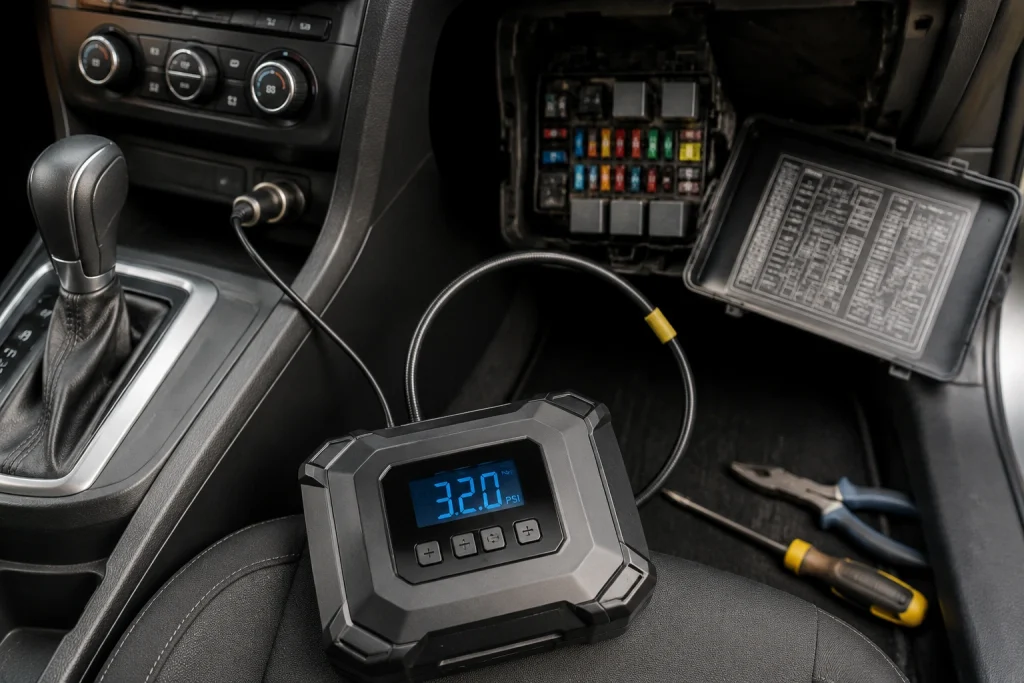
Many 12-volt inflators have a small glass or blade-style fuse inside the plug. The plug tip may unscrew to provide access.
Disconnect the inflator before opening the plug. Examine the fuse for a broken internal wire or dark discoloration. Replace it with the exact type and rating specified by the manufacturer.
2. The Rechargeable Battery Is Discharged or Damaged
Cordless tire inflators depend on an internal or removable rechargeable battery. A display may light up even when the battery does not have enough energy to run the compressor motor.
Charge the unit fully with the manufacturer-approved charger. Then test it without connecting it to a tire.
A battery-related problem is likely when:
- The charge indicator does not increase.
- The inflator runs for only a few seconds.
- The battery loses power while stored.
- The unit works while plugged in but not on battery power.
- The battery case is swollen, cracked, leaking, or unusually hot.
Battery age, heat exposure, repeated deep discharge, and incompatible chargers can reduce battery life.
The Consumer Product Safety Commission identifies overheating, fire, electrical shock, and thermal burns among the potential hazards associated with batteries and chargers. Follow the manufacturer’s charging instructions and stop using any damaged or swollen battery, as explained in the CPSC’s battery safety information. (U.S. Consumer Product Safety Commission)
Do not open, puncture, crush, or attempt to rebuild a sealed lithium-ion battery pack.
3. The Motor Has Overheated
Small portable inflators are not designed to run continuously for long periods. Most have a recommended operating time followed by a cooling period. This is known as the inflator’s duty cycle.
For example, a manufacturer may instruct the user to operate the unit for several minutes and then allow it to cool before continuing. The exact limit varies by model.
When the inflator becomes too hot, a thermal protection circuit may shut off the motor. The unit may restart after it cools.
What to Do
- Turn off and disconnect the inflator.
- Place it on a dry, hard surface with open airflow.
- Keep it away from carpeting, grass, upholstery, and direct heat.
- Allow it to cool completely.
- Review the operating-time limit in the owner’s manual.
- Restart it without exceeding the recommended duty cycle.
Do not pour water on the unit or place it in a refrigerator to accelerate cooling. Rapid temperature changes can create condensation inside the electrical components.
Repeated overheating may indicate that the inflator is too small for the tire, the tire is extremely low, or the compressor is beginning to fail.
4. The Air Hose Is Not Properly Connected
If the motor runs but the tire does not inflate, inspect the connection at the valve stem.
The connector must press the center pin inside the tire valve while also creating an airtight seal. A connector that is only partly attached may allow air to escape around the fitting.
Remove the connector and install it again:
- For a threaded connector, screw it on straight until snug.
- For a lever-style chuck, push it fully onto the valve before locking the lever.
- Keep the hose straight so it does not pull sideways.
- Listen and feel for escaping air.
- Confirm that the displayed pressure changes after the motor starts.
A short hiss while connecting or disconnecting the hose is normal. Continuous hissing during inflation usually indicates a poor seal or damaged connector.
5. The Hose or Connector Is Leaking
Portable inflator hoses can crack near the compressor housing or valve connector. Heat, age, sharp bends, and improper storage can damage the rubber or internal reinforcement.
Check the full length of the hose for:
- Cuts or splits
- Flattened sections
- Loose fittings
- Burn marks
- Bulges
- Air escaping near either end
You can apply a small amount of soapy water to a suspected connection while the inflator is running. Growing bubbles indicate an air leak.
Keep water away from the motor, display, battery, plug, and electrical connections.
A replaceable hose or chuck may be worth repairing on a high-quality inflator. If the hose is permanently attached to an inexpensive unit, replacement may be more practical.
6. The Tire Valve Stem Is Blocked or Damaged
The inflator may be working normally while the tire valve prevents airflow.
Valve-related warning signs include:
- The inflator quickly shows an unusually high pressure.
- The hose becomes pressurized, but the tire stays flat.
- Air enters only when the connector is held at a certain angle.
- The valve stem leaks after the inflator is removed.
- The valve appears bent, cracked, corroded, or loose.
Dirt can also collect inside the valve opening. Wipe the outside gently, but do not force metal objects into the valve.
A damaged valve core can often be replaced by a tire shop. A cracked rubber valve stem usually requires removing the tire from the wheel, which is not a suitable roadside repair.
7. The Tire May Be Too Flat or Damaged
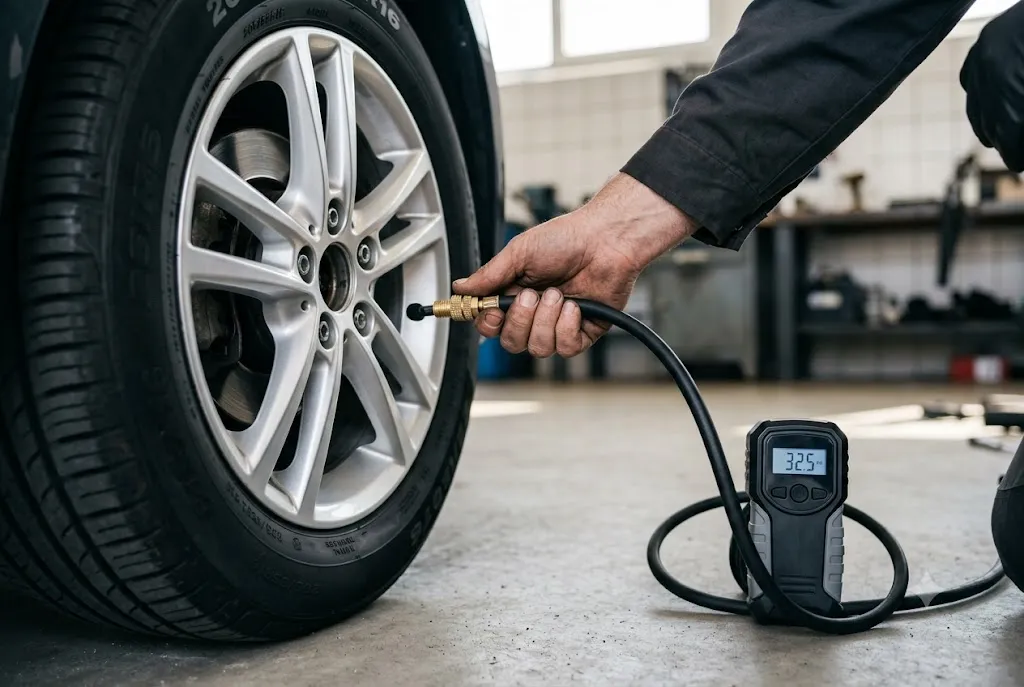
A small inflator may struggle when a tire is completely flat, separated from the wheel bead, or carrying the vehicle’s full weight.
When the tire bead is no longer sealed against the rim, air may escape faster than the inflator can supply it. A damaged sidewall, puncture, bent wheel, or cracked rim can cause the same problem.
Do not continue inflating if you notice:
- Exposed tire cords
- A large sidewall cut
- A sidewall bubble
- A visibly bent or cracked wheel
- The tire separated from the rim
- Rapid air loss
- Unusual popping or cracking sounds
The correct cold tire pressure is normally printed on the driver-side doorjamb label or listed in the vehicle owner’s manual. It is not usually the maximum pressure printed on the tire sidewall.
The NHTSA TireWise guidance recommends checking the tires promptly when the tire-pressure monitoring system indicates significant underinflation. Proper pressure supports safe handling, tire durability, and efficient vehicle operation. (NHTSA)
Never attempt to inflate a tire that appears structurally damaged. High-pressure air stored inside a damaged tire can be dangerous.
Workplace tire-servicing rules are more detailed than normal consumer inflation, but the underlying safety principle is important: tires should not be inflated beyond the pressure specified by the manufacturer. OSHA’s tire and wheel servicing requirements also prohibit unsafe inflation practices involving damaged wheel components. (OSHA)
8. The Pressure Setting or Automatic Shutoff Is Incorrect
Digital inflators often stop automatically after reaching a preset pressure. A mistaken setting can make a working inflator appear defective.
Check whether:
- The target pressure is lower than the tire’s current pressure.
- The unit is displaying bar or kPa instead of PSI.
- The increase and decrease buttons are stuck.
- The automatic mode is set for a bicycle, ball, or motorcycle tire.
- The memory setting changed after the battery was removed.
- The display is showing the target pressure instead of the current pressure.
Turn the unit off, reset the target pressure, and select the correct measurement unit.
A separate handheld tire gauge can help verify whether the inflator’s sensor is accurate.
9. The Power Cord or Plug Is Damaged
A cord can look normal while containing a broken conductor inside the insulation. Damage commonly develops near the plug or where the cord enters the inflator housing.
Possible warning signs include:
- The inflator works only when the cord is bent.
- Power cuts in and out.
- The plug becomes hot.
- The insulation is cracked or melted.
- The metal contact tip is loose.
- Sparks appear when the plug is inserted.
Do not wrap exposed wiring with household tape and continue using the inflator. A damaged 12-volt connection can overheat, short the vehicle circuit, or repeatedly blow fuses.
Cord replacement may be reasonable for a durable, serviceable unit. Replacement is usually safer for a sealed inflator with burned or melted wiring.
10. The Internal Motor or Compressor Has Failed
If the inflator receives proper power but still does not operate, an internal component may have failed.
Potential failures include:
- Worn motor brushes
- Seized compressor bearings
- Broken piston or connecting mechanism
- Failed switch
- Damaged circuit board
- Defective pressure sensor
- Failed thermal protector
- Internal wiring damage
A humming sound without normal compressor movement may indicate a seized motor or mechanical blockage. Loud knocking or grinding can indicate internal damage.
Disconnect the inflator rather than repeatedly trying to restart it. Continued operation can overheat the wiring or damage the power source.
For inexpensive sealed units, replacement is normally more sensible than internal repair. A professional-grade inflator may justify replacement parts if the manufacturer supports repairs.
A Safe Troubleshooting Process
Use this sequence to avoid unnecessary repairs:
- Inspect the tire first. Do not inflate a tire with major sidewall or wheel damage.
- Confirm the required pressure. Use the doorjamb label or owner’s manual.
- Check the inflator’s power source. Test the outlet, battery, plug, and fuse.
- Allow the inflator to cool. Reset any thermal protection.
- Reconnect the hose. Make sure the chuck is straight and airtight.
- Inspect for leaks. Check the hose, fittings, and valve stem.
- Verify the pressure setting. Confirm PSI, bar, or kPa units.
- Compare the reading. Use a separate tire-pressure gauge.
- Stop if abnormal heat or noise appears. Do not force a damaged compressor to run.
- Test the inflator on another suitable tire. This helps separate an inflator fault from a valve or tire problem.
Expert Tip: Test your portable inflator at home every few months. Run it briefly, inspect the cord and hose, and recharge its battery. Discovering a problem in your driveway is much safer than discovering it beside a highway.
Repair or Replace the Tire Inflator?
The best decision depends on the problem, product quality, warranty, and availability of replacement parts.
| Problem | Repair may make sense when | Replacement may be better when |
|---|---|---|
| Blown plug fuse | Correct replacement fuse is available | Fuse repeatedly blows |
| Loose valve connector | Connector or seal is replaceable | Hose assembly is permanently damaged |
| Damaged power cord | Manufacturer provides a replacement | Plug or housing is melted |
| Weak rechargeable battery | Battery is removable and supported | Battery is sealed, swollen, or unavailable |
| Inaccurate gauge | Sensor can be calibrated or replaced | Readings remain unreliable |
| Overheated compressor | Unit works normally after cooling | It overheats during every short use |
| Internal motor failure | Inflator is professional-grade | Repair cost approaches replacement cost |
Durability matters when selecting a replacement. Look for a clearly stated duty cycle, adequate power-cord length, a reinforced hose, a readable gauge, automatic shutoff, thermal protection, and manufacturer support.
A very small cordless inflator may be convenient for topping up tires but may not be suitable for repeatedly inflating large truck or SUV tires from a very low pressure.
Common Mistakes Vehicle Owners Should Avoid
- Using the pressure printed on the tire sidewall as the normal target. Use the vehicle manufacturer’s doorjamb specification.
- Installing a larger vehicle fuse. This can allow the circuit wiring to overheat.
- Running the inflator beyond its duty cycle. Allow the motor to cool as directed.
- Inflating a visibly damaged tire. Cuts, bulges, exposed cords, and wheel damage require professional inspection.
- Testing for leaks near electrical parts with excessive water. Keep moisture away from the motor, battery, plug, and display.
- Holding a loose connector at an angle. This can damage the tire valve and produce inaccurate pressure readings.
- Leaving a cordless inflator discharged for months. Recharge it according to the manufacturer’s storage instructions.
- Ignoring a hot plug or cord. Excess heat can indicate a poor connection or electrical failure.
- Relying only on the inflator’s digital gauge. Periodically compare it with a separate, reliable pressure gauge.
- Trying to open a sealed lithium battery. Damaged rechargeable packs should be removed from service.
When to Call a Transmission Professional
A nonworking tire inflator is usually an accessory, tire, or electrical problem. It is not normally caused by the transmission.
However, professional diagnosis is appropriate when the inflator problem occurs with broader vehicle symptoms, such as:
- Several accessory outlets losing power
- Repeatedly blown vehicle fuses
- Battery or charging-system warning lights
- Dim lights or slow engine cranking
- Burning smells from the dashboard or console
- Transmission warning messages appearing with electrical faults
- Harsh shifting, failure to engage gear, or limp mode
Modern automatic, CVT, and dual-clutch transmissions depend on stable electrical voltage and electronic control modules. A weak battery, charging fault, damaged ground, or power-distribution problem can affect multiple systems at the same time.
Start with a qualified general automotive electrical technician when the issue involves outlets, fuses, the battery, or charging system. Consult a transmission specialist when there are actual shifting, engagement, driveline, or transmission-control symptoms.
ASE explains that its certifications verify the technical knowledge of automotive service professionals. Vehicle owners can use the ASE repair-center locator when looking for a recognized facility. (ASE)
FAQs
Why does my tire inflator turn on but not pump air?
The hose may not be sealed against the valve stem, or the hose, connector, or tire valve may be leaking. A blocked valve core or internal compressor failure can also prevent airflow.
Why does my tire inflator keep shutting off?
It may be overheating, operating beyond its duty cycle, or receiving insufficient voltage. Let it cool, fully charge the battery, or test the vehicle outlet before trying again.
Can a blown fuse stop a tire inflator from working?
Yes. A blown accessory-outlet fuse or a fuse inside the inflator’s 12-volt plug can completely stop the unit. Replace only with the specified fuse rating.
Why is my cordless tire inflator not charging?
The charger, cable, charging port, battery pack, or internal charging circuit may be defective. Try the approved charger and inspect for damage. Stop using the battery if it is swollen or unusually hot.
Why does the inflator show pressure immediately on a flat tire?
The air hose may be pressurized while air is not entering the tire. This can happen when the connector does not press the valve core correctly or the valve is blocked.
Is it safe to leave the vehicle running while using a tire inflator?
Follow the inflator and vehicle owner’s manuals. Some 12-volt inflators require the engine to run to maintain voltage. Use the vehicle only outdoors with the parking brake applied and keep the exhaust area unobstructed.
How do I know whether to repair or replace my tire inflator?
Repair simple external problems such as a replaceable fuse, hose seal, or removable battery. Replace the unit when it has a burned cord, swollen battery, unreliable pressure sensor, repeated overheating, or major internal motor damage.
Conclusion
When you ask, “Why is my tire inflator not working?”, begin with the simplest possibilities. Check the power source, vehicle fuse, rechargeable battery, hose connection, pressure setting, and tire valve before assuming the compressor has failed.
Allow an overheated unit to cool, follow its duty-cycle limit, and never inflate a tire with serious sidewall or wheel damage. Replace the inflator if it has unsafe wiring, a swollen battery, repeated fuse failures, or major internal damage.
Before your next trip, test the inflator at home and verify its reading with a separate tire gauge. If the problem involves the vehicle’s electrical system or appears alongside transmission warning signs, arrange a professional inspection before relying on the vehicle for a longer drive.
