
What Is Auto Shut Off on a Tire Inflator, and How Does It Work?

You connect a portable inflator, choose a pressure, press start, and the machine stops by itself. That sounds simple, but many owners still wonder: what is auto shut off on a tire inflator, and can it be trusted to prevent overinflation?
Auto shutoff is a useful feature on modern digital inflators. It reduces guesswork and makes routine pressure checks easier. However, it does not replace the correct pressure information, a reliable gauge, or an inspection for tire leaks and damage.
This guide explains how the feature works, how to use it safely, what affects its accuracy, and when professional help is the smarter choice.
Quick Answer
Auto shutoff on a tire inflator means the unit automatically stops pumping when the tire reaches the pressure you selected. A built-in sensor monitors pressure and turns off the motor at the preset PSI. It improves convenience and helps prevent overinflation, but you should still verify the final pressure.
How Auto Shutoff Works on a Tire Inflator
A digital tire inflator with auto shutoff combines an air pump, pressure sensor, electronic controller, and display.
The process works like this:
- Connect the hose to the tire valve.
- Read the tire’s current pressure.
- Enter the target pressure, such as 35 PSI.
- Start the compressor.
- The sensor monitors pressure as air enters the tire.
- The controller stops the motor at the preset pressure.
Some better inflators slow down, pause, or recheck pressure near the target to reduce overshoot. Milwaukee, for example, describes a system that senses the filling rate and stops at the selected PSI. Its explanation of automatic pressure shutoff technology shows how manufacturers refine this basic function. (Milwaukee Tool)
What the Sensor Measures
The sensor measures pressure in the connected hose and tire. While air is flowing, the displayed number may jump slightly because the compressor is pushing air through a narrow hose and valve.
A well-designed unit accounts for this movement before shutting down. Some inflators briefly pause near the target so the pressure can stabilize.
Why Pressure May Drop After Disconnecting
A small pressure drop does not always mean the inflator failed. A brief hiss can occur when removing the chuck, warm air can cool, or the hose pressure may be slightly higher than the stabilized tire pressure.
If the tire repeatedly finishes below the target, compare the result with a separate gauge. Do not compensate by adding a large amount of extra pressure.
Why Auto Shutoff Is Useful
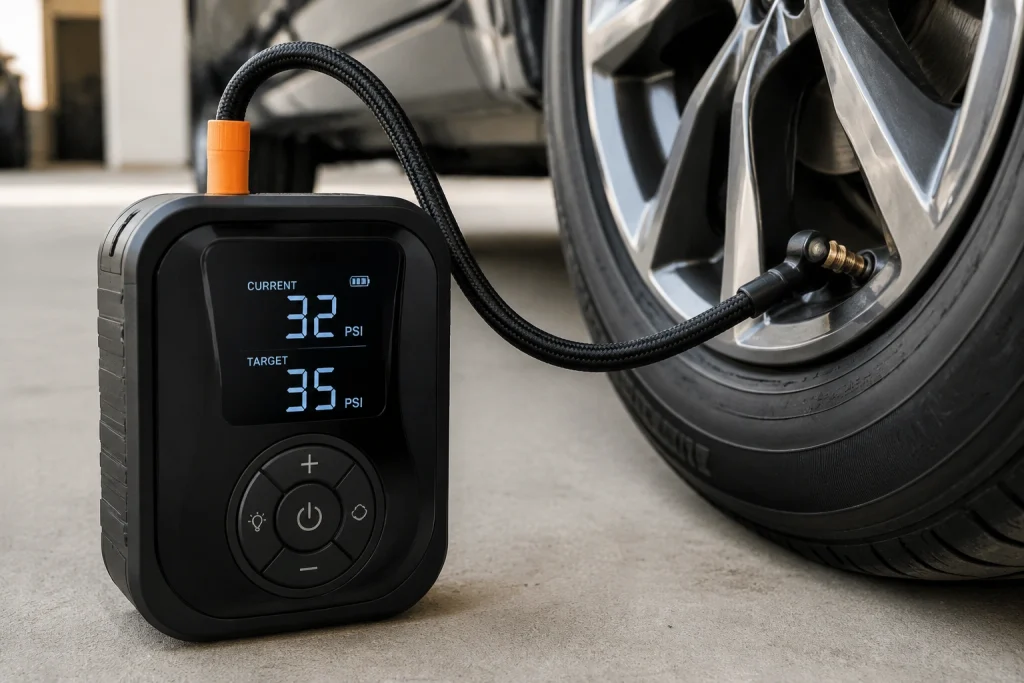
The main benefit is control. With a manual inflator, you must watch the gauge and stop at the right moment. An automatic model handles that step for you.
Key benefits include:
- Less risk of overinflation: It stops at the selected pressure.
- Better consistency: You can use the same target for several tires.
- Easier roadside use: Less monitoring is helpful in poor weather or darkness.
- More confidence for beginners: It removes some guesswork.
Proper inflation affects safety, tire life, and fuel use. The U.S. Department of Energy says properly inflated tires last longer, improve fuel economy, and are safer. Its efficient driving and tire-maintenance guidance also advises using the manufacturer-recommended pressure. (Alternative Fuels Data Center)
Auto Shutoff vs. Manual Shutoff
| Feature | Auto-Shutoff Inflator | Manual Inflator |
|---|---|---|
| How it stops | Stops at preset pressure | User switches it off |
| Ease of use | Easier for routine top-offs | Requires attention |
| Overinflation control | Better when set correctly | Depends on user timing |
| Gauge | Usually digital | Digital or analog |
| Main limitation | Sensor or setting errors | Easier to overshoot |
| Final verification | Recommended | Recommended |
Auto shutoff is usually the better choice for everyday owners. A manual inflator can still work well when it has a good gauge and the operator watches it carefully.
How to Use Auto Shutoff Safely
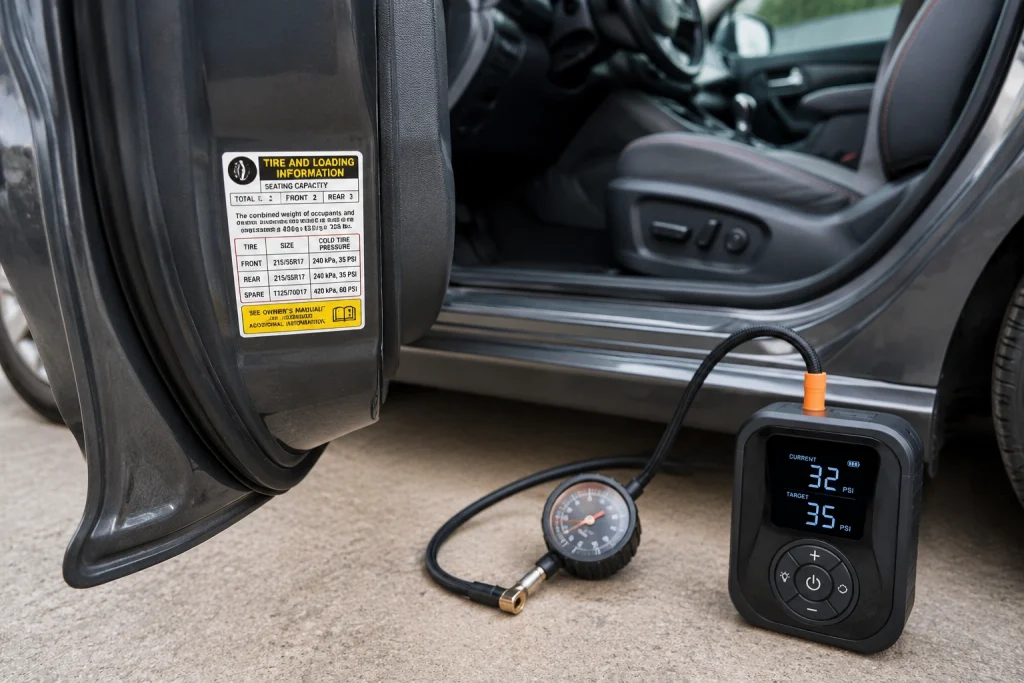
- Find the recommended pressure.
Check the Tire and Loading Information label inside the driver’s door or the owner’s manual. - Check cold tires.
Measure after the vehicle has been parked for about three hours or driven only a short distance. - Ignore the sidewall maximum as a fill target.
The tire sidewall does not normally show the recommended pressure for your vehicle. - Connect the hose securely.
A loose chuck can leak and create a false reading. - Select the correct unit and pressure.
Confirm that the display uses PSI rather than bar or kPa, then enter the door-label pressure. - Start the unit and stay nearby.
Auto shutoff is convenient, but a running compressor should not be left unattended. - Verify the result.
Wait a few seconds after shutdown and check the pressure with a separate gauge, especially before a long trip.
NHTSA advises checking pressure when tires are cold and using the vehicle manufacturer’s recommended pressure rather than the maximum printed on the tire. Its summer driving tire guidance reinforces both points. (NHTSA)
Expert Tip: Compare a new auto-shutoff inflator with a trusted handheld gauge on all four tires. You will quickly learn whether the inflator consistently reads slightly high or low.
What Auto Shutoff Does Not Do
It Does Not Repair a Leak
A nail, damaged valve, bent wheel, bead leak, or cracked tire may allow air to escape. The inflator can restore pressure temporarily, but it cannot fix the cause.
Do not keep adding air to a tire that repeatedly loses pressure without having it inspected.
It Does Not Guarantee Perfect Accuracy
The shutoff point depends on sensor quality and calibration. Readings can change after heavy use, impact damage, moisture exposure, or extreme temperatures.
It Is Not the Same as Thermal Shutoff
Pressure auto shutoff stops the motor because the selected PSI has been reached. Thermal shutoff stops the compressor because it is too hot.
If overheating caused the shutdown, the tire may still be underinflated. Let the unit cool according to its manual before continuing.
It Does Not Replace TPMS or a Gauge
A tire pressure monitoring system, or TPMS, warns about significant underinflation. It may not show exact cold pressure or warn after a small pressure loss.
NHTSA’s TireWise safety guidance recommends monthly checks even on vehicles with TPMS because the warning generally appears only after meaningful underinflation. (NHTSA)
How Accurate Is Auto Shutoff?
A good inflator can be accurate enough for normal passenger-car maintenance, but results vary.
Accuracy can be affected by:
- Sensor quality and calibration
- Battery charge or unstable 12-volt power
- Hose restriction or a leaking chuck
- Tire and outside temperature
- Compressor vibration and pressure overshoot
- Wear, dust, moisture, or impact damage
A consistent one-PSI difference may be manageable once identified. A large or changing difference is a warning. Compare the inflator with a known-good gauge rather than assuming either reading is correct.
Stop using automatic mode if the unit repeatedly overfills, fails to stop, or gives unstable readings.
Signs Auto Shutoff Is Not Working Correctly
Watch for these problems:
- The motor runs beyond the selected pressure.
- The unit stops several PSI early.
- The reading jumps while pressure is stable.
- Air leaks around the hose connection.
- The inflator resets or displays an error.
- It becomes extremely hot or smells burned.
- It stops from heat before reaching the target.
Disconnect the inflator and check the chuck, hose, selected unit, and power supply. Let an overheated unit cool. If the behavior continues, replace or service it.
Choosing a Reliable Auto-Shutoff Inflator
Choose a unit that matches your tire size and expected use. Look for:
- A clear display: Current and target pressure should be easy to distinguish.
- Simple controls: Settings should not change accidentally.
- A secure chuck: A good seal improves accuracy.
- Adequate airflow: Maximum PSI alone does not indicate filling speed.
- A stated duty cycle: The manual should explain required cooling breaks.
- Overheat protection: Useful, but different from pressure shutoff.
- Suitable power: Choose 12-volt, battery, or AC for your situation.
- Warranty support: Important for frequent use.
A small emergency inflator should be easy to store and power from the vehicle. A unit for trucks or trailers needs stronger airflow, a longer duty cycle, and a durable hose.
Cost, Quality, and Durability
Budget inflators may work for occasional top-offs but can run slowly or hot. Better-built units often provide stronger housings, more secure hoses, clearer displays, and more consistent pressure control.
Professional-grade models generally cost more because they are designed for larger tires and repeated use. Do not judge value by maximum PSI alone.
For most car owners, repeatable readings, dependable shutoff, adequate airflow, and a useful warranty matter more than an extreme pressure claim.
Common Mistakes Vehicle Owners Should Avoid
- Using the maximum PSI printed on the tire as the target
- Filling hot tires to the cold-pressure specification
- Confusing PSI with bar or kPa
- Assuming auto shutoff is perfectly accurate
- Leaving the compressor unattended
- Ignoring repeated pressure loss
- Exceeding the inflator’s duty cycle
- Relying only on the TPMS light
- Continuing to use a unit that fails to stop
When to Call a Transmission Professional
An inflator or tire-pressure problem normally belongs with a tire shop, roadside provider, or general repair technician—not a transmission specialist.
Correct tire pressure first if the vehicle vibrates, pulls, or feels unstable. If symptoms remain and you also notice slipping, delayed engagement, harsh shifts, transmission warnings, fluid leaks, or shuddering under acceleration, arrange a transmission diagnosis.
All-wheel-drive vehicles also require attention when tire sizes, circumferences, or tread depths differ significantly. Vehicle manufacturers may require closely matched tires because differences can affect handling and place additional stress on AWD driveline components. (Owners Manuals)
A tire professional can measure the tires, while a transmission or driveline specialist can investigate binding, overheating, or transfer-case symptoms.
Do not assume the inflator caused a transmission problem. A proper diagnosis should separate tire, wheel, driveline, and transmission faults.
FAQs
What pressure should I set on an auto-shutoff tire inflator?
Use the cold pressure on the driver-side door label or in the owner’s manual. Do not use the maximum molded into the tire sidewall.
Will auto shutoff prevent all overinflation?
It reduces the risk but cannot guarantee perfect pressure. A wrong setting, bad sensor, loose hose, or unit-selection error can still cause an incorrect result.
Can I leave the inflator running by itself?
No. Stay nearby and stop it if the hose leaks, the unit overheats, or pressure rises beyond the target.
Why does my inflator stop before reaching the set PSI?
Possible causes include a leaking chuck, weak battery, overheating compressor, or pressure-sensor error. Let the pressure stabilize and check it with another gauge.
Why Is Pressure Lower After I Remove the Hose?
A little air may escape during disconnection, or warm compressed air may cool and settle. A poor chuck can also release extra air.
Is Pressure Auto Shutoff the Same as Overheat Protection?
No. Pressure shutoff stops at the target PSI. Thermal protection stops a hot motor even when the tire is not full.
Do I Still Need a Separate Pressure Gauge?
Yes. A separate quality gauge helps verify that the inflator’s sensor and shutoff point remain accurate.
Conclusion
Auto shutoff on a tire inflator is a pressure-control feature that stops the compressor at the selected PSI. It makes inflation easier, improves consistency, and lowers the chance of accidental overfilling.
It works best when you use the correct cold pressure, connect the hose securely, remain nearby, and verify the result. It cannot repair a leak or guarantee perfect accuracy.
Now that you know what auto shut off on a tire inflator means, check the driver-door pressure label, test your inflator against a separate gauge, and have any tire with repeated air loss inspected before your next drive.
