
Does a Tire Inflator Drain Car Battery Power?

You plug a portable tire inflator into your vehicle’s 12-volt outlet, start adding air, and then wonder whether the car will still start afterward. It is a reasonable concern, especially if the battery is old, the weather is cold, or the engine is turned off.
So, does a tire inflator drain car battery power? Yes. A 12-volt tire inflator draws electricity from the vehicle’s battery whenever its compressor motor is running. A short inflation session usually will not drain a healthy battery completely, but longer use, repeated inflation, or a weak battery can leave the vehicle unable to start.
This guide explains how much power tire inflators use, when battery drain becomes a concern, how to operate one safely, and when the problem requires professional diagnosis.
Quick Answer
Yes, a tire inflator can drain a car battery because its electric motor uses significant current. A healthy battery can normally handle a brief inflation session, especially with the engine running outdoors. However, operating the inflator for too long with the engine off may weaken or discharge an old, cold, or partially charged battery.
How a Tire Inflator Uses Your Car Battery
Most compact automotive tire inflators receive power in one of three ways:
- A 12-volt accessory outlet inside the vehicle
- Battery clamps connected directly to the battery
- A built-in rechargeable battery
A plug-in 12-volt inflator converts electrical energy into mechanical movement. Its motor drives a small compressor, which forces air through the hose and into the tire.
The compressor motor is the part that draws substantial current. The pressure display, LED light, or control buttons use much less electricity.
Portable compressor specifications show how widely power demands can vary. For example, some compact inflators draw about 10 amps, while larger compressors may draw 20, 30, or more amps. Manufacturer specifications for portable 12-volt compressors and their amp draw demonstrate why the inflator must match the vehicle’s outlet and fuse rating. (Viair Corp)
Does Leaving the Inflator Plugged In Drain the Battery?
It depends on the vehicle and the inflator.
Some vehicle accessory outlets switch off when the ignition is turned off. Others remain powered continuously. If the outlet remains live, an inflator with an illuminated display, standby circuit, or built-in light may continue drawing a small amount of electricity.
The drain is usually much slower when the compressor is not running. However, leaving accessories connected for hours or days can contribute to a weak battery. AAA explains that a powered 12-volt outlet may continue drawing electricity with the engine off, depending on how the vehicle is designed. (AAA Club Alliance)
Unplug the inflator after every use. This prevents accidental operation, unnecessary standby drain, cord damage, and overheating around the outlet.
How Quickly Can a Tire Inflator Drain a Car Battery?
There is no single time limit that applies to every vehicle. Battery drain depends on several factors:
- Inflator amp draw
- Length of operation
- Battery age and condition
- Battery state of charge
- Outdoor temperature
- Vehicle outlet capacity
- Number and size of tires being inflated
- Other electrical accessories operating at the same time
A simple electrical estimate helps explain the load. A 10-amp inflator operating for 10 minutes uses approximately:
10 amps × 10/60 hour = 1.67 amp-hours
A 15-amp inflator operating for the same period uses approximately 2.5 amp-hours. That may not sound like much, but a starter battery must retain enough power to crank the engine. A battery can still operate lights or a display even when it no longer has sufficient starting power.
The calculation is only an estimate. Compressor current can change as tire pressure rises, and battery voltage may fall faster when the battery is cold, old, damaged, or incompletely charged.
Battery-Drain Risk by Situation
| Situation | Battery-drain risk | Recommended action |
|---|---|---|
| Topping up one tire for 2–5 minutes | Low with a healthy battery | Follow the inflator instructions |
| Inflating all four slightly low tires | Low to moderate | Run the engine outdoors if both manuals permit |
| Inflating a nearly flat tire | Moderate | Monitor inflation time and battery condition |
| Running a heavy-duty compressor with the engine off | High | Use the required direct-battery connection and follow its manual |
| Using the inflator with an old or weak battery | High | Start the vehicle first or test the battery |
| Leaving the inflator operating unattended | Very high | Stop immediately and supervise the unit |
| Leaving a digital inflator plugged into a live socket overnight | Variable | Unplug it after use |
Should the Engine Be Running While Using a Tire Inflator?
In many cases, running the engine helps prevent battery discharge because the vehicle’s charging system supports the electrical load. However, you must check both the vehicle owner’s manual and the inflator instructions.
Some inflators specifically instruct users to start the vehicle before operating the compressor. Others may have a different connection sequence. Heavy-duty models often connect directly to the battery because a normal accessory outlet cannot safely supply enough current.
Never run a gasoline or diesel vehicle inside a garage or another enclosed area. The CDC warns that a car or truck should not be operated inside an attached garage, even when the garage door is open, because exhaust can expose occupants to carbon monoxide. (CDC)
Move the vehicle completely outdoors before starting the engine.
What About Hybrids and Electric Vehicles?
Hybrid and electric vehicles still use a low-voltage electrical system for accessories, but their operating procedures may differ from those of conventional vehicles.
Do not assume that placing the vehicle in accessory mode will maintain the 12-volt battery. Consult the owner’s manual for:
- The correct power mode
- Approved accessory-outlet loads
- Whether the vehicle should be in READY mode
- Safe connection points for battery clamps
- Restrictions on external 12-volt equipment
Never attach compressor clamps to high-voltage hybrid or EV components. Use only the connection points identified by the vehicle manufacturer.
How to Use a 12-Volt Tire Inflator Without Draining the Battery
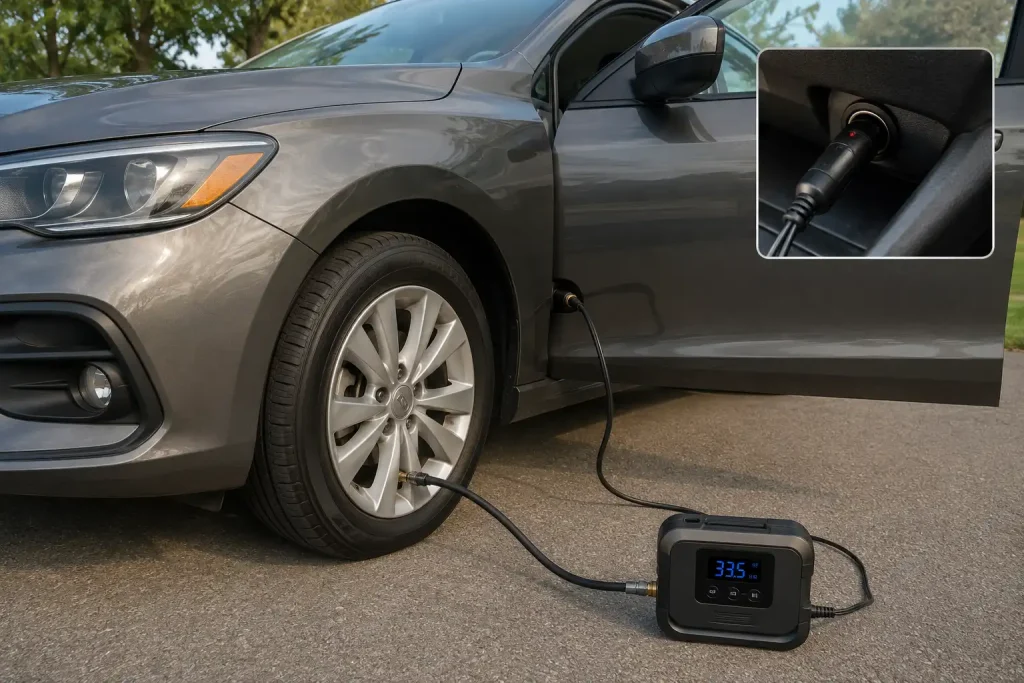
Follow this process unless the inflator or vehicle manufacturer provides different instructions.
1. Check the Inflator’s Electrical Rating
Look for the amp or watt rating on the inflator label or in its manual.
Then check the maximum rating of the vehicle’s accessory outlet. This information may appear:
- On the outlet cover
- In the owner’s manual
- In the fuse-box information
- Near the dashboard power-port instructions
Do not use an inflator that exceeds the circuit’s rating. An overloaded circuit may blow a fuse, overheat the plug, damage the socket, or melt wiring.
2. Inspect the Battery’s Condition
Be more cautious when the vehicle has:
- Slow engine cranking
- Dim lights during startup
- A battery more than several years old
- Frequent jump-starts
- Corroded battery terminals
- A recent period of inactivity
- Warning messages related to low voltage
A weak battery may start the vehicle normally before inflation but fail after the compressor draws additional power.
3. Move the Vehicle Outdoors
Park on a stable, level surface away from moving traffic. Apply the parking brake and place the transmission in Park. A manual-transmission vehicle should be placed in Neutral only when the manufacturer’s procedure requires it and the vehicle is fully secured.
4. Turn Off Unnecessary Accessories
Reduce the electrical load by turning off:
- Headlights when safe and legal
- Heated seats
- Rear-window defroster
- High-speed cabin blower
- Audio equipment
- Phone chargers and other plug-in devices
This leaves more charging capacity available for the tire inflator.
5. Start the Vehicle When Permitted
When both manuals allow it, start the engine before operating the inflator. Keep the vehicle outdoors throughout the process.
For hybrids and EVs, use only the operating mode specified by the manufacturer.
6. Connect the Inflator Directly
Insert the plug firmly into the approved outlet. Avoid cheap socket splitters, damaged extension cords, loose adapters, or undersized wiring.
For a clamp-style compressor, follow the manufacturer’s polarity and connection sequence exactly.
7. Set the Correct Tire Pressure
Use the pressure listed on the driver-side doorjamb label or in the owner’s manual. Do not use the maximum pressure molded into the tire sidewall as the vehicle’s normal target pressure.
The NHTSA tire-maintenance guidance recommends checking tires when they are cold and following the vehicle manufacturer’s specified pressure. (NHTSA)
8. Monitor the Inflator Continuously
Watch the pressure reading and check the inflator’s temperature. Stop when the recommended pressure is reached.
Do not exceed the compressor’s duty cycle. The duty cycle is the amount of time the inflator may operate before it needs to cool. Continuing beyond this limit can overheat the motor, power plug, wiring, or hose.
9. Unplug and Store the Inflator
Switch the inflator off before disconnecting it. Unplug it from the vehicle, allow it to cool, and store the cord without tight bends.
Restart or confirm normal vehicle operation before leaving a remote location.
Expert Tip:
Test your tire inflator at home before relying on it during a roadside emergency. Confirm that the plug fits securely, the fuse does not blow, the hose reaches every tire, and the pressure gauge produces a reasonable reading.
Signs the Inflator Is Overloading the Electrical System
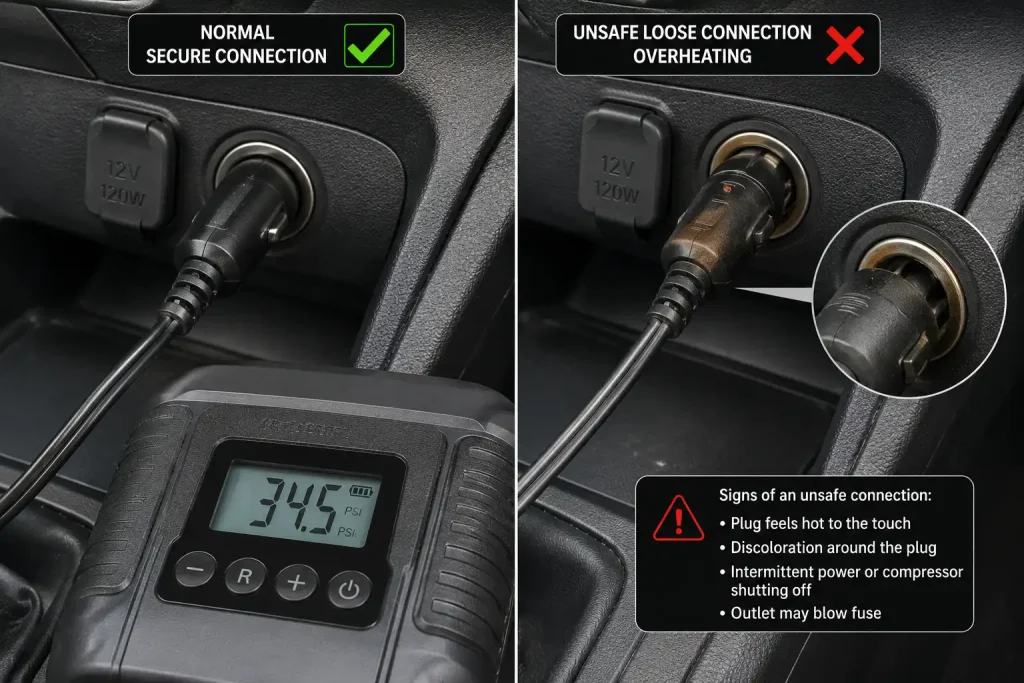
Stop using the inflator if you notice any of the following:
- The accessory plug becomes extremely hot
- The socket smells like burning plastic
- The power cord softens, melts, or changes color
- The compressor repeatedly stops and restarts
- The vehicle’s lights dim heavily
- The outlet fuse blows
- Sparks appear around a battery clamp
- The inflator motor sounds unusually slow
- A battery or charging-system warning appears
- The vehicle will not restart afterward
A slightly warm plug may be normal during operation. A plug that is too hot to touch, smells burned, or shows melted plastic is not normal.
Do not replace a blown fuse with one rated higher than the vehicle manufacturer specifies. A larger fuse can allow wiring to overheat before the circuit is interrupted.
Can a Tire Inflator Damage the Car Battery?
A normal inflation session should not damage a healthy battery when the equipment is compatible with the vehicle and used correctly.
Problems become more likely when the battery is repeatedly discharged deeply. Automotive starter batteries are designed to provide a short burst of high current for starting the engine. They are not intended to be repeatedly drained like a deep-cycle battery.
Battery life may be shortened by:
- Repeatedly operating the inflator with the engine off
- Using a compressor that draws excessive current
- Inflating large tires with an undersized compressor
- Continuing after the compressor overheats
- Leaving powered accessories connected for long periods
- Allowing the battery to remain partially discharged
- Using the inflator when the charging system is already weak
If the vehicle needs a jump-start after only a few minutes of inflation, the inflator may have exposed an existing battery or charging-system problem rather than creating the entire problem by itself.
Choosing an Inflator That Matches Your Vehicle
A higher-powered compressor is not automatically the better choice. The right inflator must match the tire size, required pressure, outlet capacity, and expected use.
Compact Plug-In Inflators
These are usually suitable for:
- Passenger-car tires
- Small crossovers
- Routine pressure adjustments
- Emergency top-ups
Benefits include small size and convenient storage. Their limitations may include slower inflation, shorter duty cycles, and lower airflow.
Direct-to-Battery Compressors
These are more appropriate for:
- Pickup trucks
- Large SUVs
- LT tires
- Off-road tires
- Multiple large tires
- Higher-volume inflation
They often draw more current than an interior outlet can provide. Their battery clamps, heavier wiring, and larger motor are designed for greater electrical demand.
Rechargeable Inflators
A cordless inflator does not draw from the car battery while operating from its internal battery. However, it must remain charged and may have limited runtime.
A model with a replaceable or widely supported battery system may offer better long-term durability than a unit with a permanently sealed battery.
Common Mistakes Vehicle Owners Should Avoid
- Inflating tires inside a closed garage with the engine running: This creates a carbon-monoxide hazard.
- Assuming every 12-volt outlet has the same capacity: Outlet and fuse ratings vary by vehicle.
- Using the tire sidewall pressure as the target: The sidewall normally shows a maximum rating, not the vehicle’s recommended operating pressure.
- Ignoring the inflator’s duty cycle: Continuous operation can overheat and damage the compressor.
- Using a socket splitter: The splitter may not safely carry the inflator’s current.
- Leaving the inflator unattended: Pressure can rise quickly, and equipment can overheat.
- Running the compressor with a weak battery: The vehicle may not restart.
- Installing a larger fuse after the correct fuse blows: This can expose the wiring to unsafe current.
- Leaving the inflator plugged in after use: A live outlet may allow standby drain.
- Assuming the inflator can repair tire damage: It adds air but does not fix a puncture, sidewall cut, bead leak, or damaged wheel.
When to Call a Transmission Professional
A tire inflator normally has no direct mechanical effect on the transmission. If the vehicle fails to start after inflation, the first checks should involve the battery, charging system, accessory outlet, and related fuses.
Contact a qualified automotive electrical technician when:
- The battery repeatedly dies
- The vehicle requires frequent jump-starts
- The battery warning light remains on
- The inflator repeatedly blows the outlet fuse
- The outlet or wiring overheats
- The engine starts but quickly stalls
- Charging voltage is abnormal
- Multiple electrical warning messages appear
Call a transmission professional when shifting problems continue after normal battery voltage has been restored. Relevant symptoms include:
- Delayed engagement into Drive or Reverse
- Harsh or unpredictable shifting
- A transmission warning message
- The vehicle remaining in one gear
- Failure to move despite normal engine operation
- Transmission-related diagnostic codes that return after low-voltage problems are corrected
Low voltage can sometimes cause electronic modules to record misleading faults. Ask the shop to test the battery and charging system before approving expensive transmission repairs.
When choosing a repair facility, the ASE Blue Seal repair-shop locator can help vehicle owners identify shops employing a high percentage of ASE-certified professionals. (ASE)
FAQs
Does a tire inflator drain a car battery if the engine is running?
It normally places less demand on the battery when the engine is running because the charging system helps supply electricity. Operate the vehicle outdoors and follow both the vehicle and inflator instructions.
Can a tire inflator kill a car battery in five minutes?
It is unlikely to completely drain a healthy, fully charged battery in five minutes. However, a weak, cold, old, or partially discharged battery may not have enough power left to restart the engine.
Should I start the car before plugging in the tire inflator?
Follow the inflator’s manual. Some manufacturers require the vehicle to be started before compressor operation, while others specify a particular connection sequence.
Can I leave a tire inflator plugged in overnight?
It is better to unplug it. Some vehicle outlets remain powered after the ignition is turned off, and certain inflators may draw standby current through a display, light, or control circuit.
Why did my tire inflator blow the car’s fuse?
The inflator may exceed the outlet’s current rating, the plug may be loose, the wiring may be damaged, or the compressor may be failing. Replace the fuse only with the specified rating and diagnose the cause before trying again.
Can I use a tire inflator after jump-starting the vehicle?
Allow the charging system to operate before adding another heavy electrical load. If the battery was severely discharged, it should be properly tested and recharged rather than relying only on a short period of idling.
Will a cordless tire inflator drain my car battery?
Not while it is running from its own rechargeable battery. It will draw vehicle power only when connected to the car for charging or when designed to operate through the 12-volt outlet.
Conclusion
So, does a tire inflator drain car battery power? Yes, but brief, correct use usually will not leave a healthy vehicle stranded. The greatest risk occurs when a high-draw compressor is operated for too long with the engine off, particularly when the battery is already weak or the weather is extremely cold.
Check the inflator’s amp rating, confirm the vehicle outlet capacity, follow the duty cycle, use the manufacturer’s recommended tire pressure, and unplug the unit after every use. When permitted, operate the inflator with the vehicle running completely outdoors.
If a short inflation session causes a no-start condition, arrange a battery and charging-system test before replacing parts or authorizing transmission work. Correct diagnosis protects both your vehicle and your repair budget.
