
How Accurate Are Tire Inflator Gauges? A Practical Guide for Vehicle Owners

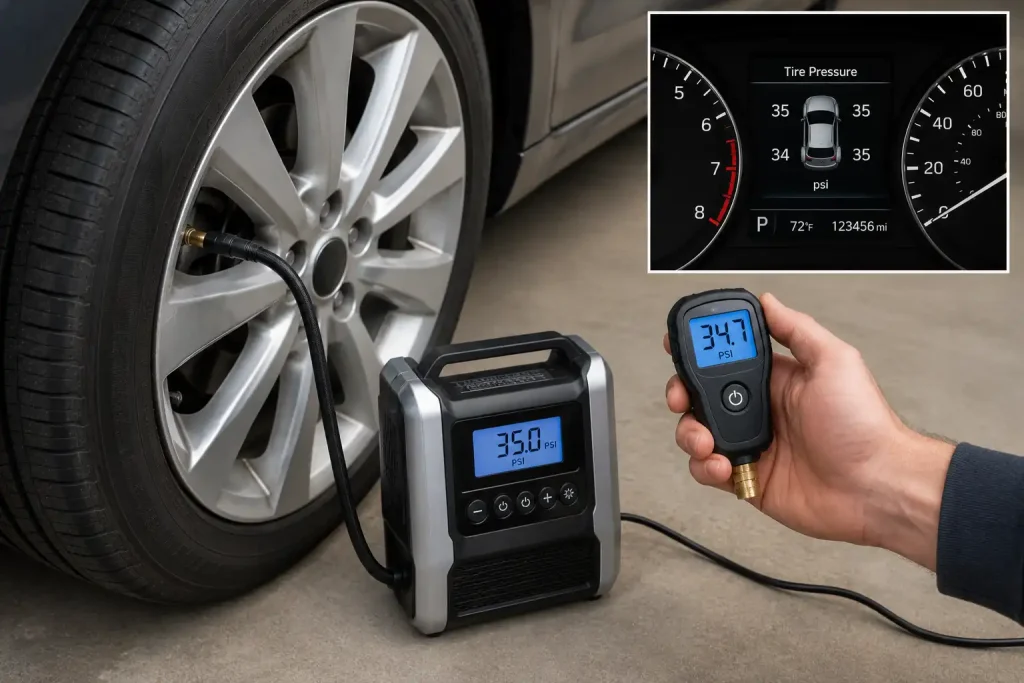
You connect a portable inflator, set it to 35 PSI, and let it stop automatically. Then a separate tire gauge shows 33 PSI—or your dashboard displays 36 PSI. Which reading should you trust?
The answer depends on the inflator’s quality, condition, temperature, hose design, and how the measurement was taken. Understanding how accurate tire inflator gauges are matters because even a small error can lead to uneven tire wear, reduced handling, misleading TPMS warnings, and unnecessary vehicle troubleshooting.
This guide explains typical gauge accuracy, why readings disagree, how to test your inflator, and when a tire-pressure problem may point to a larger driveline concern.
Quick Answer
Most good-quality tire inflator gauges are accurate enough for normal vehicle maintenance, especially when their readings stay within about 1 PSI of a trusted reference gauge. Cheap, damaged, poorly calibrated, or aging gauges may be off by 2 PSI or more. Always measure cold tires and verify questionable readings with a separate gauge.
How Accurate Are Tire Inflator Gauges in Real-World Use?
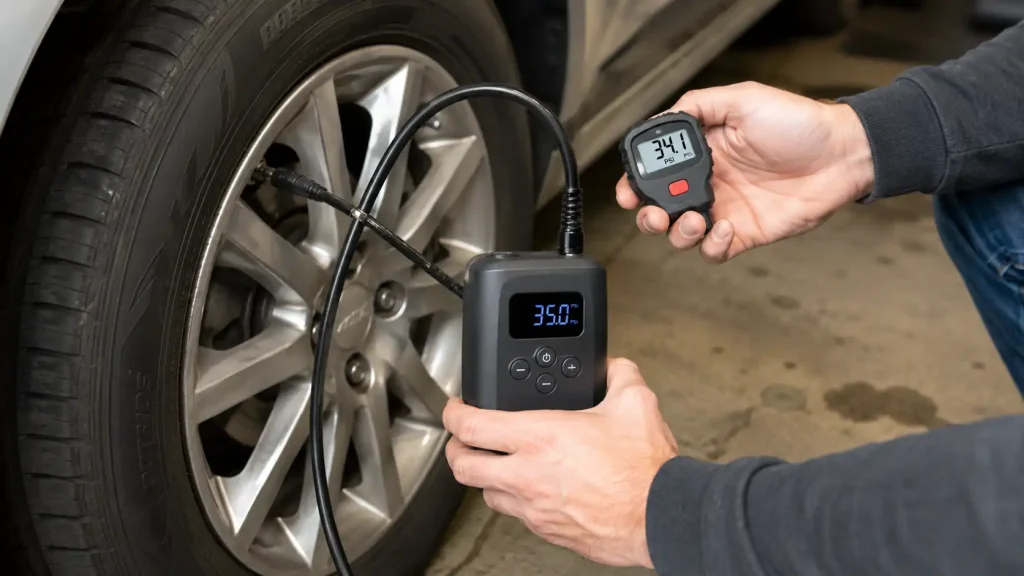
A tire inflator gauge does not need laboratory-level precision to be useful. For most passenger vehicles, the important question is whether it can repeatedly place the tire close to the manufacturer’s recommended pressure.
As a practical standard:
- A difference of 0–1 PSI is usually acceptable for routine vehicle use.
- A consistent difference of 1–2 PSI may be manageable once you understand the offset.
- A difference greater than 2 PSI should be investigated.
- A reading that changes widely from one test to the next suggests a faulty gauge, poor valve connection, weak battery, or unstable air hose.
Accuracy and repeatability are not exactly the same. A gauge may repeatedly show 34 PSI when the true pressure is 35 PSI. That gauge is slightly inaccurate but consistent. You can account for the 1 PSI difference.
A gauge that shows 32, 35, and 38 PSI during repeated checks is not dependable, even if one reading happens to be correct.
Independent testing also shows that handheld gauge performance can vary by model and temperature. Consumer Reports’ tire pressure gauge testing compares gauges against a calibrated reference and evaluates how temperature affects their readings. (Consumer Reports)
Why Two Tire Pressure Gauges May Show Different Readings
A disagreement between your portable inflator, handheld gauge, and dashboard does not automatically mean one device is broken.
Several conditions can change the result.
The Tire Is Warm
Driving heats the tire and the air inside it. As the air temperature rises, the measured pressure normally rises too.
For the most accurate comparison, measure the tires before driving or after the vehicle has been parked for at least three hours. The NHTSA summer driving and tire safety guidance recommends checking tires cold and using the pressure listed on the driver’s door placard or owner’s manual—not the maximum pressure printed on the tire sidewall. (NHTSA)
A gauge reading taken after a highway trip should not be directly compared with a reading taken the following cold morning.
The Compressor Is Still Running
Some inflators display pressure while air is moving through the hose. That reading may fluctuate or temporarily appear higher than the tire’s settled pressure.
For a better result:
- Stop the compressor.
- Wait several seconds.
- Allow the displayed pressure to stabilize.
- Check again with a separate gauge.
This is especially important with small portable compressors that create pressure pulses.
The Valve Connection Is Leaking
If the chuck is not seated squarely on the valve stem, air may escape during measurement. This can create a low reading or make the display jump.
Listen for continuous hissing. A brief release of air while connecting or removing the chuck is normal, but constant leaking is not.
The Gauge Uses a Different Calibration
Every measuring instrument has some level of uncertainty. Manufacturing quality, sensor design, wear, and calibration affect the result.
A product advertised as “NIST traceable” should have documentation showing how its calibration connects to recognized measurement standards. NIST’s explanation of metrological traceability makes clear that traceability involves a documented chain of calibrations and does not automatically guarantee that every product is suitable for every use. (NIST)
For normal car maintenance, a certified shop-grade gauge is helpful as a reference, but most owners do not need a laboratory certificate.
The Digital Gauge Battery Is Weak
A weak battery may cause:
- A dim display
- Slow response
- Intermittent readings
- Failure to hold a stable number
- Unexpected shutdowns
Replace the battery before assuming the pressure sensor has failed.
The Gauge Has Been Dropped or Damaged
Dial gauges contain mechanical parts that may shift after an impact. Digital gauges can also suffer internal sensor or circuit damage.
Inspect the unit after it has been:
- Dropped onto concrete
- Crushed under tools
- Exposed to water
- Stored in extreme heat
- Pulled sharply by the hose
Digital, Dial, Pencil, and TPMS Accuracy Compared
| Gauge type | Practical accuracy potential | Main advantages | Common limitations |
|---|---|---|---|
| Digital inflator gauge | Usually good when properly calibrated | Easy to read, automatic shutoff, precise display | Requires power or batteries; sensor quality varies |
| Dial inflator gauge | Good with a quality mechanism | Large display, no battery needed | Can lose calibration after drops or vibration |
| Pencil gauge | Adequate for basic checks | Cheap, compact, simple, durable | Harder to read precisely; limited resolution |
| Separate digital gauge | Often useful as a reference | Portable, easy to compare against inflator | Battery dependent; quality varies |
| Dashboard TPMS display | Generally useful for monitoring | Shows pressure while driving; warns of pressure loss | May update slowly and should not replace regular manual checks |
AAA tested the displayed TPMS readings of 11 newer vehicles and found the average absolute difference between displayed and measured pressure was approximately 1.2% to 1.5%, depending on tire position. However, the warning light did not immediately illuminate in every vehicle when tires were reduced to 75% of the placard pressure. This supports using TPMS as a safety system—not as the only tire-maintenance tool. See the AAA study on tire pressure monitoring system accuracy.
How to Test Your Tire Inflator Gauge at Home
You can perform a useful comparison without specialized calibration equipment.
1. Find the Recommended Cold Pressure
Check the label inside the driver’s door frame. Front and rear tires may require different pressures.
Do not use the maximum PSI printed on the tire sidewall as your normal inflation target.
2. Park the Vehicle Long Enough for the Tires to Cool
Leave the vehicle parked for at least three hours. Morning is often the easiest time to obtain consistent readings.
3. Check One Tire With the Inflator
Connect the inflator firmly. Record the pressure before adding air.
Do not run the compressor unless the pressure is below the target.
4. Check the Same Tire With a Separate Gauge
Remove the inflator and immediately use a trusted digital or dial gauge.
Repeat the process two or three times while minimizing air loss.
5. Compare the Results
Use this basic interpretation:
- Within 1 PSI: The inflator is generally suitable for routine use.
- Consistently 1–2 PSI different: Note the offset and verify occasionally.
- More than 2 PSI different: Test against a third gauge or visit a tire shop.
- Difference changes each time: Inspect the valve connection, battery, hose, and gauge.
6. Compare With a Tire Shop Gauge
A reputable tire or repair shop can compare your inflator with a calibrated shop gauge. Ask the technician to test both devices on the same tire under the same conditions.
Avoid comparing readings taken several minutes apart after adding or releasing significant air.
Can an Inaccurate Inflator Damage Your Tires?
A small error usually does not cause immediate damage. However, repeatedly setting tires several PSI too low or too high can affect vehicle behavior over time.
If the Gauge Reads Higher Than the True Pressure
Suppose the inflator displays 35 PSI when the tire actually contains 32 PSI. You may unknowingly leave the tire underinflated.
Possible results include:
- Increased sidewall flex
- Excess heat buildup
- Reduced steering precision
- Faster shoulder wear
- Lower fuel efficiency
- Greater risk of tire damage under heavy loads
If the Gauge Reads Lower Than the True Pressure
Suppose the display shows 35 PSI when the actual pressure is 38 PSI. You may continue adding unnecessary air.
Possible effects include:
- A firmer ride
- Reduced impact absorption
- Increased center-tread wear
- Less predictable grip on rough surfaces
- Greater sensitivity to potholes
Do not intentionally overinflate tires to compensate for expected air loss. Check them regularly instead.
How Tire Pressure Can Affect Transmission and Driveline Diagnosis
Tire pressure does not directly control transmission fluid pressure or internal gear operation. However, tire problems can create symptoms that drivers mistake for transmission trouble.
Uneven pressure may contribute to:
- Pulling or wandering
- Steering vibration
- Road-speed humming
- Uneven acceleration feel
- Traction-control activity
- Harshness during low-speed turns
On all-wheel-drive and four-wheel-drive vehicles, tire circumference matters. A severely underinflated tire effectively rolls at a different radius than a correctly inflated tire. Significant or prolonged differences in tire size, tread depth, or pressure can make the differentials or transfer case work harder.
A 1 PSI gauge disagreement is unlikely to damage a healthy transmission. The greater concern is a tire that remains substantially underinflated, mismatched, or incorrectly sized for an extended period.
Before paying for transmission diagnostics, confirm:
- All four tires have the correct cold pressure.
- Tire sizes match the vehicle specification.
- AWD tires have reasonably similar tread depth.
- No tire has a bulge, separated belt, or severe uneven wear.
- Wheel balance and alignment have been checked when appropriate.
Choosing a More Accurate Tire Inflator
Price alone does not guarantee accuracy. Look for useful specifications and practical build quality.
Published Accuracy Specification
A reputable manufacturer should state the expected tolerance, such as an error range in PSI or a percentage of full scale.
Be careful with vague descriptions such as “high precision” when no tolerance is provided.
Appropriate Pressure Range
A gauge designed for 0–250 PSI may be less convenient for reading small changes around a 32–36 PSI passenger-car target.
For regular cars and crossovers, choose a display that clearly shows 0.5- or 1-PSI increments.
A Secure Tire Chuck
A strong locking or threaded chuck helps prevent air leakage. A poor chuck can make an accurate sensor appear unreliable.
Durable Hose and Housing
Look for strain relief where the hose enters the inflator. This area often experiences bending and pulling.
Easy-to-Read Display
Large numbers, a backlight, and a pressure-hold function reduce reading mistakes, especially at night.
Reliable Automatic Shutoff
Automatic shutoff is convenient, but verify its result with a handheld gauge when the inflator is new. Some units briefly overshoot and then settle close to the selected pressure.
Expert Tip: Keep one trusted handheld gauge in the vehicle and use it only as your reference. Comparing every inflator and service-station machine with the same gauge helps you recognize consistent measurement differences.
When Should You Replace the Gauge?
Consider replacing or professionally checking the inflator when:
- It differs from two trusted gauges by more than 2 PSI.
- Readings change significantly during repeated checks.
- The display flickers or resets.
- The dial needle does not return to zero.
- The hose or chuck leaks.
- The inflator has suffered a hard fall.
- Automatic shutoff repeatedly stops far from the selected pressure.
- The unit becomes unusually hot, noisy, or slow.
A damaged hose or electrical cord may create a safety risk even when the gauge remains accurate.
DIY Check vs Professional Verification
| Situation | DIY check is reasonable | Professional help is preferable |
|---|---|---|
| Inflator and handheld gauge differ by 1 PSI | Yes | Usually unnecessary |
| Two gauges disagree by more than 2 PSI | Test with a third gauge | Yes |
| Air leaks around the chuck | Inspect connection and seal | Yes, if damage is present |
| Tire repeatedly loses pressure | Check for visible puncture | Tire inspection required |
| TPMS light remains on after correction | Recheck all tires and spare | TPMS diagnosis may be needed |
| Vehicle shudders despite correct tire pressure | Basic tire inspection | Driveline or transmission diagnosis |
| AWD vehicle has mismatched tires | Confirm tire sizes | Consult a qualified shop promptly |
Common Mistakes Vehicle Owners Should Avoid
- Checking pressure immediately after driving. Warm tires produce higher readings than cold tires.
- Using the sidewall maximum as the target. Follow the vehicle placard instead.
- Trusting the inflator’s first number while air is flowing. Stop the pump and let the reading stabilize.
- Assuming extra decimal places mean extra accuracy. A display reading 34.7 PSI may still have a larger measurement error.
- Ignoring a consistent gauge difference. Verify it and record the offset.
- Using weathered service-station equipment as the only reference. Public gauges receive heavy use and may be damaged.
- Inflating all four tires to one pressure without checking the placard. Some vehicles specify different front and rear pressures.
- Depending only on the TPMS warning light. The system is designed to warn about significant underinflation, not replace monthly checks.
- Continuing to inflate a visibly damaged tire. A sidewall bulge, cut, exposed cord, or severe puncture requires professional inspection.
- Assuming every vibration is a transmission problem. Check tire pressure, condition, balance, and wheel alignment first.
When to Call a Transmission Professional
Contact a qualified transmission or driveline professional when the vehicle continues to show symptoms after all tires are correctly inflated and inspected.
Relevant warning signs include:
- Shuddering during acceleration
- Delayed engagement into Drive or Reverse
- Engine speed rising without normal acceleration
- Clunking during gear changes
- Binding or hopping during tight turns in an AWD vehicle
- Transfer-case or all-wheel-drive warning messages
- Transmission fluid leaks
- Burning odors
- Persistent vibration that changes with load rather than road speed
A transmission shop should not begin with a major repair recommendation before basic tire and wheel conditions are considered. Ask whether the technician checked tire sizes, tread-depth differences, pressure, wheel speed data, and driveline fault codes.
Stop driving and arrange assistance if a tire is visibly damaged, rapidly losing air, or cannot safely hold the recommended pressure.
FAQs
Are digital tire inflator gauges more accurate than analog gauges?
Digital gauges are often easier to read and may provide better resolution, but their actual accuracy depends on sensor quality and calibration. A good dial gauge can be equally dependable. Compare either type with a trusted reference.
Is a 1 PSI difference between gauges normal?
Yes. A 1 PSI difference is generally acceptable for ordinary passenger-vehicle maintenance, especially when temperature and measurement technique are considered. Monitor whether the difference remains consistent.
Why does my inflator show a higher pressure than my handheld gauge?
The compressor may be displaying pressure while air is moving through the hose. Stop inflation, wait several seconds, and measure again. Warm tires, a leaking chuck, or gauge calibration differences may also cause the mismatch.
Should I trust the inflator or the car’s TPMS display?
Use both as helpful tools, but verify questionable readings with a trusted handheld gauge. TPMS is primarily designed to warn about significant pressure loss and may not update immediately.
How often should I check my inflator’s accuracy?
Compare it with your reference gauge when it is new, every few months, after replacing its battery, and after it has been dropped or exposed to harsh conditions.
Can I calibrate a portable tire inflator myself?
Most consumer inflators do not provide a user calibration adjustment. You can identify a consistent offset by comparing it with a known reference, but an unstable or significantly inaccurate unit should be replaced.
Can incorrect tire pressure feel like transmission trouble?
Yes. Uneven or incorrect tire pressure can cause vibration, pulling, road noise, traction-control intervention, or unusual acceleration feel. Correct the tire pressure and inspect the tires before assuming the transmission is failing.
Conclusion
So, how accurate are tire inflator gauges? A well-made and undamaged unit is usually accurate enough for regular tire maintenance, particularly when it remains within about 1 PSI of a dependable reference gauge. The safest approach is to check cold tires, follow the driver-door placard, pause the compressor before reading, and compare the inflator with a separate gauge.
Replace any inflator that produces inconsistent or substantially incorrect readings. If vibration, shuddering, binding, or acceleration problems continue after tire pressure and tire condition have been corrected, schedule a proper transmission and driveline inspection before authorizing expensive repairs.
