
What Is the Maximum PSI in a Tire Inflator? A Practical Vehicle Owner Guide

A portable tire inflator may advertise 100, 120, 150, or even 160 PSI. That number can be confusing when your car tires need only about 30–35 PSI.
Many vehicle owners therefore ask, “What is maximum PSI in tire inflator, and how much pressure should I actually use?” The inflator’s maximum PSI describes the tool’s pressure capability. It does not tell you the correct pressure for your tires.
This guide explains tire inflator pressure ratings, how to find the correct PSI for your vehicle, what size inflator you need, and how to avoid dangerous overinflation.
Quick Answer
The maximum PSI in a tire inflator is usually between 100 and 150 PSI, although some models reach 160 PSI or more. This is the inflator’s maximum capability—not the pressure your car tire needs. Always inflate tires to the cold PSI listed on the driver-side door placard or in the owner’s manual.
What Does Maximum PSI Mean on a Tire Inflator?
Maximum PSI is the highest pressure the inflator is designed to produce under specified conditions.
PSI means pounds per square inch. It measures how much air pressure is inside the tire, hose, or other inflatable object.
For example, an inflator rated for 150 PSI should be capable of producing pressure up to that limit. It does not mean you should set every tire to 150 PSI.
Think of maximum PSI as the upper limit of the tool, not the recommended setting for your vehicle.
Official manufacturer specifications show how much inflator ratings can vary. A compact inflator may be rated around 120 PSI, while a larger cordless model may reach 150 PSI. For example, the Milwaukee M18 tire inflator specifications list a maximum rating of 150 PSI, while other portable designs may have different limits. (Milwaukee Tool)
Maximum Inflator PSI vs. Recommended Tire PSI
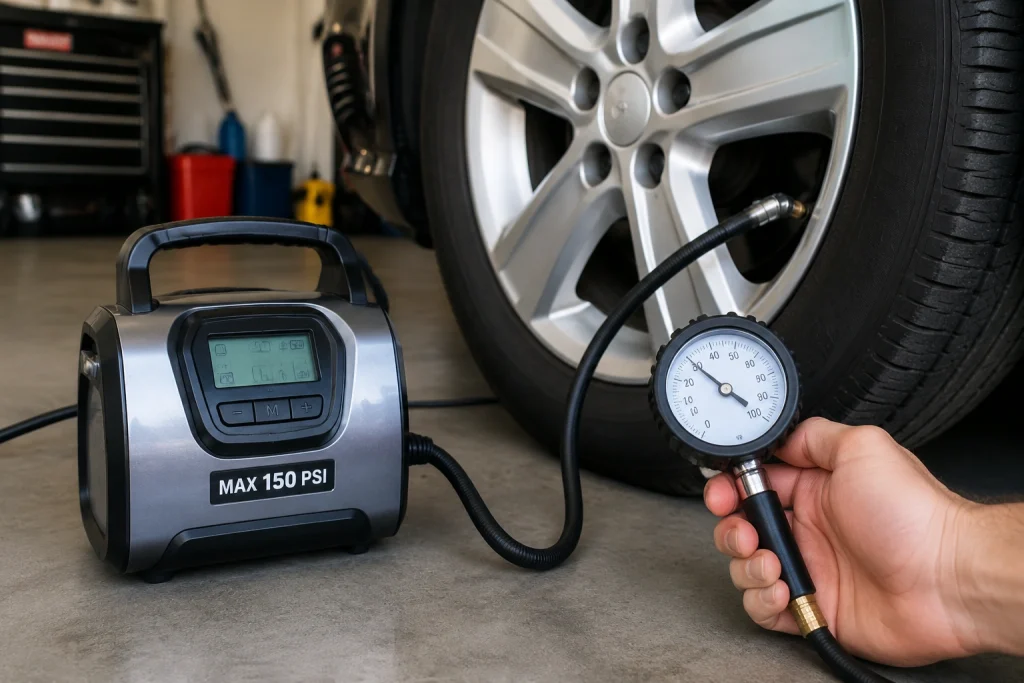
These two numbers serve completely different purposes.
Inflator Maximum PSI
This is the maximum pressure the machine can generate. It helps indicate the types of tires and equipment the inflator may be able to handle.
Vehicle Recommended PSI
This is the pressure selected by the vehicle manufacturer based on factors such as:
- Vehicle weight
- Tire size
- Suspension design
- Handling
- Braking performance
- Ride comfort
- Load capacity
- Fuel efficiency
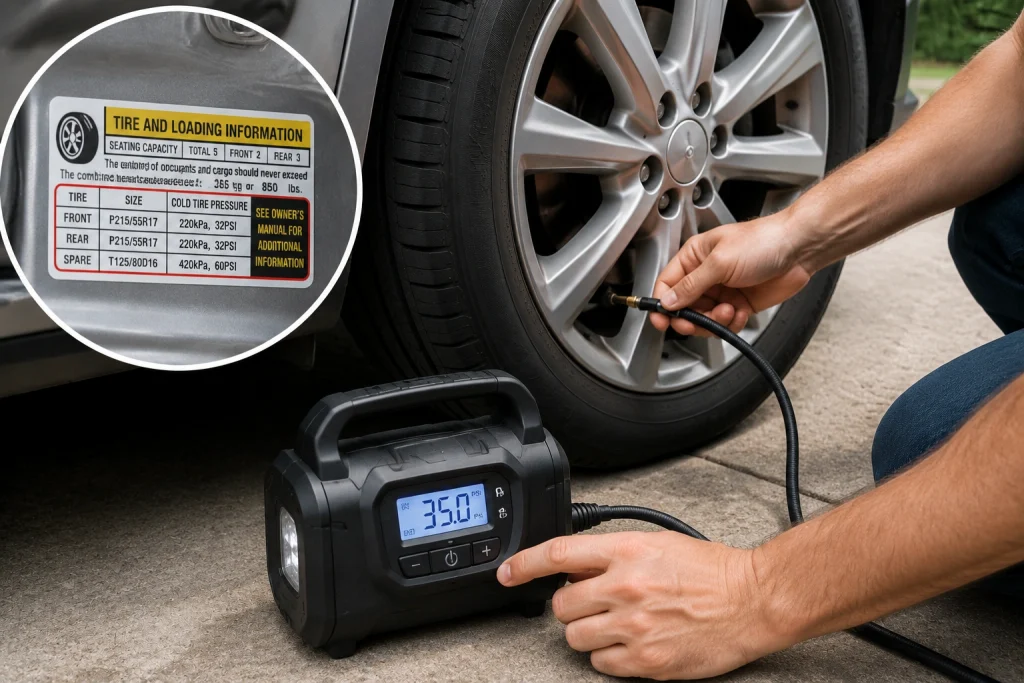
According to the NHTSA tire pressure guidance, the correct tire pressure is found on the Tire and Loading Information Label inside the driver-side door area or in the owner’s manual. NHTSA specifically warns drivers to use the vehicle manufacturer’s pressure rather than the number molded into the tire itself. (NHTSA)
Never inflate a passenger tire to the inflator’s maximum pressure simply because the machine can reach it.
What PSI Do Most Vehicle Tires Need?
Many passenger cars operate somewhere around 30–35 PSI when the tires are cold. However, this is only a general example.
Some SUVs, pickups, performance cars, commercial vehicles, and temporary spare tires require different pressures. The front and rear tires may also have separate recommendations.
Use the following table only as a general comparison:
| Application | Common Pressure Range | Suggested Inflator Capability | Important Note |
|---|---|---|---|
| Passenger car tire | About 30–35 PSI | 100 PSI or higher | Follow the door placard |
| SUV or crossover tire | About 32–40 PSI | 100–120 PSI or higher | Pressure depends on load and tire size |
| Light-truck tire | About 35–80 PSI | 120–150 PSI | Confirm whether it is a passenger or LT-rated tire |
| Temporary spare tire | Often around 60 PSI | 100 PSI or higher | Check the spare tire label |
| Bicycle or recreational equipment | Varies widely | Depends on equipment | Use the manufacturer’s specification |
These figures are not replacement pressure recommendations. The vehicle placard and owner’s manual always take priority.
Is a 100 PSI Tire Inflator Enough for a Car?
Yes. A properly designed 100 PSI inflator is normally sufficient for standard passenger-car tires that require roughly 30–40 PSI.
However, maximum PSI alone does not tell you how quickly or efficiently the inflator will work.
A small inflator may technically reach 100 PSI but take several minutes to add only a few pounds of pressure to a large tire. It may also need cooling breaks between tires.
When comparing inflators, consider:
- Maximum pressure
- Airflow
- Inflation speed
- Duty cycle
- Hose quality
- Gauge accuracy
- Power supply
- Automatic shutoff
- Recommended tire size
A higher PSI rating does not automatically mean faster inflation.
Is a 150 PSI Inflator Better Than a 100 PSI Inflator?
A 150 PSI inflator provides more pressure capacity, but it is not always the better choice.
For a normal sedan, both inflators may be capable of reaching the required pressure. The better unit is usually the one that delivers air faster, has a reliable gauge, and can run long enough without overheating.
Benefits of a 150 PSI Inflator
- More suitable for high-pressure light-truck tires
- Greater operating range
- May handle temporary spare tires more comfortably
- Provides additional capability for different vehicles
- Often available with stronger motors and improved cooling
Possible Limitations
- May cost more
- May be larger or heavier
- Maximum pressure may be mostly unnecessary for passenger tires
- A high rating does not guarantee high airflow
- Cheap high-PSI models may still inflate slowly
The DEWALT portable inflator range illustrates that some portable units are designed with pressure capacity well above normal passenger-tire requirements. That extra capacity can increase versatility, but the vehicle’s required PSI remains the same. (DeWalt)
Maximum PSI Is Not the Same as Airflow
Pressure and airflow are related, but they are not identical.
Pressure tells you how strongly the inflator can compress air.
Airflow tells you how much air the inflator can move over a period of time.
A compact pump may create high pressure through a small cylinder while moving relatively little air. It may work well for topping a car tire from 31 to 35 PSI but struggle to fill a completely flat truck tire quickly.
A larger inflator may have the same maximum PSI rating but deliver much more air. It can fill larger tires faster and run with less heat buildup.
When choosing a unit, do not judge performance by the largest PSI number on the box.
What Is Duty Cycle?
Duty cycle describes how long the inflator can run before it needs to cool.
For example, a small inflator may be designed to run for several minutes and then rest. Continuous operation beyond that limit can overheat the motor, damage internal seals, or shorten the tool’s life.
Check the manual for:
- Maximum continuous run time
- Required cooling period
- Tire-size limitations
- Ambient temperature limits
- Battery or power-cord requirements
Stop the inflator if it becomes unusually hot, smells burned, slows sharply, or shuts off repeatedly.
How to Find the Correct PSI for Your Vehicle
Follow these steps before connecting the inflator:
- Open the driver-side door.
Look for the Tire and Loading Information Label on the doorjamb, door edge, or nearby body pillar. - Find the cold tire pressure.
The label usually shows separate front and rear tire pressures. - Check the units.
U.S. vehicles normally display PSI, while some labels also show kPa. - Confirm the tire size.
Make sure the installed tire size matches the size listed on the placard or an approved alternative. - Check the owner’s manual when uncertain.
This is especially important for towing, heavy loads, aftermarket wheels, or unusual tire sizes.
NHTSA recommends checking tires when they are cold, meaning the vehicle has not been driven for at least three hours. Warm tires naturally show a higher reading, so releasing air from a warm tire can leave it underinflated after it cools. (NHTSA)
How to Use a Tire Inflator Safely
- Park on a stable, level surface away from moving traffic.
- Set the parking brake and switch off the engine unless the inflator’s instructions require the engine to run.
- Inspect the tire for cuts, bulges, exposed cords, or severe sidewall damage.
- Remove the valve cap.
- Attach the inflator hose securely to the valve stem.
- Set the recommended cold PSI.
- Start the inflator and watch the reading.
- Allow the pressure to stabilize if the unit pauses automatically.
- Stop at the placard pressure.
- Verify the result with a separate, accurate tire gauge.
- Remove the hose and reinstall the valve cap.
- Recheck the tire later if it was nearly flat.
Expert Tip:
Keep a separate pencil or digital tire gauge in your vehicle. Built-in inflator gauges can lose accuracy after repeated vibration, drops, heat exposure, or hose damage.
What Happens If You Exceed the Correct Tire Pressure?
Overinflation changes how the tire contacts the road.
Possible effects include:
- Reduced ride comfort
- Increased center-tread wear
- Less traction on rough or wet roads
- Greater sensitivity to pothole impacts
- Longer or less predictable braking in some conditions
- Increased risk of tire or wheel damage
- Incorrect handling balance
The number printed on the tire sidewall is generally a maximum pressure associated with the tire’s rated load. It is not automatically the correct operating pressure for your vehicle.
OSHA’s professional tire-servicing rules also warn against inflating tires beyond the sidewall or manufacturer limits and require workers to stay outside the tire’s potential failure path during inflation. (OSHA)
Do not lean over a tire while adding air. Keep your face and upper body away from the sidewall.
Can an Inflator Damage a Tire?
A tire inflator can contribute to damage when it is used incorrectly.
Common risks include:
- Setting the pressure too high
- Leaving a manual inflator unattended
- Trusting an inaccurate built-in gauge
- Inflating a tire with a damaged sidewall
- Continuing after the tire fails to hold pressure
- Using the wrong connector
- Running the inflator beyond its duty cycle
- Trying to seat a tire bead without proper equipment
A normal portable inflator is intended to adjust pressure in an assembled, serviceable tire. It is not a substitute for professional bead-seating equipment or a tire safety cage.
How to Choose the Right Tire Inflator
Maximum Pressure
A 100–120 PSI model is generally enough for passenger cars. Consider a 150 PSI unit for light trucks, high-pressure tires, or broader use.
Inflation Speed
Look for real-world inflation information, not just maximum PSI. A useful specification might describe how long the unit takes to raise a certain tire from one pressure to another.
Gauge Quality
Choose a clear gauge with small pressure increments. Digital displays are easy to read, but gauge accuracy matters more than display style.
Automatic Shutoff
An auto-stop function lets you select a target pressure. The machine stops when it reaches that setting.
Still verify the pressure afterward. Automatic systems can be affected by hose pressure, heat, calibration, and the brief pressure drop that occurs when the connector is removed.
Power Source
Common options include:
- 12-volt vehicle outlet
- Direct battery clamps
- Rechargeable internal battery
- Cordless tool battery
- Household AC power
- Multiple power sources
A 12-volt unit is convenient for emergencies, while a cordless model may offer more portability. Make sure the cord or battery can support the motor’s power demand.
Hose and Chuck
A durable hose and secure metal chuck reduce leaks. Threaded connectors seal well but may take longer to attach. Lever-style chucks are faster but must fit tightly.
Durability and Cost
The cheapest inflator may be acceptable for occasional pressure adjustments. Frequent users may benefit from a stronger motor, better cooling, a longer hose, replaceable parts, and a longer warranty.
Pay for useful performance rather than an unnecessarily high maximum PSI number.
Warning Signs You Should Stop Inflating
Stop immediately when:
- The sidewall has a bulge, cut, crack, or exposed cord
- The tire makes popping or cracking sounds
- The wheel appears bent, cracked, or heavily corroded
- The pressure rises unusually quickly
- The pressure will not increase
- The tire loses air as soon as the inflator stops
- The valve stem moves, cracks, or leaks
- The inflator or hose becomes dangerously hot
- The gauge gives unstable or unrealistic readings
A tire that was driven while completely flat may have hidden internal damage. Adding air does not make that tire safe.
When to Call a Transmission Professional
Tire inflation problems are normally handled by a tire shop or general repair technician, not a transmission specialist.
However, tire pressure can affect how a vehicle feels on the road. Correct all tire pressures first if you notice vibration, pulling, harshness, or unusual wheel-speed behavior.
Contact a transmission or driveline professional when symptoms remain after the tires are properly inflated and inspected, especially if you notice:
- Shudder during acceleration
- Vibration only in a particular gear
- Delayed engagement
- Slipping engine speed
- Clunking when shifting between Drive and Reverse
- Fluid leaks
- Grinding from the axle or differential area
- Warning lights related to the transmission or all-wheel-drive system
A technician may need to separate a tire or wheel problem from a CV axle, wheel bearing, driveshaft, differential, or transmission concern.
Common Mistakes Vehicle Owners Should Avoid
- Using the tire sidewall number as the target pressure. Use the vehicle placard instead.
- Inflating all four tires to the same PSI without checking the label. Some vehicles require different front and rear pressures.
- Checking pressure immediately after a long drive. Warm tires read higher.
- Buying an inflator based only on maximum PSI. Airflow and duty cycle matter too.
- Ignoring a tire that repeatedly loses pressure. It may have a puncture, damaged valve, cracked wheel, or bead leak.
- Relying only on the TPMS warning light. The system may not warn you about smaller pressure losses.
- Leaving a manual inflator unattended. Pressure can increase faster than expected.
- Inflating a visibly damaged tire. A weakened sidewall can fail suddenly.
- Running a small inflator continuously. Follow its cooling requirements.
- Forgetting to check the spare tire. Spare tires often require more pressure than the road tires.
FAQs
What is the highest PSI a portable tire inflator can produce?
Many portable inflators are rated between 100 and 150 PSI. Some models can reach 160 PSI or more. Always check the specification label and manual for the exact maximum.
Is 150 PSI too much for a tire inflator?
No. A 150 PSI rating is useful tool capacity. It becomes dangerous only when the user inflates a tire beyond the pressure recommended for that vehicle and tire.
Can I put 50 PSI in a tire that says 51 PSI maximum?
Not unless the vehicle placard or approved service information calls for 50 PSI. The sidewall maximum is not normally the vehicle’s recommended everyday pressure.
Why does my 150 PSI inflator stop before reaching 150 PSI?
The unit may be overheating, reaching its duty-cycle limit, experiencing low battery voltage, leaking at the connector, or working against a tire or object beyond its intended capacity.
Is a 120 PSI inflator enough for an SUV?
Usually, yes. Most passenger-based SUVs operate far below 120 PSI. Check the vehicle placard and make sure the inflator is rated for your tire size and expected workload.
Should I inflate tires when they are hot or cold?
Check and adjust them when cold whenever possible. A cold tire has generally been parked for at least three hours. Pressure rises as the tire warms during driving.
Can I use a tire inflator when the TPMS light is on?
You can add air after inspecting the tire for obvious damage. Inflate it to the placard pressure, then monitor it. If the light returns or the tire loses pressure again, have the tire inspected for a leak.
Conclusion
The answer to what is maximum PSI in tire inflator depends on the model, but most portable units are rated around 100–150 PSI. That rating shows the inflator’s maximum capability—not the correct pressure for your car.
For safe inflation, use the cold PSI printed on the driver-side door placard. Choose an inflator with enough pressure capacity, useful airflow, a reasonable duty cycle, an accurate gauge, and dependable automatic shutoff.
Before your next trip, inspect all four tires and the spare, confirm their pressure with a separate gauge, and arrange a professional inspection for any tire that repeatedly loses air.
