
What to Do If a Tire Inflator Fuse Blows: A Safe Troubleshooting Guide

You plug your portable tire inflator into the vehicle’s 12-volt outlet, switch it on, and suddenly everything stops. The inflator goes silent, the outlet loses power, or you notice a blown fuse inside the plug.
Knowing what to do if a tire inflator fuse blows can prevent damage to the inflator, the vehicle’s wiring, and the power outlet. A fuse may fail because of a temporary overload, but repeated failures can indicate a damaged cord, an incompatible inflator, a short circuit, or a worn accessory socket.
This guide explains how to identify the failed fuse, replace it safely, test the system, estimate possible repair costs, and decide when professional electrical diagnosis is necessary.
Quick Answer
If a tire inflator fuse blows, switch off the inflator, unplug it, and turn off the vehicle. Inspect the inflator plug, cord, and power socket for heat or damage. Replace the fuse only with the exact amperage specified. If the new fuse blows again, stop testing and have the inflator or vehicle circuit inspected.
Why Does a Tire Inflator Blow a Fuse?
A fuse is a safety device designed to break the electrical circuit when too much current flows through it. This helps protect the vehicle’s wiring from overheating or catching fire.
Portable tire inflators can draw a relatively high amount of electricity, especially when they first start or when they are working against high tire pressure.
Common causes include:
- The inflator requires more current than the outlet can supply.
- Other accessories are using the same circuit.
- The inflator motor is damaged or beginning to seize.
- The power cord has an internal short.
- The 12-volt plug is loose, dirty, or overheated.
- The vehicle’s accessory socket is worn or corroded.
- The inflator has been running longer than its recommended duty cycle.
- The wrong fuse was previously installed.
- The inflator is being used on a tire larger than it was designed to handle.
One blown fuse does not always mean the vehicle has a serious electrical problem. However, a replacement fuse that blows immediately is a warning sign that should not be ignored.
What to Do Immediately After the Fuse Blows
Follow these steps before trying the inflator again.
1. Turn Off the Inflator
Move the inflator’s switch to the off position before disconnecting anything. Do not leave the switch on while installing a replacement fuse.
2. Unplug It From the Vehicle
Remove the inflator plug carefully. If the plug feels unusually hot, allow it to cool before handling it further.
Do not continue using a plug that is melted, discolored, cracked, or smells like burned plastic.
3. Turn Off the Vehicle
Switch off the ignition and remove the key when applicable. This reduces the chance of creating a short while checking the outlet or vehicle fuse panel.
Some vehicle outlets remain powered even when the ignition is off, so treat the socket as potentially live until you confirm otherwise.
4. Check the Tire’s Condition
A failed inflator does not solve the original tire-pressure problem. Look for:
- A visibly flat tire
- Sidewall damage
- An exposed nail or screw
- A separated tread
- Air leaking around the valve stem
- A tire-pressure monitoring system warning
According to the NHTSA TireWise safety guidance, an illuminated tire-pressure warning means at least one tire is significantly underinflated and should be checked as soon as possible. (NHTSA)
Do not drive on a completely flat tire. Even a short distance can damage the tire internally and may bend or scrape the wheel.
5. Inspect the Inflator
Examine the entire power cord and plug. Look for crushed sections, exposed wires, loose connections, melted plastic, or corrosion.
Also inspect the air hose. A severely restricted or damaged hose can make the compressor work harder and draw more current.
6. Check the Power Socket
Use a flashlight to inspect the vehicle’s 12-volt socket. Remove any coins, metal pieces, dirt, or other debris.
Do not insert a screwdriver, knife, or other metal tool into the socket. A metal object can create a direct short.
7. Read Both Manuals
Check the inflator’s label or instruction manual for its rated amperage. Then check the vehicle owner’s manual for the maximum capacity of the 12-volt outlet.
For example, some vehicle power outlets are limited to approximately 10 amps or 120 watts. Limits vary by vehicle, outlet location, and model year.
Determine Which Fuse Actually Blew
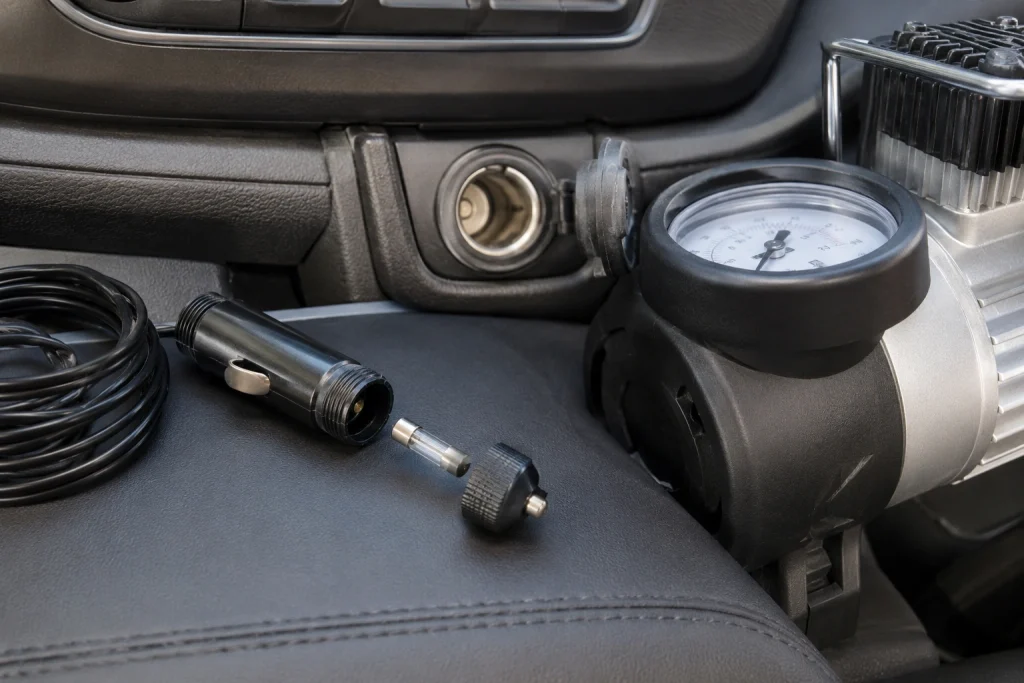
A portable tire inflator may be protected by more than one fuse. Identifying the correct one prevents unnecessary disassembly.
Fuse Inside the Inflator Plug
Many 12-volt inflators have a small cylindrical fuse inside the tip of the cigarette-lighter-style plug.
The plug may contain:
- A removable threaded tip
- A spring-loaded metal contact
- A small glass or ceramic fuse
- A printed amperage rating
Unscrew the tip carefully over a table so the spring and contact pieces do not fall into the vehicle.
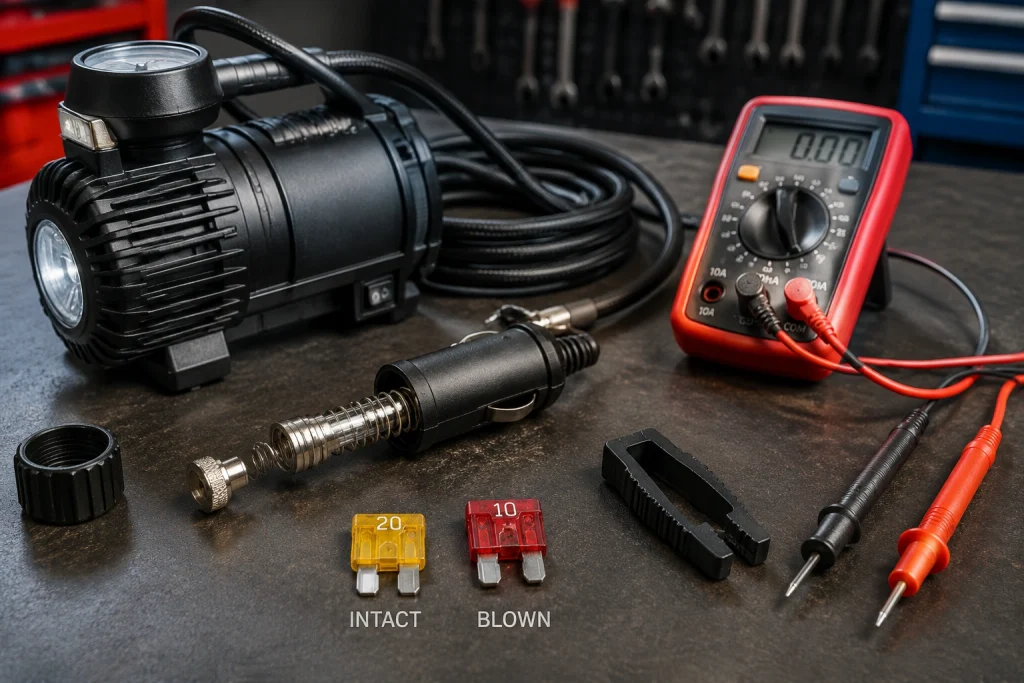
A blown glass fuse may have a broken internal wire or dark discoloration. However, visual inspection is not always reliable. A multimeter set to continuity mode provides a more dependable test.
Vehicle Accessory-Outlet Fuse
If the inflator fuse appears good but the socket no longer powers any accessory, the vehicle’s power-outlet fuse may have blown.
The fuse box may be located:
- Under the dashboard
- Behind a trim panel
- Inside the glove compartment area
- Under the hood
- In the rear cargo compartment
Use the vehicle owner’s manual or fuse-box diagram to locate the correct fuse. It may be labeled “PWR OUTLET,” “ACC,” “CIG,” “12V,” or something similar.
Inline Fuse on Battery-Powered Inflators
Larger inflators that connect directly to the battery may have an inline fuse holder on the positive cable. These units often draw more current than a normal accessory outlet can provide.
Disconnect the clamps from the battery before opening the fuse holder. Remove the negative clamp first, followed by the positive clamp, unless the product instructions specify a different procedure.
Internal Inflator Fuse or Thermal Protector
Some inflators contain an internal fuse, circuit board protector, or thermal cutoff that is not intended for owner replacement.
If the unit remains dead after the external fuse is replaced, check the warranty before opening the housing. Disassembly can expose electrical components and may void the warranty.
Tire Inflator Fuse Troubleshooting Table
| What You Notice | Likely Cause | Recommended Action |
|---|---|---|
| Fuse blew after several minutes | Inflator overheated or exceeded its duty cycle | Let it cool completely and review the operating-time limit |
| Fuse blows immediately | Short circuit, seized motor, damaged cord, or excessive current draw | Stop using the inflator and have it tested |
| Plug becomes very hot | Loose socket contact, corrosion, or poor plug construction | Replace the damaged plug or inspect the vehicle socket |
| Vehicle fuse blows, but plug fuse does not | Inflator demand exceeds outlet capacity or vehicle circuit has a fault | Compare the inflator rating with the outlet limit |
| Fuse blows only on one vehicle | Weak, dirty, or damaged accessory socket | Have that vehicle’s outlet circuit inspected |
| Fuse blows on multiple vehicles | Inflator likely has an internal electrical problem | Repair or replace the inflator |
| Outlet remains dead with a new fuse | Damaged socket, relay, wiring, or another failed fuse | Schedule electrical diagnosis |
| Fuse blows when another accessory is connected | Shared circuit is overloaded | Disconnect other accessories and follow the circuit limit |
How to Replace the Fuse Safely
Replacing a fuse is usually simple, but using the wrong fuse can create a serious electrical hazard.
1. Confirm the Correct Fuse Rating
Read the number printed on the old fuse, inflator label, plug housing, fuse-box cover, or owner’s manual.
Common ratings may include 10, 15, 20, or 30 amps, depending on the device and circuit. These examples are not interchangeable.
Always use the exact specified amperage.
Ford’s official owner-manual guidance warns owners to replace a fuse with the specified amperage rating. Installing a larger fuse may allow the wiring to overheat before the fuse opens.
2. Match the Fuse Type
The amperage and physical type must both match.
Possible fuse types include:
- Standard blade fuse
- Mini blade fuse
- Low-profile mini fuse
- Micro fuse
- Glass cartridge fuse
- Ceramic cartridge fuse
- Inline automotive fuse
Do not force a fuse into a holder that was not designed for it.
3. Remove the Old Fuse
Use the fuse puller supplied with the vehicle or a plastic fuse-removal tool. Avoid twisting the fuse aggressively because this can damage the terminals.
For a plug fuse, carefully unscrew the plug tip and note the order of the spring and contact pieces.
4. Inspect the Holder
Check for black marks, melted plastic, loose terminals, or green corrosion.
A damaged holder can create electrical resistance. Resistance produces heat, which can melt the plug or repeatedly blow fuses.
5. Install the Correct Replacement
Push the new fuse firmly into place. Reassemble the plug exactly as it was originally configured.
Replace the fuse-box cover after installation. The cover helps protect the circuit from moisture and accidental contact.
6. Test Carefully
Before reconnecting the inflator:
- Disconnect phone chargers, power inverters, and other accessories.
- Confirm the inflator switch is off.
- Plug the inflator in securely.
- Start it while watching the plug and cord.
- Stop immediately if the fuse blows, the cord becomes hot, or you smell burning material.
Do not repeatedly install new fuses to “see if it eventually works.” Each failure confirms that excess current is still present.
Why the New Fuse May Blow Again
A fuse that fails a second time usually indicates more than a random overload.
Inflator Current Exceeds the Outlet Rating
Suppose an inflator is rated for 15 amps, but the vehicle outlet allows only 10 amps. The inflator may work briefly before the circuit opens, or it may blow the fuse immediately during startup.
In that situation, use a manufacturer-approved direct-to-battery connection if the inflator supports one. Do not modify the plug or bypass the vehicle circuit.
The Compressor Motor Is Failing
A worn motor may require more current to turn. Warning signs include:
- Slow compressor operation
- Grinding or squealing noises
- Frequent overheating
- Burning odors
- Excessive vibration
- Repeated fuse failure
Replacing a low-quality or heavily worn inflator is often safer than attempting to repair its motor.
The Inflator Has Exceeded Its Duty Cycle
Duty cycle describes how long a compressor can operate before it must cool.
A small inflator may be designed to run for only 10 to 15 minutes before requiring a rest period. Attempting to inflate several large tires continuously may overheat the motor and increase electrical demand.
Follow the manufacturer’s operating and cooldown instructions.
The Plug or Socket Has Poor Contact
A loose plug may create intermittent contact and electrical arcing. The connection can become hot even when current remains near the normal limit.
If the plug easily moves or falls out, test the inflator only after the socket has been inspected.
The Cord Is Shorted
Cords can become damaged when they are:
- Pinched in a door
- Wrapped tightly around the inflator
- Stored under heavy cargo
- Pulled by the wire instead of the plug
- Exposed to water
- Melted against a hot vehicle component
A cord with exposed copper or melted insulation should be replaced, not taped and reused.
Expert Tip: Before buying a replacement inflator, compare its maximum current draw with your vehicle outlet’s amp or watt limit. A more powerful inflator is not automatically better if the vehicle cannot safely supply the required electricity.
Can You Drive After the Tire Inflator Fuse Blows?
The failed inflator fuse usually does not affect the engine, transmission, steering, or braking system. The vehicle may still operate normally.
The real concern is the tire that needed air.
You may be able to drive slowly to a nearby air pump when the tire is only slightly low and has no visible damage. However, you should not continue driving when:
- The tire is completely flat.
- The sidewall is crushed or folded.
- The wheel is touching the ground.
- The tire is losing pressure rapidly.
- The vehicle pulls strongly to one side.
- The tire has a bulge, cut, or exposed internal material.
Use the spare tire, roadside assistance, or a tow service when the tire is unsafe.
Repair Cost, Quality, and Durability Considerations
The fuse itself is usually the least expensive part of the problem. The final cost depends on what caused it to fail.
| Repair or Replacement | Approximate U.S. Cost | Best Decision Guidance |
|---|---|---|
| Replacement plug or blade fuse | $1–$10 | Reasonable when no heat or wiring damage is present |
| Replacement 12-volt plug | $5–$25 | Useful if the cord and inflator motor remain in good condition |
| Basic portable inflator | $30–$70 | Practical for occasional passenger-car use |
| Higher-duty inflator | $70–$200+ | Better for trucks, SUVs, multiple vehicles, or frequent use |
| Vehicle power-socket repair | $75–$250+ | Needed when the socket is loose, melted, or electrically damaged |
| Electrical diagnosis | $100–$250+ | Worthwhile when fuses repeatedly blow or several circuits fail |
Prices vary by vehicle, labor rate, inflator design, and location.
When comparing inflators, consider more than maximum pressure. Look for:
- Current draw compatible with your vehicle
- A clearly stated duty cycle
- Thermal overload protection
- Replaceable fuse protection
- Thick, flexible power wiring
- A stable plug or battery-clamp connection
- An accurate pressure gauge
- A warranty from an established manufacturer
A cheap inflator may be adequate for emergency top-ups. It may not be durable enough to inflate large SUV or truck tires repeatedly.
When to Call a Transmission Professional
Most tire inflator fuse failures are electrical accessory problems, not transmission problems. A general automotive electrical technician is normally the better first choice.
A transmission professional may be appropriate when the fuse problem began immediately after transmission-related work involving:
- Battery disconnection
- Center-console removal
- Gear-selector wiring
- Transmission control module wiring
- Shift-interlock components
- Shared interior wiring harnesses
Seek professional diagnosis promptly if the blown fuse occurs with transmission warning lights, a gear indicator that stops working, a shifter that will not move, erratic shifting, or several electrical systems failing together.
When choosing a shop, the FTC’s auto repair guidance recommends asking about technician experience, diagnostic charges, warranty policies, and written estimates before authorizing work. (Consumer Advice)
You can also use the ASE Blue Seal repair facility locator to look for shops employing a high percentage of ASE-certified technicians. (ASE)
Common Mistakes Vehicle Owners Should Avoid
- Installing a higher-amperage fuse: This can allow the wiring to overheat and may create a fire risk.
- Wrapping the fuse in foil: Foil bypasses the fuse’s protection and should never be used.
- Replacing the fuse repeatedly: A second blown fuse indicates an unresolved fault.
- Ignoring a hot plug: Excessive heat often points to poor electrical contact or overloaded wiring.
- Using multiple high-draw accessories: Power inverters, heated devices, and inflators may overload a shared circuit.
- Assuming every outlet has the same rating: Front, rear, and cargo-area outlets may have different limits.
- Running the inflator beyond its duty cycle: Small compressors need time to cool.
- Repairing exposed wires with basic household tape: Heat, vibration, and moisture can make temporary repairs fail.
- Testing with the wrong fuse type: The replacement must match both amperage and physical design.
- Driving on a flat tire because the inflator failed: A damaged tire requires roadside assistance, a spare, or towing.
FAQs
Can a tire inflator blow a vehicle fuse?
Yes. A tire inflator can blow the vehicle’s accessory-outlet fuse when it draws more current than the circuit allows or when the inflator, plug, cord, or socket has an electrical fault.
Can I replace a 10-amp fuse with a 15-amp fuse?
No. Replace the fuse only with the exact amperage specified by the vehicle or inflator manufacturer. A larger fuse may fail to protect the wiring from overheating.
Why does my tire inflator fuse blow immediately?
An immediate failure may indicate a shorted cord, damaged plug, seized compressor motor, incompatible current demand, or faulty vehicle socket. Stop using the inflator until the cause is identified.
Why does the fuse blow after the inflator runs for a few minutes?
The inflator may be overheating, exceeding its duty cycle, or working harder as tire pressure increases. Allow it to cool and review the manufacturer’s operating-time limit.
How can I tell whether the inflator or vehicle is faulty?
Test the vehicle outlet with a low-power accessory known to be working. If the outlet operates normally but the inflator blows fuses in more than one vehicle, the inflator is probably faulty. Do not test a visibly damaged inflator.
Can I use a direct-to-battery adapter instead?
Only use a direct battery connection when the inflator manufacturer specifically supports it. The adapter and cable must include correctly rated fuse protection. Never create an unfused homemade connection.
Should the vehicle engine run while using a tire inflator?
Follow the vehicle and inflator manuals. Some inflators recommend a running engine to prevent battery discharge, while certain vehicles specify different procedures. If the engine must run, operate the vehicle outdoors and never inside a closed garage.
Conclusion
When deciding what to do if a tire inflator fuse blows, begin by switching everything off, unplugging the inflator, and checking the cord, plug, socket, and tire condition. Identify whether the failed fuse belongs to the inflator or vehicle, then replace it only with the exact specified type and amperage.
A single fuse failure may come from a temporary overload. A second failure, excessive heat, melted plastic, or a burning smell points to a problem that requires repair or replacement.
Check your vehicle’s outlet capacity before using the inflator again. When the cause remains uncertain, have a qualified automotive electrical technician diagnose the circuit instead of risking damage with repeated fuse replacements.
