
How Does a Tire Inflator Work? A Simple Guide for Vehicle Owners

A low tire can appear at the worst possible time—before work, during a road trip, or far from the nearest service station. Knowing **how does(NHTSA)estore proper tire pressure safely, avoid unnecessary towing, and decide whether the tire needs professional repair.
A portable tire inflator is essentially a small air compressor. It draws in outside air, compresses it, and pushes it through a hose into your tire. This guide explains the process, the main inflator types, safe operating steps, common problems, buying considerations, and situations where adding air is not enough.
Quick Answer
A tire inflator uses an electric motor to operate a small piston or diaphragm pump. The pump draws in outside air, compresses it, and sends it through a hose into the tire. A pressure gauge measures the tire’s PSI, while some digital inflators automatically stop when they reach the pressure selected by the user.
What Is a Tire Inflator?
A tire inflator is a compact device used to add compressed air to vehicle tires. Most portable models receive power from one of the following sources:
- A vehicle’s 12-volt accessory outlet
- A rechargeable lithium-ion battery
- Direct connections to the vehicle battery
- A household electrical outlet
- Manual foot or hand operation
Unlike a large shop compressor, most portable inflators do not store air in a separate tank. They produce compressed air while operating and send it directly into the tire.
Portable inflators are useful for correcting normal pressure loss, seasonal pressure changes, and slightly underinflated tires. However, an inflator cannot permanently repair a puncture, damaged valve stem, cracked wheel, bead leak, or sidewall failure.
How Does a Tire Inflator Work?
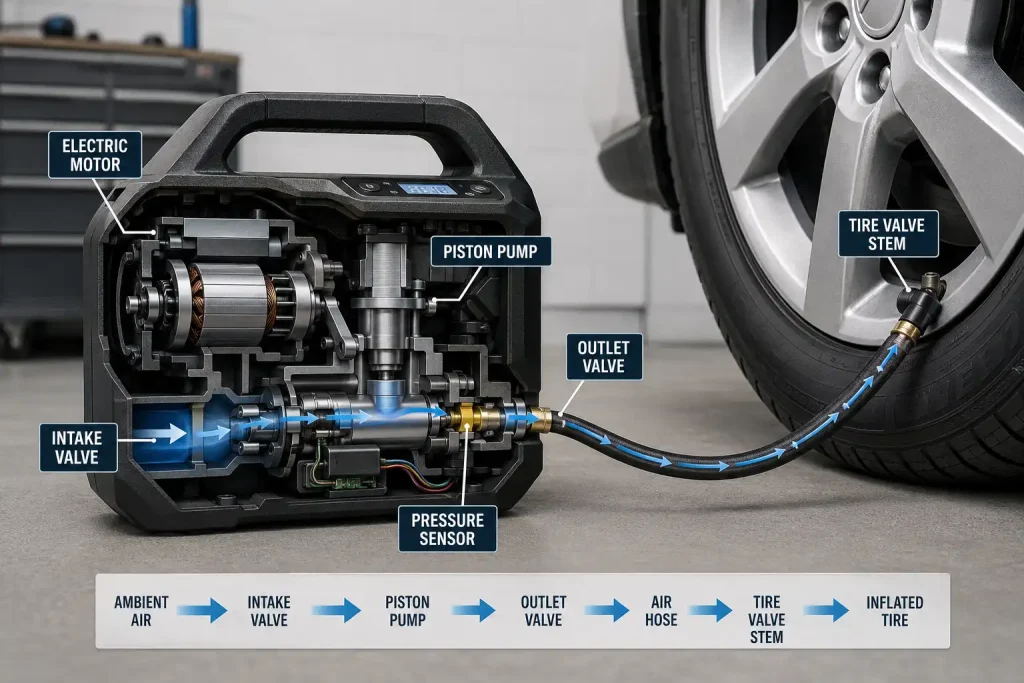
The basic operation involves converting electrical energy into mechanical movement and then using that movement to compress air.
Although the design varies between models, most electric tire inflators contain the same essential parts.
1. The Power Source Supplies Electricity
The inflator first receives electricity from its battery, power cord, or vehicle connection.
A small cordless inflator may use a rechargeable battery similar to a cordless drill battery. A 12-volt inflator normally plugs into the vehicle’s accessory outlet, while a higher-output unit may connect directly to the battery terminals.
The power source must provide enough voltage and current for the motor. A heavy-duty compressor may overload a low-amperage accessory outlet, which is why some models require direct battery clamps.
2. The Electric Motor Starts Turning
Electricity powers a compact motor inside the inflator. The motor creates rotational movement, much like the motor in a power tool.
A crank, connecting rod, or eccentric mechanism converts this rotation into an up-and-down or back-and-forth movement.
3. The Piston or Diaphragm Draws In Air
The motor moves either:
- A small piston inside a cylinder, or
- A flexible diaphragm inside a pumping chamber
As the piston moves away from the compression chamber, it creates an area of lower pressure. An intake valve opens, allowing outside air to enter through a filtered opening.
4. The Air Is Compressed
When the piston moves back into the chamber, the intake valve closes. The chamber becomes smaller, squeezing the trapped air into a reduced space.
This increases the air pressure.
A second one-way valve opens when the compressed air reaches sufficient pressure. The air then moves into the outlet hose.
5. The Hose Sends Air Into the Tire
The hose connects to the tire’s valve stem through a threaded connector, locking chuck, or push-on fitting.
Compressed air passes through the tire valve and enters the tire. The valve is designed to allow air into the tire while limiting air loss when the inflator is removed.
6. The Gauge Measures Pressure
A mechanical gauge, digital pressure sensor, or both measure the resistance created by the air inside the tire. The result is displayed in units such as:
- PSI: pounds per square inch
- kPa: kilopascals
- Bar: a metric pressure measurement
Digital inflators may briefly show a higher or unstable reading while the compressor is operating. For a more accurate result, stop the inflator and allow the gauge to settle.
7. Automatic Shutoff Stops Inflation
Many digital inflators allow the driver to select a target pressure. An electronic control board monitors the pressure sensor and switches off the motor when the selected PSI is reached.
Automatic shutoff is convenient, but the final pressure should still be checked. Small differences can occur because of hose pressure, gauge tolerance, temperature, or air escaping when the connector is removed.
Main Types of Tire Inflators
Different inflators use the same basic compression principle, but their power, speed, portability, and durability vary.
| Inflator type | Best use | Main advantage | Main limitation |
|---|---|---|---|
| 12-volt plug-in inflator | Passenger cars and occasional roadside use | Affordable and does not require charging | Limited by cord length and outlet amperage |
| Cordless inflator | Routine pressure checks and quick top-ups | Highly portable and easy to operate | Battery may be discharged during an emergency |
| Direct-battery compressor | SUVs, trucks, trailers, and larger tires | Greater airflow and stronger electrical supply | Requires correct battery-clamp connection |
| AC-powered inflator | Home garage use | Consistent household power | Not useful away from an electrical outlet |
| Tank-style compressor | Frequent tire and workshop use | High airflow and supports other air tools | Larger, louder, and less portable |
| Manual foot pump | Emergency backup | Does not require electricity | Slow and physically demanding |
PSI Is Not the Same as Inflation Speed
A common buying mistake is choosing an inflator only because it advertises a high maximum PSI.
Maximum PSI tells you the highest pressure the unit may produce. It does not tell you how quickly it can move air.
Inflation speed is more closely related to airflow, often measured in cubic feet per minute, or CFM. Larger truck and SUV tires require more air volume than passenger-car tires, even when both use similar operating pressures.
Why Duty Cycle Matters
The duty cycle tells you how long a compressor can operate before it must cool down. Some models can run continuously, while others may require a long rest after 10, 20, or 30 minutes.
The specifications in this portable compressor comparison chart demonstrate how tire-size ratings, amperage, airflow, and duty cycles can vary substantially between compressors. ([Viair Corp][2]) continue running an inflator beyond its rated duty cycle.** Excessive heat can damage the motor, wiring, seals, piston components, or power connector.
How to Use a Tire Inflator Safely
Always review the inflator’s instructions before its first use. Control layouts, power requirements, and cooling limits differ between models.
Step 1: Park in a Safe Location
Move the vehicle away from traffic whenever possible. Park on firm, level ground, activate the hazard lights if needed, and apply the parking brake.
Do not attempt roadside inflation while standing close to moving traffic.
Step 2: Inspect the Tire
Look for:
- Exposed cords
- Sidewall bubbles
- Deep cuts
- A tire separated from the wheel
- Smoke or a burning smell
- A bent or cracked wheel
- Objects embedded in the tread
Do not inflate a severely damaged tire. A weakened tire can fail as pressure increases.
Step 3: Find the Correct Tire Pressure
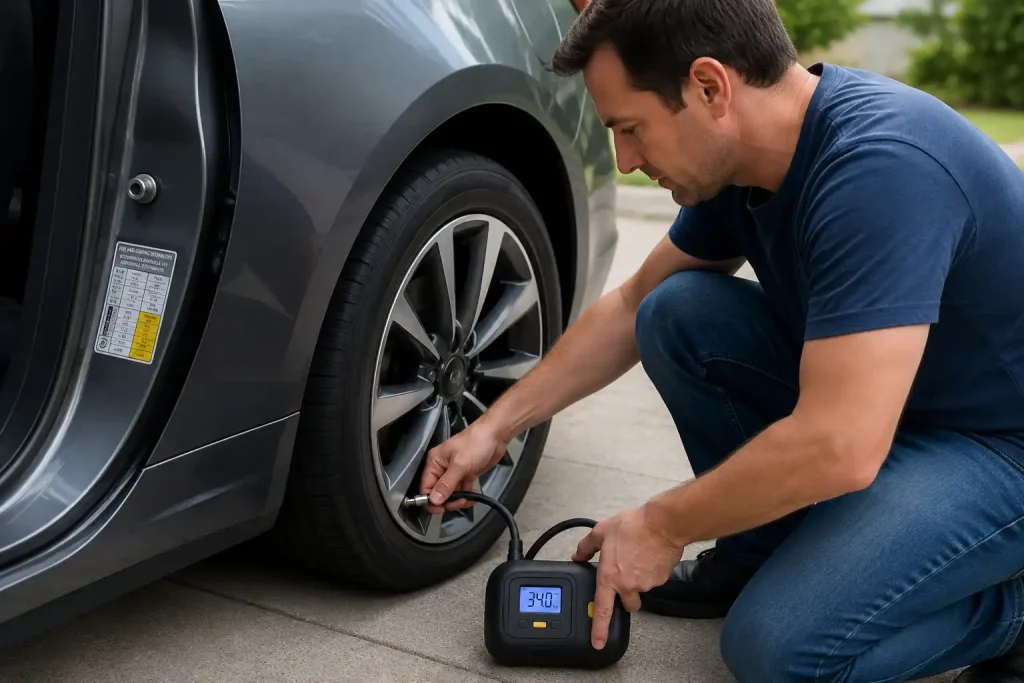
Use the recommended cold pressure shown on the driver-side doorjamb label or in the owner’s manual.
Do not use the maximum pressure molded into the tire sidewall as your normal target. That number is a tire limit, not necessarily the pressure selected by the vehicle manufacturer.
The NHTSA TireWise guidance recommends checking all tires, including the spare, at least monthly when they are cold. NHTSA defines cold tires as tires on a vehicle that has not been driven for at least three hours. (NHTSA) 4: Connect the Power
For a 12-volt inflator, fully insert the plug into the vehicle’s accessory outlet. Follow the inflator manufacturer’s instructions regarding whether the engine should be running.
When connecting directly to a battery:
- Confirm that the inflator is switched off.
- Connect the positive clamp to the positive battery terminal.
- Connect the negative clamp as instructed by the manufacturer.
- Keep cables away from belts, fans, and hot engine parts.
Never run a vehicle inside a closed garage or poorly ventilated area.
Step 5: Attach the Air Hose
Remove the tire’s valve cap and place it somewhere safe.
Attach the hose fitting firmly to the valve stem. A loose connection may hiss, leak air, and produce an inaccurate pressure reading.
Step 6: Set the Target Pressure
On a digital model, select the manufacturer-recommended PSI. On a manual model, monitor the gauge during operation.
Avoid walking away while the unit is running, even if it has automatic shutoff.
Step 7: Inflate the Tire
Switch on the inflator. The unit will normally vibrate and make a rapid mechanical sound as the piston or diaphragm operates.
Stop periodically if:
- The hose fitting becomes extremely hot
- The compressor slows noticeably
- You smell overheated plastic
- The power plug becomes hot
- The inflator exceeds its duty-cycle limit
Step 8: Verify the Final Pressure
Turn off the inflator and check the settled reading. For greater confidence, verify the pressure with a separate tire gauge.
Add or release small amounts of air until the pressure is correct. Reinstall the valve cap after removing the hose.
What Pressure Should You Use?
 portable tire inflator safely” class=”wp-image-9338″/>
The correct pressure depends on the vehicle, tire size, axle load, and manufacturer specifications. Front and rear tires may require different pressures.
Look for the recommended pressure in:
- The driver-side doorjamb
- The edge of the driver’s door
- The fuel door on some vehicles
- The owner’s manual
Tire pressure changes with temperature. The U.S. Tire Manufacturers Association tire-care guidance notes that pressure may change by approximately one to two PSI for every 10-degree temperature change. It also advises checking pressure before long trips, towing, or carrying heavy loads. (USTMA)why a tire-pressure warning may appear during a cold morning. Do not automatically assume the tire is punctured, but inspect it and measure the pressure.
Expert Tip:
Keep a reliable pencil, dial, or digital gauge with your inflator. Set the pressure with cold tires, then verify it using the separate gauge instead of depending entirely on the inflator’s built-in display.
Can a Tire Inflator Fix a Flat Tire?
A tire inflator can restore air pressure, but it does not repair the reason the air escaped.
It may provide temporary help when:
- A tire has lost pressure gradually
- Cold weather lowered the pressure
- A small tread puncture is leaking slowly
- A temporary plug or sealant has already been installed correctly
- You need enough pressure to move the vehicle to a safer location
It may not help when:
- The sidewall is cut or punctured
- The tire has separated from the wheel
- The valve stem is broken
- The wheel is cracked
- The tire loses air as quickly as the inflator supplies it
- The tread or internal structure has been damaged by driving while flat
Never keep inflating a tire that will not hold pressure. Continuous inflation can overheat the compressor and may place additional stress on an already damaged tire.
Common Warning Signs During Inflation
Stop using the inflator and investigate if you notice any of the following:
- Pressure does not increase after several minutes
- Air escapes around the hose connection
- The inflator repeatedly blows the vehicle’s fuse
- The power cord, plug, or battery clamp becomes extremely hot
- The compressor sounds slower than normal
- The digital display gives impossible or rapidly changing readings
- The tire develops a bulge
- The tire loses several PSI immediately after inflation
- The valve stem bends, cracks, or leaks
A hissing sound at the connection may simply mean the chuck is not seated correctly. A hissing sound from the tread, sidewall, wheel bead, or valve base usually indicates a leak that requires inspection.
How to Choose a Good Tire Inflator
The best inflator is not necessarily the model with the highest advertised PSI. Choose one that matches your vehicle and expected use.
Match It to Your Tire Size
A compact cordless inflator may work well for a sedan but struggle with large SUV, truck, trailer, or RV tires.
Check the manufacturer’s recommended maximum tire size and estimated inflation times.
Check the Power Requirements
Confirm that a 12-volt model will not exceed the amperage rating of your vehicle’s outlet.
High-output compressors often use battery clamps because an accessory socket may not safely provide enough current.
Compare Airflow and Duty Cycle
Higher airflow generally reduces inflation time. A longer duty cycle allows the compressor to work on several tires without overheating.
These specifications are especially important for:
- Pickup trucks
- Large SUVs
- Off-road vehicles
- Trailers
- RVs
- Drivers who regularly adjust tire pressure
Look for an Accurate Gauge
A large, easy-to-read display is useful at night or in poor weather. However, built-in gauges can vary in accuracy.
Choose a model with a clear pressure display and verify it occasionally with a separate gauge.
Consider Hose and Cord Length
The hose and power cord must reach every tire without pulling the inflator against the vehicle.
For trucks, trailers, and long-wheelbase vehicles, a direct-battery unit with a longer hose may be more practical than a short 12-volt cord.
Evaluate Build Quality
Quality features may include:
- Metal hose fittings
- Thick power cables
- Replaceable fuses
- Rubber vibration feet
- Heat-resistant hose material
- Protected pressure gauges
- Secure cable storage
- A strong carrying case
- A meaningful manufacturer warranty
Very inexpensive inflators may be adequate for occasional top-ups, but they often inflate more slowly and may have shorter duty cycles. A more durable model can be worth the additional cost when you drive long distances, tow, travel in remote areas, or own larger tires.
Benefits and Limitations of Portable Tire Inflators
Benefits
- Convenient for home and roadside use
- Helps maintain correct tire pressure
- Can reduce dependence on service-station air pumps
- Useful during seasonal temperature changes
- Compact enough for many trunks or cargo areas
- May help you reach a repair facility during a slow leak
- Allows regular spare-tire pressure checks
Limitations
- Cannot repair structural tire damage
- Small models may overheat quickly
- Inflation can be slow on large tires
- Built-in gauges may not be perfectly accurate
- Cordless batteries can lose charge during storage
- Some 12-volt models can overload accessory circuits
- Automatic shutoff does not eliminate the need for supervision
Common Mistakes Vehicle Owners Should Avoid
- Using the sidewall maximum as the target pressure: Use the vehicle placard pressure instead.
- Checking only after driving: Warm tires usually show a higher pressure than cold tires.
- Relying only on the TPMS light: A tire may be underinflated before the warning appears.
- Ignoring the spare tire: An unused spare can slowly lose pressure.
- Running the compressor continuously: Follow its duty-cycle and cooling instructions.
- Leaving a digital inflator unattended: Automatic shutoff can fail or produce an imperfect final reading.
- Inflating a visibly damaged tire: Sidewall bubbles, exposed cords, deep cuts, and wheel damage require professional inspection.
- Using an undersized inflator: A small unit may overheat while trying to fill a large truck or trailer tire.
- Assuming added air solved the problem: Repeated pressure loss indicates a leak or damaged component.
- Storing a cordless inflator with an empty battery: Check and recharge it periodically.
- Forgetting to replace the valve cap: The cap helps protect the valve core from dirt and moisture.
- Using tire sealant unnecessarily: Some sealants can complicate repairs and may affect pressure-monitoring components.
When to Call a Transmission Professional
A low tire or defective inflator does not normally require a transmission specialist. A tire shop or general automotive repair technician should be the first call for punctures, valve leaks, wheel damage, or repeated pressure loss.
However, contact a transmission professional when poor vehicle movement continues after all tires have been correctly inflated and you also notice symptoms such as:
- Delayed engagement into Drive or Reverse
- Transmission slipping
- Shuddering during acceleration
- Unusual whining or grinding
- A transmission-fluid leak
- A burning smell
- Harsh or unpredictable shifting
Low tire pressure can make a vehicle feel sluggish or cause it to pull to one side, but it does not usually cause an internal transmission fault. Correct the tire pressure first, test the vehicle carefully, and then investigate any remaining drivetrain symptoms.
When choosing a repair facility, ask for a written diagnosis and estimate before authorizing major work. The ASE resources for drivers can also help vehicle owners locate participating repair facilities with ASE-certified technicians. (ASE)to Call a Tire or Automotive Professional
Arrange professional inspection when:
- The same tire repeatedly loses pressure
- Pressure drops several PSI overnight
- The sidewall is punctured or damaged
- The tire has been driven while nearly flat
- The valve stem is leaking
- The wheel is bent or cracked
- The tire vibrates after inflation
- You see exposed cords or tread separation
- The tire cannot reach or maintain the correct PSI
- The TPMS light remains on after all tires are correctly inflated
A repairable tread puncture may be fixed from inside the tire after removal and inspection. Sidewall and shoulder damage generally cannot be repaired safely.
Ask the shop to explain:
- Where the leak is located
- Whether the tire is repairable
- Whether internal damage is present
- Whether the wheel or valve stem is also leaking
- Whether the TPMS sensor needs service
- Whether tire replacement is safer than repair
FAQs
How long does a tire inflator take to inflate a tire?
A small pressure correction may take one to three minutes. Inflating a severely low or large tire can take much longer. Speed depends on the inflator’s airflow, tire size, starting pressure, power source, and duty cycle.
Can a tire inflator completely fill a flat tire?
It may fill a flat tire if the tire is still seated on the wheel and the leak is slow. It cannot overcome a large puncture, damaged sidewall, broken valve stem, cracked wheel, or tire that has separated from the rim.
Should the engine be running while using a 12-volt inflator?
Follow the inflator and vehicle instructions. Some manufacturers recommend operating the engine to reduce battery drain. Others may require the vehicle to remain off during connection. Never run the engine in a closed garage.
Why does the pressure reading jump while the inflator is running?
The gauge may temporarily measure pressure inside the hose and compressor outlet rather than only the settled tire pressure. Turn off the inflator briefly and allow the reading to stabilize before making the final adjustment.
Can a tire inflator overinflate a tire?
Yes. Manual inflators can continue adding air until switched off, and automatic shutoff systems are not always perfectly accurate. Monitor the pressure and verify the result with a separate gauge.
Will inflating the tire turn off the TPMS light?
The light may turn off after the tire reaches the correct pressure and the vehicle is driven. Some vehicles require a reset or relearn process. If the warning remains, check every tire and consult the owner’s manual.
How often should I check tire pressure?
Check all tires, including the spare, at least once a month and before long trips, heavy-load driving, or towing. Measure the pressure when the tires are cold whenever possible.
Conclusion
A tire inflator works by using a motor-driven piston or diaphragm to draw in outside air, compress it, and push it into the tire. Its gauge measures pressure, while digital models may stop automatically at a selected setting.
The safest approach is to use the cold pressure shown on the vehicle placard, inspect the tire before inflation, follow the compressor’s duty cycle, and verify the final PSI with a reliable gauge.
Understanding how does a tire inflator work helps you choose a suitable model and respond calmly to low tire pressure. Keep a tested inflator and separate pressure gauge in your vehicle, but arrange professional inspection whenever a tire repeatedly loses air or shows signs of physical damage.
