
How Long Does a Tire Inflator Take? Average Times and What Affects Speed

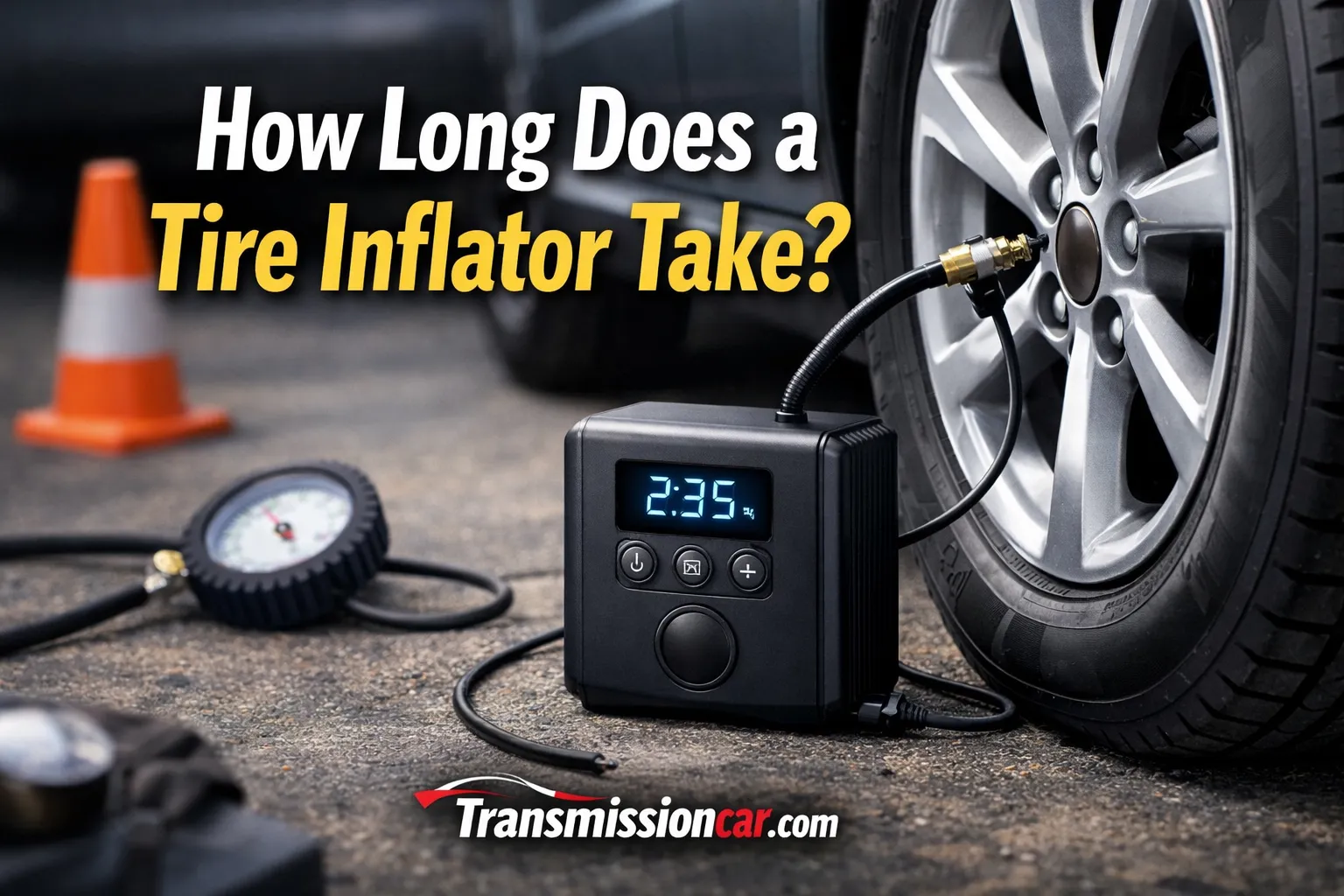
A low tire can interrupt your commute, delay a road trip, or leave you wondering whether a small portable inflator is powerful enough to help. The good news is that most modern inflators can correct ordinary pressure loss within a few minutes.
So, how long does a tire inflator take? A routine top-up may take less than two minutes per tire, while inflating a nearly flat car tire can take five to ten minutes. The actual time depends on the tire’s size, starting pressure, inflator output, power source, temperature, and condition.
This guide explains realistic inflation times, why some inflators work faster than others, how to use one safely, and when adding air is not enough.
Quick Answer
A portable tire inflator usually takes 30 seconds to 3 minutes to top up a slightly low tire. Inflating a standard car tire from nearly flat to the recommended pressure often takes 4–10 minutes. Large SUV or truck tires may require 10–20 minutes, especially with a small 12-volt inflator.
Average Tire Inflator Times
There is no single inflation time that applies to every vehicle. However, the following estimates are realistic for common passenger vehicles.
| Inflation situation | Typical time per tire |
|---|---|
| Add 1–3 PSI | 30 seconds–2 minutes |
| Add 5–10 PSI | 1–4 minutes |
| Standard car tire from nearly flat | 4–10 minutes |
| SUV or crossover tire from nearly flat | 6–15 minutes |
| Light-truck or large off-road tire | 10–25+ minutes |
| Check and top up all four tires | 5–15 minutes |
These times assume that the inflator is suitable for the tire and is operating normally. A weak battery, leaking hose connection, damaged valve stem, or undersized compressor can make the process much slower.
Official manufacturer figures also show how much performance can vary. For example, the VIAIR 88P portable compressor specifications list approximately three to five minutes for certain tires to reach 30 PSI from empty. A smaller Slime 12-volt tire inflator lists about eight minutes for a standard midsize car tire from flat to full. (Viair Corp)
These ratings are useful for comparison, but real roadside conditions may produce different results.
What Determines How Long a Tire Inflator Takes?
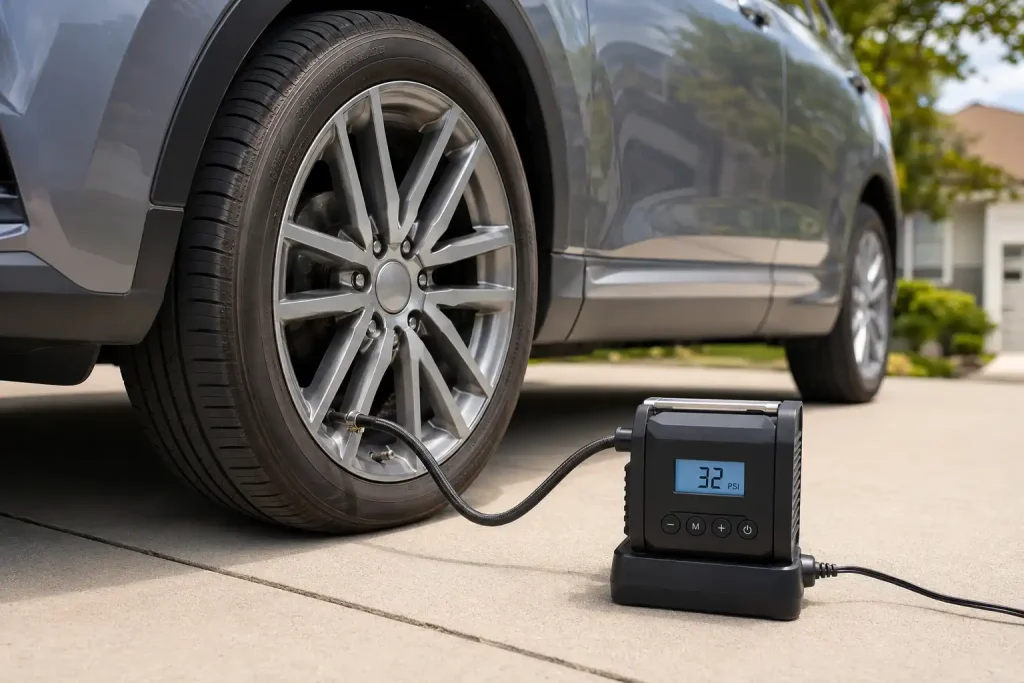
Starting Tire Pressure
A tire that is only three PSI below its recommended pressure may need less than two minutes. A tire at 10 PSI or completely flat contains much less air and will take considerably longer.
A completely flat tire may also have a puncture, damaged valve, broken bead seal, or sidewall damage. In that situation, the inflator may run continuously without raising the pressure.
Do not assume that a tire is safe simply because it accepts air. It may lose pressure again as soon as you begin driving.
Tire Size and Air Volume
Large tires contain more air than small tires. Therefore, an inflator that fills a compact sedan tire in five minutes might take twice as long on a full-size SUV or pickup.
The following tires generally require progressively more inflation time:
- Compact-car tires
- Midsize sedan tires
- Crossover and SUV tires
- Pickup-truck tires
- High-volume off-road tires
- Heavy-duty light-truck tires
Check whether the inflator manufacturer lists a maximum recommended tire size. A small emergency inflator may be adequate for a sedan but frustratingly slow on a truck.
Inflator Airflow
An inflator’s maximum PSI does not tell you how quickly it works. A unit advertising 150 PSI is not automatically faster than a 100 PSI model.
Inflation speed depends heavily on airflow, often measured in CFM, or cubic feet per minute. Higher airflow generally means faster inflation, especially with large tires.
For ordinary vehicle owners, published fill-time tests are often easier to compare than maximum PSI claims. Look for a test involving a tire size similar to the tires on your vehicle.
Power Source
Portable inflators commonly use one of four power sources:
- A 12-volt accessory outlet
- Direct battery clamps
- A rechargeable lithium-ion battery
- A household 120-volt outlet
Small 12-volt plug-in inflators are convenient but may have limited output. Direct-to-battery and larger cordless models are often faster because they can draw more power.
A cordless unit may slow down as its battery charge falls. Cold weather can also reduce battery performance.
Hose and Valve Connection
Air escaping around the valve connection can add several minutes to the process. The hose chuck should sit straight and seal firmly against the valve stem.
Stop and reconnect the hose when you hear constant leaking. Do not force the connector sideways because this can damage the valve stem.
Temperature
Tire pressure changes with temperature. Cold weather lowers measured pressure, while driving warms the tire and raises it.
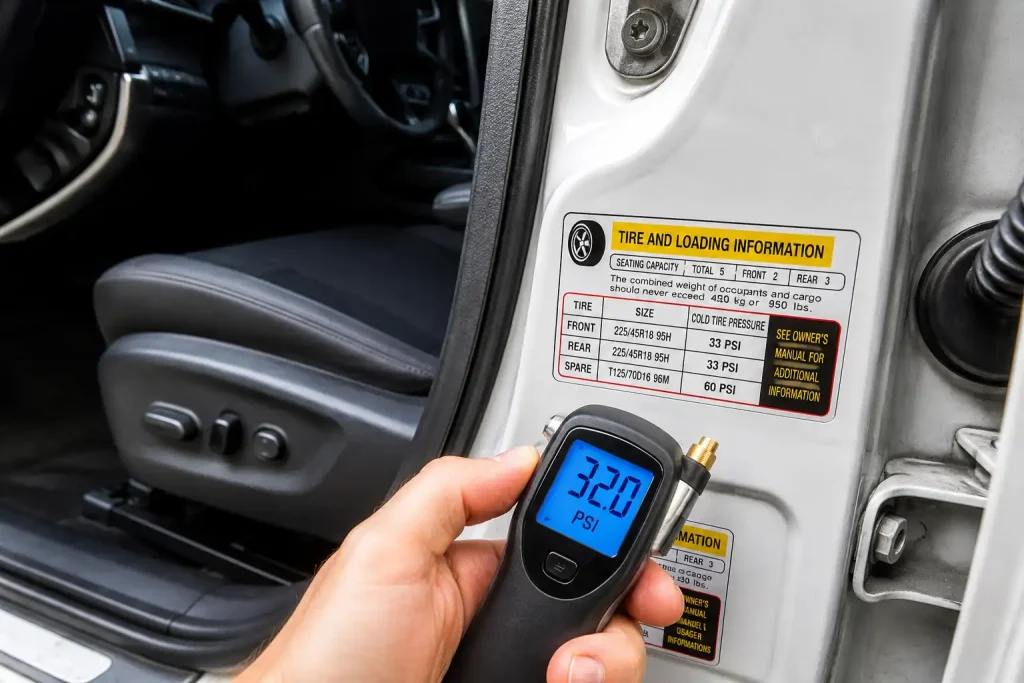
The NHTSA tire-safety guidance recommends checking pressure when tires are cold, meaning the vehicle has not been driven for at least three hours. The correct cold pressure is printed on the driver-side door placard or in the owner’s manual—not on the tire sidewall. (NHTSA)
Inflator Duty Cycle
The duty cycle tells you how long an inflator can operate before it needs to cool down.
For example, a unit may be designed to run for 10 minutes and then rest for 20 minutes. Running it beyond that limit can overheat the motor, damage internal parts, or shorten its useful life.
Check the instruction manual before inflating several tires in one session.
Expert Tip:
Time your inflator the first time you use it at home. Knowing how long it takes to add five PSI to your vehicle’s tire gives you a useful performance reference before a roadside emergency.
How Long Does It Take to Add 5 PSI?
For most standard passenger-car tires, adding five PSI takes approximately one to three minutes with a working portable inflator.
A faster battery-powered or direct-connect compressor may do it in less than one minute. A small budget inflator may need three to five minutes, particularly with a larger tire.
For example, suppose your door placard recommends 35 PSI, but your cold tire measures 30 PSI. Connect the inflator, add air, and pause to verify the reading. The process should normally be completed within a few minutes.
If pressure does not increase after two or three minutes, check for:
- An incomplete hose connection
- Air leaking around the valve
- A loose or damaged valve core
- A puncture
- A discharged inflator battery
- An overheated or failing compressor
How Long Does It Take to Inflate a Completely Flat Tire?
A standard car tire may take five to ten minutes to inflate from zero PSI. Larger tires can take 15 minutes or longer.
However, “completely flat” requires extra caution. Driving even a short distance on a flat tire can damage the sidewall internally. The tire may appear normal after inflation while remaining unsafe.
Do not continue inflating when:
- The sidewall is cut, cracked, bulging, or badly crushed
- The tire has separated from the wheel rim
- Air escapes as quickly as it enters
- The valve stem is broken
- The tire was driven while completely flat
- The inflator exceeds its allowed operating time
A portable inflator only supplies air. It does not repair structural damage or permanently seal a puncture.
How to Inflate a Tire Efficiently and Safely
- Park in a safe location.
Move away from traffic when possible. Turn on the hazard lights if you are stopped near a road. - Find the recommended PSI.
Read the tire-pressure placard inside the driver-side door or consult the owner’s manual. - Inspect the tire.
Look for a nail, cut, bulge, damaged valve stem, or separation from the rim. - Connect the inflator to its power source.
Follow the manufacturer’s instructions. Some 12-volt inflators should be used with the engine running to prevent battery drain, while others specify a different procedure. - Attach the hose securely.
Place the connector straight onto the valve stem and lock or screw it into position. - Set the required pressure.
Use the preset function if the inflator has automatic shutoff. - Start the inflator and monitor it.
Do not leave the unit unattended. Check that the displayed pressure is rising steadily. - Stop at the recommended PSI.
Verify the final pressure with a separate gauge when possible. - Allow the inflator to cool.
The compressor body and hose connection may become hot during operation. - Recheck the tire later.
If you inflated a warm tire or suspect a leak, check it again when cold.
Why Proper Inflation Matters
Correct tire pressure supports predictable handling, braking, tire life, and fuel efficiency. Underinflated tires flex more, generate additional heat, and create extra rolling resistance.
The U.S. Department of Energy reports that underinflated tires can reduce fuel economy by approximately 0.2% for every one-PSI drop in average tire pressure. Its fuel-saving tire-maintenance guidance reinforces the value of regular pressure checks. (The Department of Energy’s Energy.gov)
Overinflation is also undesirable. Too much pressure can produce a harsher ride, reduce the tire’s contact area, and contribute to uneven center tread wear.
Warning Signs the Inflator Is Not Solving the Problem
Stop treating the issue as a simple pressure top-up when you notice:
- The same tire becomes low repeatedly
- Pressure falls within hours or overnight
- The inflator runs but the gauge does not rise
- You hear air escaping from the tread or valve
- The tire has a visible nail, screw, cut, or bulge
- The vehicle pulls to one side
- The steering wheel vibrates
- The low-pressure warning returns soon after inflation
- The tire smells hot after driving
- The rim appears bent or damaged
A slow leak may come from the tread, valve stem, wheel bead, or a damaged rim. A tire shop can locate the leak and determine whether the tire qualifies for a safe internal patch.
Choosing a Faster and More Durable Inflator
A quality inflator should match your vehicle rather than simply advertise the highest pressure number.
Consider:
- Published inflation time: Look for testing on a realistic car, SUV, or truck tire.
- Duty cycle: Longer duty cycles are useful for large tires or multiple vehicles.
- Power connection: Direct battery clamps may support higher output than a basic accessory plug.
- Accurate gauge: An inaccurate display can cause underinflation or overinflation.
- Automatic shutoff: This reduces the chance of accidentally exceeding the target pressure.
- Hose length: The hose should reach every tire without pulling on the valve.
- Thermal protection: Overheat protection can improve safety and durability.
- Replacement parts and warranty: These matter if the hose, connector, or gauge fails.
A low-cost inflator can be suitable for occasional sedan tire top-ups. Owners of trucks, trailers, or oversized tires should consider a higher-output compressor with a longer duty cycle.
Common Mistakes Vehicle Owners Should Avoid
- Using the PSI printed on the tire sidewall. That is not normally the vehicle’s recommended operating pressure.
- Checking pressure immediately after driving. Warm tires can show a higher reading.
- Leaving the inflator unattended. Gauges and automatic shutoff systems can fail.
- Running the compressor beyond its duty cycle. This can overheat and damage it.
- Assuming added air repairs a puncture. Inflation may only provide temporary mobility.
- Continuing to drive on a tire that loses air quickly.
- Inflating a visibly damaged sidewall.
- Using a weak accessory socket. Check the inflator’s amperage requirement and the vehicle circuit rating.
- Forgetting the spare tire. A neglected spare may be unusable when needed.
- Relying only on the dashboard warning. Tire-pressure monitoring systems usually warn after pressure has already fallen significantly.
When to Call a Transmission Professional
A low tire or slow tire inflator is not normally a transmission problem. Contact a tire technician, general repair shop, or roadside-assistance provider when the tire is damaged, will not hold air, or cannot be inflated safely.
A transmission professional becomes relevant only when the vehicle also has genuine drivetrain symptoms, such as:
- Delayed engagement when shifting into Drive or Reverse
- Engine speed rising without matching acceleration
- Grinding, shuddering, or harsh gear changes
- Transmission-fluid leakage
- A transmission warning message
- Loss of power that continues after tire pressure is corrected
Low tire pressure can make a vehicle feel sluggish or cause pulling, but it does not usually indicate internal transmission failure. Correct the tire pressure first, then reassess the vehicle’s behavior.
FAQs
How long does a tire inflator take to add 5 PSI?
Most portable inflators take about one to three minutes to add five PSI to a passenger-car tire. Large tires and low-output inflators may take longer.
How long does it take to inflate a tire from completely flat?
A standard car tire generally takes five to ten minutes. SUV, truck, and off-road tires may require 10–25 minutes depending on the compressor’s airflow.
Why is my tire inflator taking so long?
Common causes include a leaking hose connection, large tire volume, weak power supply, low battery, restricted airflow, overheating, or a puncture that allows air to escape.
Can I leave a tire inflator running unattended?
No. Stay beside the inflator and monitor the pressure, hose, power cord, and compressor temperature. Stop immediately if the unit overheats or behaves abnormally.
Should the car engine be running while using a 12-volt inflator?
Follow the inflator and vehicle instructions. Many plug-in models work better with the engine running, but the vehicle must be outdoors to prevent dangerous exhaust-gas buildup.
Can a tire inflator fix a puncture?
No. A standard inflator only adds air. It may temporarily restore pressure in a slowly leaking tire, but the puncture still requires inspection and proper repair.
What PSI should I set the inflator to?
Use the recommended cold pressure on the driver-side door placard or in the owner’s manual. Do not use the maximum PSI molded into the tire sidewall as your routine target.
Conclusion
So, how long does a tire inflator take? Expect roughly 30 seconds to three minutes for a normal top-up and approximately five to ten minutes for a nearly flat passenger-car tire. Large tires, weak power sources, low temperatures, leaks, and small compressors can extend that time.
Use the recommended cold PSI, monitor the inflator continuously, and respect its duty-cycle limit. Most importantly, do not treat repeated pressure loss or visible tire damage as a simple inflation problem.
Check your tire now, compare its pressure with the driver-door placard, and arrange a professional tire inspection if it cannot maintain the correct pressure.
