
How Much PSI Should Car Tires Have? A Practical Inflation Guide

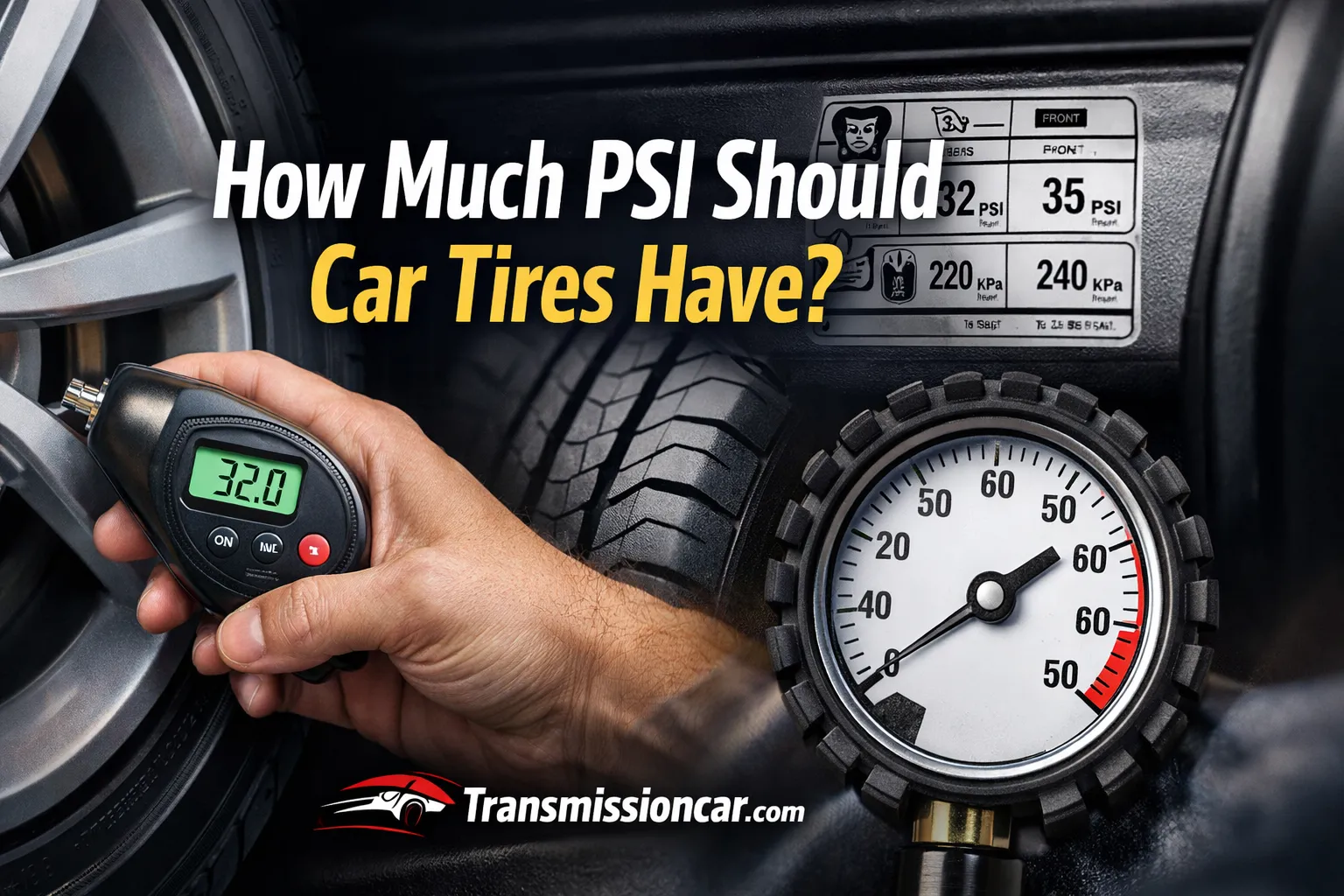
Seeing a low tire-pressure warning can leave you wondering w(NHTSA) whether something more serious is wrong. Using the wrong pressure can affect handling, braking, fuel use, ride comfort, and tire life.
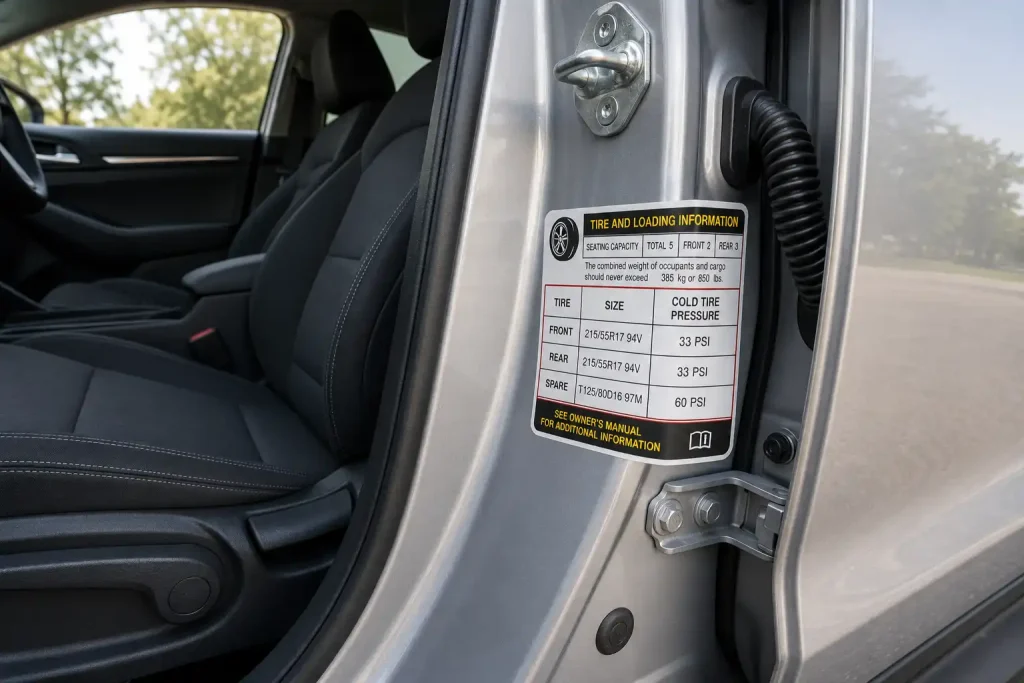
So, how much PSI should car tires have? The correct answer depends on your specific vehicle. You should use the cold tire pressure printed on the driver-side door-jamb label or listed in the owner’s manual—not the maximum PSI molded into the tire itself.
This guide explains where to find the correct pressure, how to check it, how to use a tire inflator safely, and when low pressure requires professional attention.
Quick Answer
Most passenger vehicles use tire pressures somewhere around 30–35 PSI, but your car may require a different setting. Check the tire-information placard inside the driver’s door or the owner’s manual. Measure and adjust the pressure when the tires are cold, and never use the tire sidewall’s maximum PSI as your normal setting.
What Does PSI Mean?
PSI stands for pounds per square inch. It measures how much air pressure is inside the tire.
For example, if your vehicle label recommends 33 PSI, each tire should normally be adjusted to 33 PSI when cold unless the label gives different front and rear specifications.
Correct pressure helps the tire maintain the shape and contact area intended by the vehicle manufacturer. Too little or too much air changes how the tire meets the road.
Where to Find the Correct Tire Pressure
The safest source is the vehicle manufacturer’s tire-information label. You can usually find it in one of these places:
- On the driver-side door jamb
- On the edge of the driver’s door
- Inside the glove compartment
- Inside the fuel door on some vehicles
- In the vehicle owner’s manual
The label normally shows:
- Recommended front-tire pressure
- Recommended rear-tire pressure
- Original tire size
- Vehicle load information
- Pressure in PSI and sometimes kPa
According to the NHTSA TireWise safety guidance, the manufacturer’s recommended pressure applies when the tire is cold, meaning the vehicle has generally not been driven for at least three hours. (NHTSA)t and Rear Tires May Need Different PSI
Do not assume all four tires use the same pressure.
Some vehicles carry more weight over the front axle because of the engine and transmission. Others require more rear pressure when carrying passengers, luggage, or cargo. Performance cars may also use different front and rear tire sizes.
For example, a door label might show:
- Front tires: 35 PSI
- Rear tires: 33 PSI
In that situation, setting every tire to 35 PSI would not follow the manufacturer’s specification.
Check the Spare Tire Separately
Compact spare tires often have a different pressure requirement than the regular tires. The correct figure may be printed on the spare, near the spare-tire compartment, or in the owner’s manual.
Because spare tires are rarely used, they are also easy to forget. Check the spare during regular maintenance and before a long trip.
Do Not Use the Maximum PSI on the Tire Sidewall
The pressure molded into the tire sidewall is commonly misunderstood.
That number generally identifies the tire’s maximum permitted inflation pressure under specified load conditions. It is not automatically the pressure your vehicle should use every day.
The vehicle manufacturer selects a recommended PSI after considering:
- Vehicle weight
- Suspension design
- Steering response
- Braking performance
- Tire size
- Ride comfort
- Front-to-rear weight distribution
- Expected passenger and cargo loads
The NHTSA road-trip tire guidance specifically advises drivers to use the pressure on the vehicle placard or in the owner’s manual rather than the pressure printed on the tire. (NHTSA)g: Never inflate a tire beyond its rated limits.** Overinflation can make the vehicle harder to control and may increase the risk of tire damage.
Why Tire Pressure Must Be Checked When Cold
Driving generates heat as the tires flex and contact the road. As the air inside warms, pressure increases.
A tire that reads 36 PSI immediately after highway driving may show a lower reading the next morning. This does not necessarily mean the tire developed a leak overnight.
For the most accurate result, check pressure:
- Before driving in the morning
- After the car has been parked for at least three hours
- Before a long trip rather than after arriving
- Before the tires have been heated by direct driving
If you must add air to a warm tire because it is significantly low, bring it to at least the recommended cold pressure and check it again after the vehicle has cooled. NHTSA recommends rechecking and adjusting warm tires once an accurate cold reading is available. (NHTSA)emperature Affects Tire PSI
Cold weather usually lowers tire pressure. Hot weather and driving heat usually raise it.
This is why the tire-pressure monitoring light may appear on a cold morning and disappear later in the day. The warning should still be taken seriously. A tire that is only barely above the warning point after warming may remain underinflated.
Check your tires whenever:
- The season changes
- Temperatures drop sharply overnight
- The TPMS warning light appears
- The vehicle has been parked for several weeks
- You are preparing for a road trip
- The car feels unusually soft, heavy, or unstable
Do not deliberately overinflate tires in winter to compensate for future temperature changes. Set them to the manufacturer’s cold-pressure specification and inspect them more frequently.
Recommended Tire Pressure Decision Table
| Situation | What the Reading May Mean | Best Action |
|---|---|---|
| Pressure matches the door placard when cold | Tire is correctly inflated | Replace the valve cap and recheck monthly |
| Tire is 1–2 PSI low | Normal air loss or temperature change may be involved | Add air and monitor it |
| One tire repeatedly becomes low | Possible puncture, valve leak, bead leak, or wheel damage | Have the tire inspected |
| All four tires are low | Seasonal temperature change or neglected maintenance | Inflate all tires to placard specifications |
| Pressure is above the placard after driving | Normal heat-related increase may be involved | Do not release air until tires are cold |
| Pressure is above the placard when cold | Tire may have been overinflated | Release air gradually and recheck |
| TPMS light flashes before staying on | Possible TPMS system or sensor fault | Arrange a diagnostic inspection |
| Tire has a bulge, cut, exposed cord, or severe damage | Tire may be unsafe regardless of PSI | Do not continue normal driving |
How to Check Tire Pressure Correctly
You need a reliable tire-pressure gauge. Digital gauges are easy to read, while pencil-style and dial gauges can also work well when they are in good condition.
Follow these steps:
- Park on a level surface.
Allow the tires to cool for at least three hours whenever possible. - Find the recommended PSI.
Read the driver-side door placard or owner’s manual. - Remove the valve cap.
Put it somewhere clean so it does not get lost. - Press the gauge firmly onto the valve stem.
A brief hiss is normal. A continuing hiss means the gauge is not sealed correctly. - Read the pressure.
Compare it with the recommended cold PSI. - Add or release air as needed.
Make small adjustments rather than adding a large amount at once. - Measure again.
Continue until the tire reaches the specified pressure. - Replace the valve cap.
The cap helps keep dirt and moisture away from the valve.
Repeat the process for all four tires and the spare.
How to Add Air With a Portable Tire Inflator
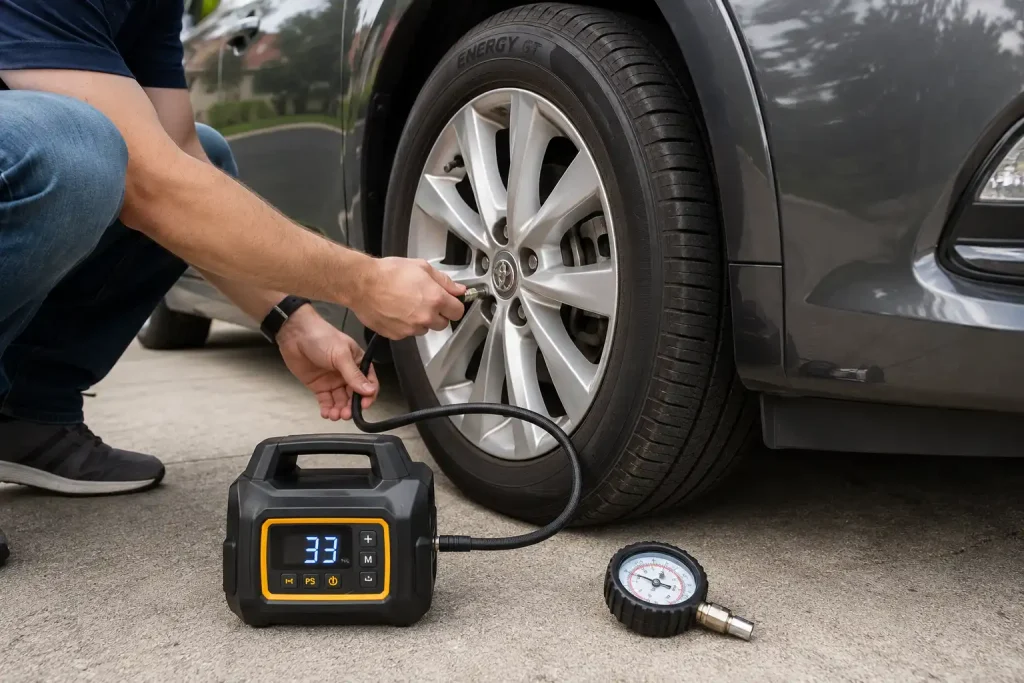
A portable tire inflator can be powered by a vehicle’s 12-volt outlet, a rechargeable battery, or direct connection to the battery. Read the inflator instructions before use because operating limits vary.
Step 1: Position the Vehicle Safely
Park away from moving traffic. Apply the parking brake and switch on the hazard lights when roadside visibility is poor.
Do not kneel beside a tire where passing traffic could strike you or the vehicle.
Step 2: Confirm the Target PSI
Read the vehicle placard before turning on the inflator. Do not guess based on another vehicle, tire appearance, or the sidewall maximum.
Step 3: Connect the Inflator Hose
Remove the valve cap and attach the hose securely. A poor connection can leak air and produce an inaccurate reading.
Step 4: Set the Target Pressure
If the inflator has automatic shutoff, enter the recommended PSI. Keep a separate gauge available because inexpensive inflator displays may not always be perfectly accurate.
Step 5: Inflate in Short Intervals
Turn on the inflator and watch the pressure. Small portable units can become hot during extended operation, so follow the manufacturer’s duty-cycle instructions.
Do not leave the inflator unattended.
Step 6: Verify With a Gauge
Turn off the inflator, disconnect the hose, and check the tire with a separate gauge. Release a small amount of air if the tire is slightly overfilled.
Step 7: Look for Continued Air Loss
Listen for hissing and inspect the tread and sidewall. If the pressure drops again, adding more air is not a repair. The tire needs professional inspection.
Underinflation vs. Overinflation
What Happens When Tire Pressure Is Too Low?
An underinflated tire bends and flexes more than intended. That extra movement creates heat and rolling resistance.
Possible effects include:
- Slower steering response
- Reduced stability
- Longer or less predictable braking
- Excess wear along the outer tread shoulders
- Increased heat buildup
- Lower fuel efficiency
- Greater risk of tire failure
- A heavy or sluggish driving feel
Properly inflated tires can also improve efficiency. The U.S. Department of Energy’s vehicle-maintenance guidance reports that maintaining correct pressure can improve fuel economy while helping tires last longer and operate more safely. (Alternative Fuels Data Center) Happens When Tire Pressure Is Too High?
An overinflated tire becomes stiffer and may place too much load on the center of the tread.
Possible effects include:
- A harsh or bouncy ride
- Reduced grip on uneven surfaces
- Faster center-tread wear
- Greater sensitivity to pothole damage
- Less predictable handling
- Reduced ride comfort
Adding extra PSI does not automatically improve fuel economy enough to justify the safety and wear tradeoffs. Use the manufacturer’s setting.
Can You Trust the TPMS Light?
The tire-pressure monitoring system is an important warning system, but it should not replace manual pressure checks.
A TPMS warning light generally means at least one tire is significantly underinflated. By the time the light appears, the pressure may already be far below the ideal setting. NHTSA recommends inspecting tires monthly with an accurate gauge even when the warning light is off. (NHTSA)ntion to how the light behaves:
- Light stays on: Check all tire pressures as soon as possible.
- Light appears only on cold mornings: A tire may be marginally low.
- Light flashes and then stays on: The system may have a sensor or monitoring fault.
- Light remains on after inflation: Recheck the pressure, drive briefly if the manual requires it, and inspect for leaks or TPMS problems.
Warning Signs That Require More Than Air
Stop treating the problem as routine inflation if you notice:
- The same tire loses pressure repeatedly
- A nail or screw is visible in the tread
- The sidewall has a cut, bubble, crack, or bulge
- The wheel is bent or cracked
- The valve stem is damaged
- The car pulls strongly to one side
- The steering wheel vibrates
- The tire makes a thumping noise
- The tread is separating or unevenly worn
- The tire becomes hot or smells like burning rubber
Do not attempt a permanent sidewall repair. Sidewall damage usually requires tire replacement because that area flexes heavily while driving.
A portable compressor may temporarily restore pressure, but it cannot correct structural damage, wheel damage, alignment problems, or a leaking valve.
Expert Tip
Expert Tip: Record each tire’s cold PSI once a month. If one tire consistently loses more air than the others, arrange an inspection before the leak becomes a roadside flat.
Cost, Quality, and Durability Considerations
Correct tire pressure costs very little to maintain, but ignoring it can become expensive.
Low or uneven pressure may lead to:
- Premature tire replacement
- Reduced fuel economy
- Wheel-alignment problems becoming more noticeable
- Tire damage from overheating
- Roadside-assistance charges
- Wheel damage after driving on a flat
- Extra strain on suspension components
A quality inflator should have an easy-to-read display, a secure valve connector, adequate hose length, and enough output for your vehicle’s tires. Automatic shutoff is convenient, but you should still verify the result with a separate gauge.
Durability matters if the inflator will remain in a hot trunk or be used for larger SUV and truck tires. Follow its storage instructions and operating duty cycle.
When to Call a Transmission Professional
Incorrect tire pressure does not normally cause an internal transmission problem. However, tire and drivetrain symptoms can sometimes feel similar from the driver’s seat.
First, correct the tire pressures and inspect the tires. Then consult a transmission professional if the vehicle still has symptoms such as:
- Shuddering specifically during gear changes
- Delayed engagement when selecting Drive or Reverse
- Engine speed rising without normal acceleration
- Hard or slipping shifts
- Transmission-fluid leakage
- Grinding or whining linked to gear selection
- A warning message related to the transmission or drivetrain
Unequal tire sizes, severe pressure differences, or mismatched tire circumferences may also confuse some all-wheel-drive systems and place unnecessary stress on driveline components. Follow the vehicle manufacturer’s tire-size and replacement instructions.
For tire, driveline, or transmission diagnosis, consider a shop with trained technicians, written estimates, and documented inspection findings. The ASE resources for drivers explain how certification can help vehicle owners identify technicians who have demonstrated knowledge in specific automotive service areas. (ASE)shop to explain:
- What was tested
- What measurements were found
- Whether the problem is tire-, wheel-, axle-, or transmission-related
- Which repair is required now
- Which work can safely wait
- Whether parts and labor include a warranty
Common Mistakes Vehicle Owners Should Avoid
- Using the tire sidewall maximum as the target PSI. Use the vehicle placard instead.
- Checking only the tire that looks low. Measure all four tires because underinflation can be difficult to see.
- Releasing air from warm tires. The pressure naturally rises while driving.
- Relying only on TPMS. The warning light may not appear when a tire is only moderately low.
- Ignoring repeated pressure loss. Repeatedly adding air can hide a puncture or wheel leak.
- Assuming front and rear specifications match. Read both values on the placard.
- Forgetting the spare tire. A flat spare offers little help during an emergency.
- Using a damaged inflator hose or gauge. Leaks and inaccurate readings can lead to incorrect pressure.
- Continuing to drive on a visibly flat tire. This can destroy the tire and damage the wheel.
- Mixing tire sizes without checking manufacturer requirements. This is especially important on all-wheel-drive vehicles.
FAQs
How much PSI should car tires have?
Use the cold PSI printed on the driver-side door-jamb placard or listed in the owner’s manual. Many passenger vehicles are near 30–35 PSI, but the correct figure depends on the vehicle.
Is 40 PSI too high for a car tire?
It may be too high if the vehicle placard recommends a lower pressure. Some vehicles legitimately require pressures near 40 PSI, so check the manufacturer’s specification rather than using a general number.
Should all four tires have the same PSI?
Not always. Some vehicles specify different front and rear pressures because of weight distribution, tire size, or handling requirements.
Should I inflate my tires to the maximum PSI printed on the sidewall?
No. The sidewall number is not normally the vehicle’s recommended everyday pressure. Use the door placard or owner’s manual.
Can I drive when the tire-pressure warning light is on?
Check the tires as soon as it is safe. A significantly low, damaged, or rapidly deflating tire may be unsafe to drive. Inflate it only if there is no visible structural damage and arrange an inspection when needed.
How often should I check tire pressure?
Check it at least once a month, before long trips, and whenever temperatures change sharply. Always measure pressure when the tires are cold whenever possible.
Why does one tire keep losing air?
Common causes include a tread puncture, leaking valve stem, poor bead seal, wheel corrosion, or wheel damage. Repeated air loss requires professional inspection.
Conclusion
The correct answer to how much PSI should car tires have is found on your vehicle’s tire-information placard, not on the tire sidewall. Check the pressure when the tires are cold, follow separate front and rear specifications, and verify the reading with an accurate gauge.
A portable tire inflator is useful for routine adjustments and temporary roadside help, but it cannot repair a damaged or repeatedly leaking tire. Check all four tires and the spare today, correct any pressure differences, and schedule a professional inspection if a tire will not hold air or the vehicle continues to vibrate, pull, or shift abnormally.
