
What Is a Tire Inflator? How It Works and When to Use One

A low tire can appear without much warning. You may notice the tire-pressure light on your dashboard, a softer-looking tire, or unusual handling while driving. Finding an air pump quickly is not always easy, especially at night, during bad weather, or on a long road trip.
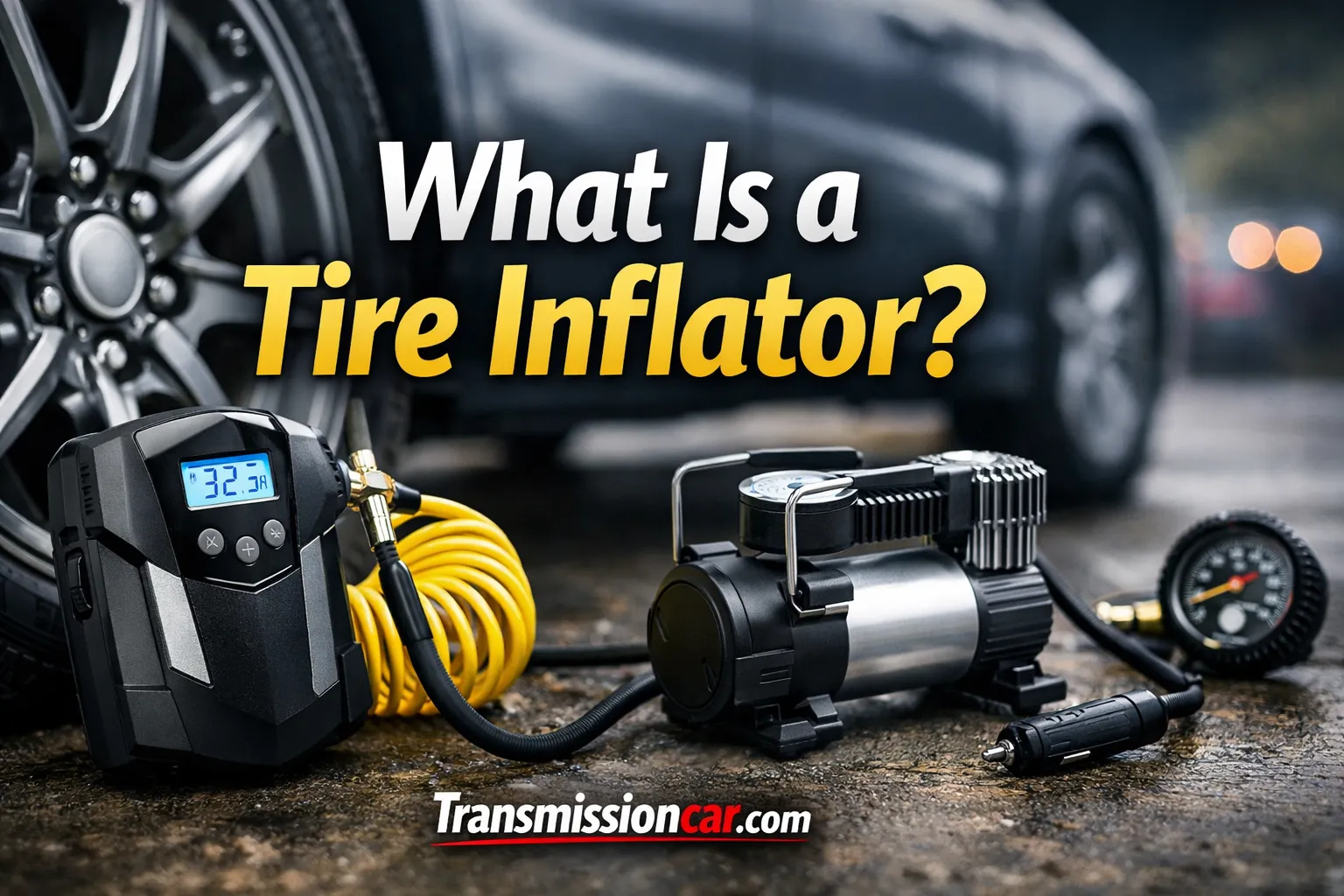
So, what is a tire inflator, and is it worth keeping one in your vehicle? A tire inflator is a compact air compressor designed to add pressurized air to vehicle tires. It can help you correct minor pressure loss, maintain proper tire pressure, and reach a repair shop safely when a tire is slowly leaking.
This guide explains how tire inflators work, the main types available, how to use one safely, what features matter, and when inflation is not enough to solve the problem.
Quick Answer
A tire inflator is a portable air compressor that pumps air into a vehicle tire through the valve stem. Most models use power from a 12-volt vehicle outlet, battery, or household outlet. It helps restore proper tire pressure, but it cannot safely repair punctures, sidewall damage, damaged valves, or severely compromised tires.
How Does a Tire Inflator Work?
A tire inflator uses a small electric motor to operate an internal compressor. The compressor draws in outside air, compresses it, and pushes it through a hose into the tire.
Most portable inflators contain five basic parts:
- Electric motor: Powers the compressor.
- Compressor mechanism: Pressurizes the incoming air.
- Air hose: Carries compressed air to the tire.
- Valve connector or chuck: Attaches the hose to the tire’s valve stem.
- Pressure gauge: Shows the tire’s current pressure in pounds per square inch, or PSI.
Digital models may also include an automatic shutoff function. You enter the desired pressure, start the machine, and the inflator stops when it reaches the selected PSI.
The process is simple, but small inflators are not designed to run continuously for long periods. Many require a cooling break after several minutes of operation.
Why Proper Tire Pressure Matters
Correct tire pressure helps your vehicle maintain predictable steering, braking, traction, ride comfort, and tire life. An underinflated tire creates more rolling resistance and may generate additional heat as its sidewall flexes.
The U.S. Department of Energy’s fuel-saving vehicle maintenance guidance states that keeping tires properly inflated can improve fuel economy by about 0.6% on average and, in some situations, by as much as 3%. (Alternative Fuels Data Center)
Overinflation is not a good solution either. Too much air may reduce the tire’s contact with the road, create a harder ride, and contribute to uneven center tread wear.
The goal is not maximum pressure. The goal is the vehicle manufacturer’s recommended pressure.
Main Types of Tire Inflators
Different inflators are designed for different vehicles and situations.
| Tire inflator type | Power source | Best for | Main benefits | Main limitations |
|---|---|---|---|---|
| 12-volt portable inflator | Vehicle accessory outlet | Cars and small SUVs | Affordable, compact, easy to store | Usually slower and dependent on the vehicle |
| Cordless inflator | Rechargeable battery | Routine pressure checks and emergencies | No power cord, highly portable | Battery can discharge while stored |
| AC-powered inflator | Household electrical outlet | Home garage use | Consistent power and good runtime | Not useful away from an outlet |
| Dual-power inflator | 12-volt and household power | Home and roadside use | Flexible power options | Larger and usually more expensive |
| Heavy-duty compressor | Direct battery connection or larger power source | Trucks, trailers, towing and off-road tires | Faster airflow and better duty cycle | Heavier, noisier and more expensive |
| Manual pump | Hand or foot operation | Backup use and small tires | No electricity required | Slow and physically demanding |
12-Volt Tire Inflators
A 12-volt inflator plugs into the vehicle’s accessory socket. These models are popular because they are inexpensive and easy to keep in the trunk.
However, a small 12-volt unit may take several minutes to raise a nearly flat tire. Some vehicle outlets also have limited electrical capacity, so the inflator must be compatible with the outlet’s fuse rating.
Cordless Tire Inflators
Cordless units use rechargeable lithium-ion batteries. They are convenient because you do not need to unwind a long power cable or keep the inflator close to the vehicle.
Their biggest weakness is battery maintenance. A cordless inflator that has been sitting unused for six months may not have enough charge when an emergency occurs.
Heavy-Duty Inflators
Heavy-duty inflators provide greater airflow and longer operating cycles. They are better for pickup trucks, large SUVs, trailers, recreational vehicles, and off-road tires.
Many connect directly to the vehicle battery using clamps. This provides more electrical power but requires careful connection to the correct battery terminals.
What a Tire Inflator Can and Cannot Do
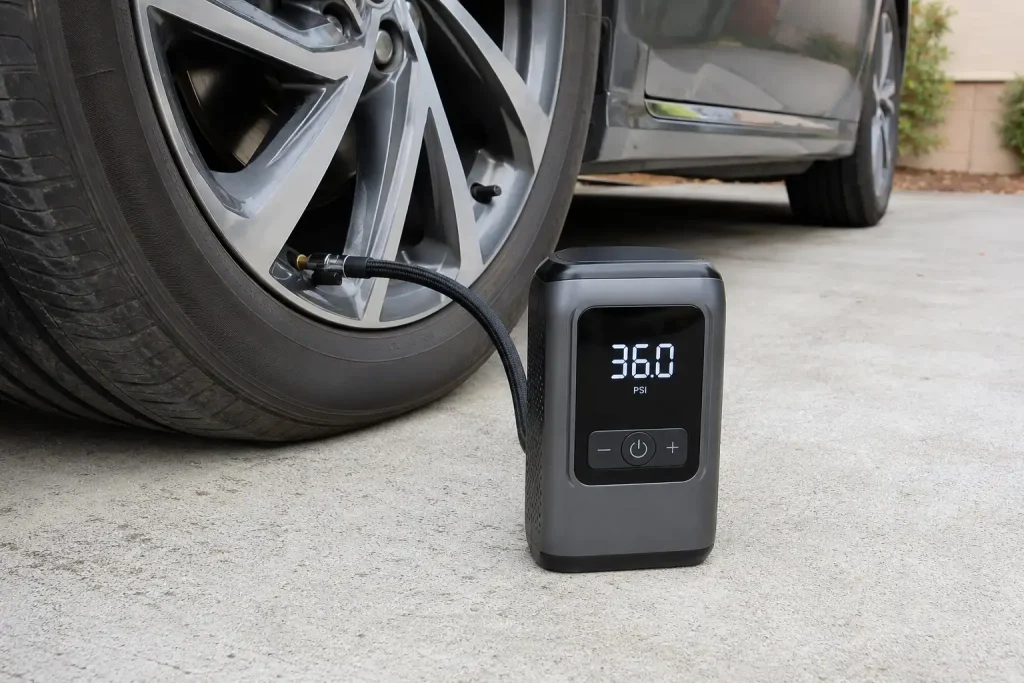
A tire inflator is useful, but it is not a complete tire-repair system.
A Tire Inflator Can:
- Correct normal pressure loss.
- Add air after a significant temperature change.
- Help maintain the recommended pressure.
- Temporarily support a tire with a very slow leak.
- Inflate a properly repaired tire.
- Inflate bicycle tires, sports equipment, or air mattresses when compatible adapters are included.
A Tire Inflator Cannot:
- Permanently seal a puncture.
- Repair a damaged tire sidewall.
- Fix a leaking valve stem.
- Restore a tire that has separated internally.
- Make a tire with exposed cords safe.
- Correct a bent or cracked wheel.
- Safely repair damage caused by driving on a flat tire.
Do not assume that adding air makes a damaged tire roadworthy. If the tire loses pressure again, the underlying cause still needs to be found.
How to Find the Correct Tire Pressure
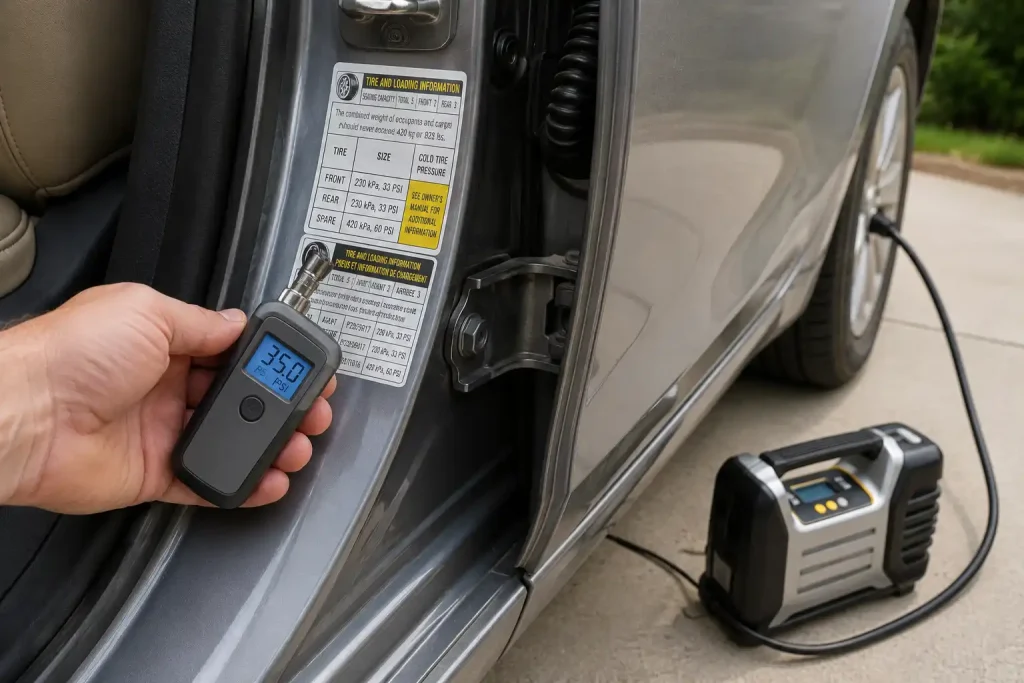
The recommended tire pressure is normally listed on a placard inside the driver’s door, on the door pillar, or in the owner’s manual.
Do not automatically use the pressure molded into the tire’s sidewall. That number generally represents the tire’s maximum allowable cold inflation pressure, not the pressure selected by the vehicle manufacturer for normal operation.
The NHTSA summer driving tire guidance recommends checking tires when they are cold, meaning the vehicle has generally been parked for at least three hours. It also directs owners to use the pressure shown on the vehicle placard or in the owner’s manual. (NHTSA)
Front and rear tires may require different pressures. Check the placard carefully rather than assuming all four tires use the same PSI.
What Does “Cold Tire Pressure” Mean?
Cold pressure does not mean the tire must feel cold to the touch. It means the tire has not been heated significantly by driving.
Driving creates heat, and heat raises the air pressure inside the tire. Measuring immediately after a long highway trip may produce a higher reading than the actual cold pressure.
Do not release air from a warm tire merely because its reading is above the cold-pressure specification. Check it again after the vehicle has been parked.
How to Use a Tire Inflator Safely
Follow these steps unless the inflator manufacturer provides different instructions.
- Park in a safe location.
Move away from traffic and choose level, stable ground. Turn on the hazard lights when necessary. - Inspect the tire before adding air.
Look for cuts, bulges, exposed cords, objects in the tread, wheel damage, or signs that the tire has separated from the rim. - Find the recommended pressure.
Read the driver-door placard or owner’s manual. - Check the inflator’s power requirements.
Confirm whether it uses a 12-volt outlet, rechargeable battery, household outlet, or direct battery connection. - Remove the valve cap.
Keep it in a safe place so it does not get lost. - Attach the air hose securely.
Press or screw the connector onto the valve stem until the connection is tight. A continuous hissing sound usually means the connection is not sealed. - Check the starting pressure.
Use the inflator’s gauge or a separate tire-pressure gauge. - Set the target PSI when available.
On an automatic digital inflator, enter the vehicle manufacturer’s recommended pressure. - Start the inflator and monitor it.
Do not leave the unit operating unattended. Stop if the hose, plug, cable, or inflator becomes excessively hot. - Verify the final pressure.
Use a reliable gauge, especially if the inflator’s built-in gauge seems inconsistent. - Disconnect the hose and reinstall the valve cap.
Listen for leakage around the valve before driving. - Recheck the tire later.
If pressure drops again, arrange an inspection instead of repeatedly adding air.
According to the NHTSA TireWise safety guidance, drivers should inspect tire pressure regularly rather than waiting for the Tire Pressure Monitoring System light. TPMS warnings generally appear only after a tire has become significantly underinflated. (NHTSA)
Expert Tip:
Check the inflator’s pressure reading against a separate, good-quality gauge when you first buy it. A small gauge error can lead to repeated underinflation or overinflation across all four tires.
Choosing the Right Tire Inflator
 Using a tire inflator with the recommended tire pressure” class=”wp-image-9337″/>
The best tire inflator is not necessarily the unit with the highest advertised pressure. Most passenger vehicles do not require extremely high PSI. Airflow, accuracy, reliability, and operating time are often more important.
Pressure Capacity
Choose an inflator that can comfortably exceed your vehicle’s recommended pressure. Avoid buying solely because a product advertises an unusually high maximum PSI.
A high maximum-pressure rating does not automatically mean the unit fills tires quickly.
Airflow and Inflation Speed
Airflow determines how quickly the inflator can move air into the tire. Small units may be suitable for topping up a car tire by three or four PSI but frustratingly slow when filling a large truck tire.
Owners of trucks, trailers, and off-road vehicles should prioritize airflow and continuous operating capability.
Duty Cycle
The duty cycle tells you how long the inflator can run before it needs to cool.
A light-duty model might operate for 10 minutes and then require a 20-minute cooling period. A stronger compressor may run longer without overheating.
Ignoring the duty cycle can damage the inflator or create a burn risk.
Gauge Accuracy
A clear, accurate gauge is essential. Digital displays are easy to read, but accuracy varies between products.
Useful gauge features include:
- Readings in PSI, bar, and kPa.
- A backlit display.
- Automatic shutoff.
- Small pressure adjustment increments.
- A display that remains readable in sunlight.
Power Cord and Hose Length
The cord and hose should reach every tire without pulling tightly against the connector. This is especially important for long pickup trucks, vans, trailers, and vehicles with the 12-volt outlet located inside the cabin.
Build Quality
Look for a stable base, protected wiring, secure hose fittings, heat-resistant materials, and accessible replacement fuses. Metal compressor components generally tolerate heat better than very light plastic assemblies, although they also add weight.
Cost and Quality Expectations
| Inflator level | Typical features | Suitable use | Important consideration |
|---|---|---|---|
| Basic | Analog gauge, 12-volt plug, limited runtime | Occasional pressure correction | May be slow and less accurate |
| Mid-range | Digital display, automatic shutoff, better hose | Regular maintenance and road trips | Good balance for most car owners |
| Premium cordless | Rechargeable battery, presets, lighting | Frequent personal use | Battery must remain charged |
| Heavy-duty | High airflow, battery clamps, longer duty cycle | Trucks, towing and off-road tires | Larger storage requirement |
A lower-priced inflator can still be useful for emergencies. However, reliability becomes more important when you regularly travel through remote areas, tow a trailer, or drive a vehicle with large tires.
Signs That Inflation Alone Is Not Enough
Stop adding air and arrange a professional inspection when you notice:
- Pressure falling repeatedly over several days.
- A nail, screw, or other object in the tread.
- Cracks, bubbles, or bulges in the sidewall.
- A bent, cracked, or heavily corroded wheel.
- Air leaking from the valve stem.
- Exposed tire cords.
- Strong vibration after inflation.
- A tire that was driven while completely flat.
- The inflator running without increasing pressure.
- A loud air leak that continues after the hose is removed.
A slow tread puncture may be repairable if its location and size meet accepted repair limits. Sidewall and shoulder damage generally requires tire replacement rather than a plug or patch.
Important Tire Inflator Safety Warnings
Never inflate a tire with visible structural damage. A weakened tire may rupture as pressure rises.
Also follow these safety practices:
- Keep your face and body away from the tire sidewall while inflating.
- Do not exceed the vehicle’s recommended pressure without a valid service reason.
- Do not operate a damaged inflator cord or melted plug.
- Keep the compressor away from water, fuel, and flammable vapors.
- Avoid touching metal compressor parts immediately after use.
- Do not let children operate the inflator unsupervised.
- Never crawl beneath a vehicle supported only by a jack.
- Do not attempt roadside inflation while standing in an active traffic lane.
If the tire is nearly flat, inspect it carefully before driving. Operating a vehicle on a severely underinflated tire can damage the tire internally even when the outside still appears usable.
When to Call a Transmission Professional
A tire inflator handles tire pressure only. It cannot correct a driveline or transmission problem.
If all four tires are properly inflated but the vehicle still hesitates, shudders, slips, or vibrates during acceleration, the cause may involve the transmission, axle, driveshaft, differential, wheel bearing, engine, or suspension.
Contact a transmission professional when you notice:
- Delayed engagement after selecting Drive or Reverse.
- Engine speed rising without matching vehicle acceleration.
- Shuddering that occurs during gear changes.
- Grinding or clunking during shifts.
- Transmission fluid leaking under the vehicle.
- A burning smell accompanied by shifting problems.
- A transmission warning message or fault code.
For tire punctures, pressure loss, valve leaks, or wheel damage, contact a tire service professional instead. When selecting a repair facility, the ASE repair shop locator can help vehicle owners identify facilities associated with recognized automotive service credentials. (ASE)
Common Mistakes Vehicle Owners Should Avoid
- Using the sidewall pressure as the normal target: The sidewall normally shows a maximum tire rating, not the vehicle’s recommended operating pressure.
- Waiting for the TPMS light: A tire may be below its ideal pressure before the warning appears.
- Checking pressure immediately after driving: Warm tires usually show a higher reading.
- Inflating a visibly damaged tire: Bulges, cuts, exposed cords, and major wheel damage require professional attention.
- Running the inflator too long: Small compressors can overheat when their duty cycle is ignored.
- Trusting an inaccurate built-in gauge: Verify the pressure with a separate gauge.
- Forgetting the spare tire: A compact spare may require a much higher PSI than the vehicle’s regular tires.
- Repeatedly filling a leaking tire: Recurring air loss indicates a puncture, valve problem, rim leak, or tire damage.
- Storing a cordless inflator with a dead battery: Recharge it periodically and before long trips.
- Using a temporary inflator as a permanent repair: Added air only restores pressure; it does not repair the cause of the leak.
What Else Should You Keep With a Tire Inflator?
A practical roadside tire kit may include:
- A separate digital or pencil-style pressure gauge.
- Work gloves.
- A flashlight or headlamp.
- Reflective warning triangles.
- Spare valve caps and valve-core tool.
- The correct wheel-lock key.
- A properly rated jack and lug wrench.
- A portable jump starter.
- A tire plug kit for appropriate emergency use.
- Roadside-assistance contact information.
A sealant kit may provide temporary mobility in certain tread-puncture situations, but sealant is not appropriate for every tire or TPMS system. Follow the vehicle and sealant manufacturer’s instructions.
FAQs
What is a tire inflator used for?
A tire inflator adds compressed air to a vehicle tire. It is mainly used for correcting low pressure, performing routine tire maintenance, and temporarily supporting a slow leak until the tire can be inspected.
Is a tire inflator the same as an air compressor?
A tire inflator is a type of compact air compressor designed mainly for tires and small inflatable items. A full-size shop compressor usually provides greater airflow, longer runtime, and enough capacity to operate pneumatic tools.
Can a tire inflator fix a flat tire?
It can add air to a tire, but it cannot repair the damage that caused the flat. If the tire has a puncture, valve leak, sidewall damage, or rim problem, it still needs inspection and repair or replacement.
Should the engine be running while using a 12-volt inflator?
Follow the inflator and vehicle manufacturers’ instructions. Some inflators are intended to operate with the engine running to reduce battery drain, while others may have different requirements. Always use the equipment outdoors because a running engine produces dangerous exhaust gases.
How long does a tire inflator take?
Inflation time depends on the compressor’s airflow, tire size, starting pressure, and power source. Adding a few PSI to a passenger-car tire may take only a few minutes. Filling a large or nearly empty tire may take much longer.
Can I use a tire inflator when the TPMS light comes on?
Yes, provided the tire has no visible damage. Check all tires with a gauge, inflate them to the pressures shown on the vehicle placard, and monitor them. If the warning returns, arrange a tire inspection.
How often should I check my tire pressure?
Check tire pressure approximately once a month, before long trips, when carrying heavy loads, and after major temperature changes. Check the tires when they are cold for the most useful comparison with the vehicle’s recommended pressure.
Conclusion
A tire inflator is a compact compressor that gives vehicle owners a practical way to correct low tire pressure at home or on the road. It can improve convenience, support routine maintenance, and help prevent a minor pressure problem from leaving you stranded.
Choose a model with enough airflow, an accurate gauge, a suitable duty cycle, and a power source that fits your vehicle. Always use the recommended cold pressure shown on the vehicle placard—not the maximum pressure printed on the tire.
Most importantly, remember that an inflator restores air but does not repair tire damage. When pressure continues to fall, the tire looks damaged, or the vehicle still drives abnormally after the pressures are corrected, stop relying on repeated inflation and schedule a proper inspection. Keep a tested tire inflator and pressure gauge in your vehicle so you can make a safer, smarter decision before your next trip.
